Are Underglow Lights Legal in the US? State Laws & Safe Colors
In the US, underglow lights are not automatically illegal, but they are usually controlled by state and local vehicle lighting laws. The safest setups use static, ground-facing, non-flashing lights in colors that do not resemble police, emergency, brake, or hazard lighting.
This guide explains when underglow is more likely to be street legal, which colors create the most risk, what to check before driving with it on, and how to choose a cleaner setup without turning a cosmetic upgrade into a citation problem.
Quick Answer
Underglow lights may be legal in some US states, restricted in others, and prohibited in certain situations. The real answer depends on your state’s laws, the color used, brightness, visibility angle, whether the lights flash, and whether the vehicle is moving or parked.
- White underglow is usually lower-risk than red or blue, but it is not automatically legal everywhere.
- Red and blue are the most commonly restricted colors because they can resemble emergency or police lighting.
- Static, ground-facing light is usually safer than exposed LEDs that shine outward.
- Flashing, strobing, music-sync, and color-chasing modes are the highest-risk options for public roads.
- Some states or local areas may allow underglow only while the vehicle is parked.
If you still plan to install underglow, choose a setup that lets you use simple static colors and turn the system off quickly, such as a Bluetooth RGB underglow kit with static color modes. Product control helps, but legality still depends on how and where you use it.
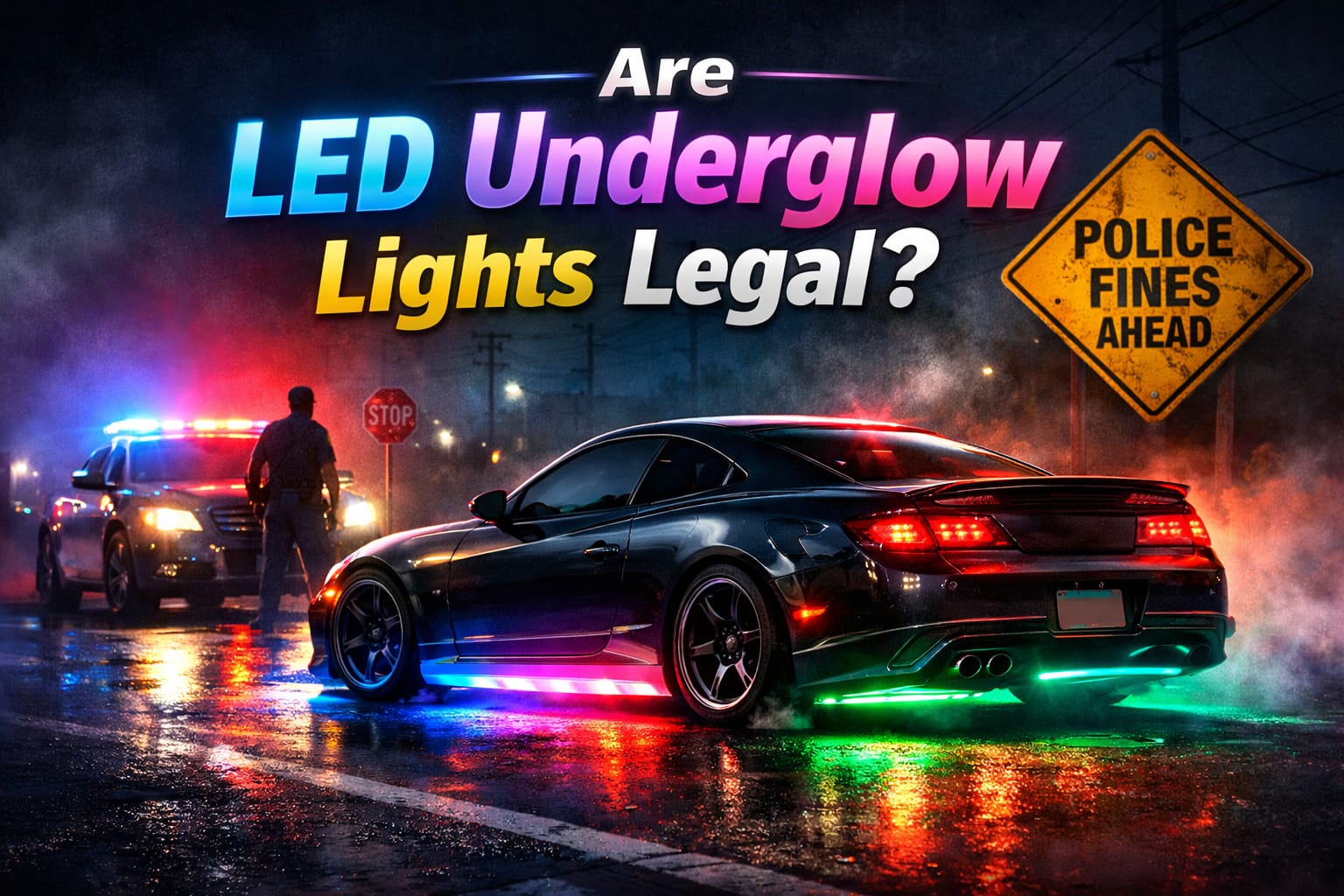
Table of Contents:
- Quick Answer
- Why Underglow Laws Vary
- Underglow Laws by State: What to Check
- What Colors Are Legal for Underglow?
- Brightness, Visibility and Driving Use
- Federal and DOT Context
- Installation Tips for a Lower-Risk Setup
- Common Violations to Avoid
- Safer Alternatives for Vehicle Customization
- FAQ
- Key Takeaways
- Sharing This Guide
Are Underglow Lights Legal? Why Laws Vary
Vehicle lighting rules are designed to make every car easy to understand at night. Drivers need to recognize headlights, brake lights, turn signals, hazard lights, police lights, and emergency lighting without confusion. Underglow is different because it is usually considered decorative or auxiliary lighting, not required safety equipment.
That is why the legality of underglow lights cannot be answered only by asking whether the car has LEDs underneath it. The more important questions are: what color is the light, can the LEDs be seen directly, does the light flash, does it shine toward other drivers, and is it being used while driving on public roads?
If you are new to vehicle lighting upgrades, the beginner’s guide to car LED lights explains how decorative lighting fits alongside interior lighting, exterior accents and functional automotive LEDs.
Underglow Laws by State: What to Check Before Driving
Underglow laws by state can be very different. One state may allow a subtle ground glow, another may restrict certain colors, and another may treat visible exterior accent lighting more strictly. Local city or county rules can also matter, especially if the lighting is considered distracting or similar to official vehicle lighting.
Before installing or driving with underglow on, check the law for the place where the car will actually be used, not only where the kit was purchased. This matters most if you cross state lines, attend car meets, drive at night, or use a kit with multiple colors and animated modes.
State-by-state quick check:
- Color rules: check whether red, blue, amber, green or white exterior lights are restricted.
- Visibility rules: check whether the light source can be directly visible from the front, rear or sides.
- Movement rules: check whether underglow is allowed while driving or only when parked.
- Flashing rules: check whether strobe, chase, pulsing, rotating or music-sync effects are prohibited.
- Mounting rules: check whether exterior lighting can interfere with required lamps, plates, reflectors or signals.
Some states take a more flexible approach if the setup is static, aimed at the ground, and does not use restricted colors. Other states allow decorative lighting only under narrow conditions. If a law is unclear, treat underglow as a parked-show feature rather than something to leave on while driving.
If you regularly cross state lines, design your setup around the strictest area where you drive, not the most permissive one.
What Colors Are Legal for Underglow?
Color is one of the biggest factors in underglow enforcement. Red and blue are the most commonly restricted shades because they can be confused with emergency vehicles, police lighting, brake lights, warning lights or official signals. Some areas may also restrict amber or yellow depending on placement because those colors can resemble hazard, service or construction lighting.
White underglow is often seen as a safer color choice than red or blue, but “safer” does not mean automatically legal. White light can still create problems if it is too bright, points outward, shines directly at other drivers, resembles required lighting, or is visible from an angle your state does not allow.
Green, purple and pink may also cause fewer issues in some places, but every color should be checked against local rules. A good practical approach is to avoid any color that could be confused with emergency, police, brake, hazard or official vehicle lighting. For a deeper breakdown of exterior vehicle colors, see our guide on which colored LED lights are permitted on cars.
Lower-risk color logic:
- Highest risk: red, blue, flashing combinations, police-style patterns.
- Medium risk: amber, yellow, very bright white or exposed side-facing LEDs.
- Lower risk: static, subtle, ground-facing white, purple, green or pink where local law allows them.
According to the National Highway Traffic Safety Administration, vehicle lighting is closely tied to visibility and driver recognition. When decorative lighting makes a vehicle harder to interpret or resembles safety-critical lighting, the legal risk increases.
Brightness, Visibility and Driving Use
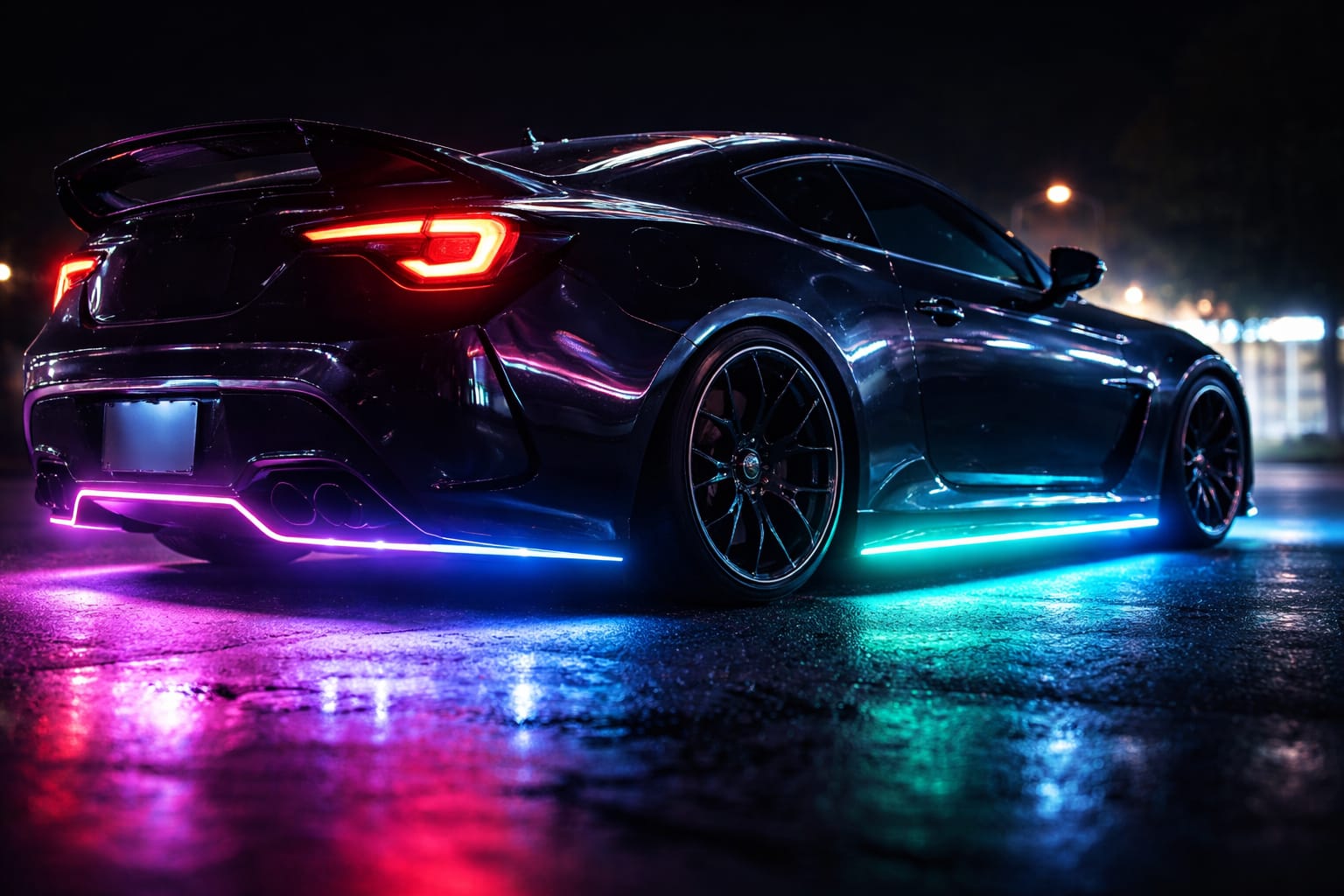
Brightness matters almost as much as color. Even a color that is allowed in your area can attract enforcement if the light is bright enough to distract other drivers, reflect strongly on wet pavement, create glare, or make the car look like it has nonstandard signal lighting.
Visibility angle is another major issue. A subtle glow on the ground is different from exposed LEDs that can be seen directly from the front, rear or side of the car. Lights visible from the front or rear may create confusion with headlights, fog lights, brake lights, reverse lights or turn signals.
The safest visual effect is usually a low-intensity halo under the vehicle, with the light source hidden and aimed downward. Avoid modes that flash, pulse, rotate, chase colors or react to music on public roads. These effects are much harder to defend as simple cosmetic lighting because they look closer to warning or emergency signals.
A color that looks harmless in daylight can become much more distracting at night, in fog or on wet roads. Test brightness in realistic conditions and keep the effect subtle.
Driving use is often the deciding factor. Some places may tolerate underglow at shows, meets or parked displays, but not while the vehicle is moving on public roads. If your local rule is conditional, use underglow as a show feature and keep it off during normal driving.
Federal and DOT Context
At the federal level, vehicle lighting standards focus mainly on required safety equipment and baseline visibility rules. Underglow kits are usually cosmetic aftermarket accessories, so federal law does not give drivers a simple nationwide “yes” or “no” answer for decorative underbody lighting.
The important principle is that added lighting should not interfere with required lamps, confuse other road users, or make the vehicle harder to understand at night. State and local authorities usually decide how exterior accent lighting is enforced on public roads.
Many underglow kits are sold as cosmetic products rather than DOT-certified road safety equipment. That means the owner and installer are responsible for using the kit in a way that follows local rules. The same pattern appears with other aftermarket upgrades, as explained in our guide to the legality of LED headlight conversions.
For a broader comparison of lighting rules outside the US, our guide to LED car light legality by country explains how different regions treat exterior lighting, color restrictions and road-use rules.
Installation Tips for a Lower-Risk Setup
A setup that looks legal can become a problem if it is installed poorly. Loose strips, exposed wiring, inconsistent brightness, poor mounting points and outward-facing LEDs can turn a decorative upgrade into a citation risk or a reliability issue.
Good installation means secure mounting, weather-resistant wiring, clean cable routing and placement that directs light downward instead of outward. For exterior installs, weatherproof underglow LED strips for exterior ground lighting make more sense than light-duty strips, but durability does not make a setup legal by itself.
An accessible switch is one of the smartest compliance features. It lets you shut the system off immediately if you enter a stricter area, get pulled over, or realize the current mode is not appropriate for public roads. If your kit supports app control, keep simple static modes saved and avoid public-road use of animated effects.
Best setup for daily drivers:
- Use a single static color that is allowed in your area.
- Keep the LEDs hidden and aimed toward the ground.
- Install a quick shutoff switch or app-controlled off mode.
- Avoid red, blue, flashing and music-reactive modes on public roads.
- Keep the effect subtle enough that it does not dominate the lane or reflect aggressively.
Before installing any lighting modification, it is also worth reviewing broader safety considerations around automotive LED upgrades. Our guide on the safety of LED lights for cars covers compatibility, heat, wiring and practical issues that matter beyond the legal question.
Common Violations to Avoid
Most underglow problems come from a few repeated mistakes: using restricted colors, leaving the lights on while driving in areas that do not allow it, installing exposed LEDs, or using animated effects that draw immediate attention.
Flashing, strobing, pulsing, rotating and chase patterns are especially risky because they can resemble emergency or warning lighting. Music-sync modes should be treated as show-only features, not normal road-use modes.
Excessive brightness is another common issue. A kit may look acceptable in a garage but become distracting when reflected off pavement, nearby vehicles or wet roads. The goal should be a controlled glow under the vehicle, not a visible light source that dominates the surrounding traffic environment.
Penalties vary widely and can include warnings, fix-it tickets, fines, orders to remove equipment and extra scrutiny if the same issue continues. The more your lighting resembles emergency or official vehicle lighting, the less likely it is to be treated as a harmless cosmetic detail.
Safer Alternatives for Vehicle Customization
If underglow lighting feels too risky where you live, interior LED lighting is usually a simpler way to customize your car without the same exterior road-use concerns. Cabin lighting stays inside the vehicle and is less likely to be confused with police, emergency, brake or hazard lighting.
A USB-powered interior LED strip set for cabin accent lighting is a lower-risk option for footwells, door pockets and interior accent zones, especially if your main goal is atmosphere rather than a visible exterior glow.
Other options include subtle grille accents, wheel-well lighting for parked displays, trunk lighting or engine-bay lighting for shows. These can still create a customized look, but the same rule applies: avoid anything that could be mistaken for required lighting, emergency lighting or a road signal.
Focused accent lighting often makes more sense than full underglow for daily-driven vehicles. If you want a broader overview of what is possible, our guide on types of LED car lighting upgrades breaks down interior, exterior, accent and functional options.
If you want to better understand the technology behind LED output, efficiency and light behavior, the LED Knowledge Center covers the core lighting concepts behind these modifications.
FAQ
Is White Underglow Legal?
White underglow is usually lower-risk than red or blue, but it is not automatically legal everywhere. It can still be restricted if it is too bright, directly visible, distracting, or not allowed while driving in your state or local area.
Can You Drive with Underglow Lights On?
It depends on local rules. Some places may allow subtle underglow while driving, while others allow it only when parked or prohibit certain exterior accent lighting on public roads. If the law is unclear, keep underglow off while driving.
Are Red and Blue Underglow Lights Illegal?
Red and blue are the highest-risk underglow colors because they can resemble police, emergency, brake or warning lights. Even if a kit includes those colors, using them on public roads can create legal problems in many areas.
Are Flashing Underglow Lights Illegal?
Flashing, strobing, pulsing, rotating and music-reactive underglow modes are commonly restricted because they can resemble emergency or warning lighting. Treat animated modes as show-only features unless your local law clearly allows them.
What Is the Safest Underglow Setup?
The safest setup is usually a subtle, static, ground-facing light in a non-restricted color, with hidden LEDs, modest brightness and a quick shutoff option. Even then, you should verify your state and local vehicle lighting rules before using it on public roads.
Key Takeaways
Underglow lights are not automatically legal or illegal across the US. The answer depends on state and local regulations, especially rules about color, brightness, visibility, flashing modes and use while driving.
White underglow is usually lower-risk than red or blue, but it still needs to be subtle, static, ground-facing and allowed by your local rules. Flashing, exposed, very bright or emergency-looking setups create the most obvious legal problems.
For daily drivers, the best approach is to keep underglow controlled, easy to shut off and legal for the strictest place you drive. If the rules are unclear, interior accent lighting or parked-show lighting is often the safer customization choice.
Sharing This Guide
If you found this guide helpful, save it for later or share it with another driver considering underglow, accent lighting or other LED car upgrades.
Share using the links below.
Interested in learning more? Browse all related articles in our category section.