LED vs. Halogen Headlights: Which Is Better for Safety?
The choice between LED and halogen headlights affects visibility, efficiency, replacement frequency, and overall confidence while driving at night.
This guide breaks down the real differences in brightness, lifespan, compatibility, cost, and beam quality, helping you decide if a basic halogen replacement is sufficient or if an LED upgrade would be a better choice.
Quick answer
LED headlights usually offer better brightness, lower power usage, and a much longer lifespan than halogen bulbs. However, they cost more upfront and require proper compatibility checks. Halogen headlights are cheaper and easier to replace in older vehicles.
- LEDs are typically brighter and more efficient.
- Halogen bulbs are cheaper and easier to replace.
- LEDs usually last far longer than halogen bulbs.
- Housing design and aiming matter more than raw brightness alone.
- The best choice depends on budget, legality, and nighttime driving needs.
Table of Contents:
- Quick Answer
- How These Technologies Work
- Brightness and Beam Performance
- Power Requirements and Efficiency
- Lifespan and Durability
- Retrofitting Your Vehicle
- Cost Analysis
- Heat Generation and Thermal Management
- Color temperature and real-world visibility
- Environmental Impact
- Common Misconceptions
- Choosing the Right Upgrade Path
- What should you choose?
- Key Takeaways
- Share this guide!
How These Technologies Work
Halogen headlights work by heating a tungsten filament inside a glass bulb filled with halogen gas. As current passes through the filament, it glows and produces light. This design has been around for decades, which is why halogen headlights are familiar, affordable, and widely available.
LED headlights work very differently. Rather than relying on a filament, they produce light through semiconductor components. This allows them to generate a strong output with less power and experience less wear over time. This basic design difference is why LED and halogen headlights appear so different in terms of brightness, efficiency, and durability.
Brightness and Beam Performance
LED headlights commonly output between 3,000 and 6,000 lumens per bulb, while halogen bulbs typically output between 1,000 and 1,500 lumens. In practice, this often means better forward visibility, earlier hazard detection, and clearer road sign recognition while driving at night.
However, raw brightness is only part of the story. A well-designed beam pattern is just as important as light output. Good LED systems use precise optics to direct light where it is most helpful instead of scattering it in ways that cause glare. If you want to understand exactly what these brightness figures mean before buying, our car LED headlight brightness guide breaks down the key numbers in plain terms.
Many drivers assume that brighter headlights automatically mean more glare for other people on the road. That is not always true. Proper aiming, correct housing design, and compliant beam patterns can significantly reduce glare. When comparing LED and halogen headlights, the quality of the installation is almost as important as the bulb technology itself.
If you want better visibility without blinding oncoming drivers, focus on beam control and proper aiming first. A brighter bulb in the wrong housing may perform worse than a lower-output bulb in a properly matched setup.
If you are checking the legality or performance standards, review the applicable safety guidance from the U.S. Department of Transportation before making major changes to your headlight setup.
Power Requirements and Efficiency
Halogen headlights typically consume 55 to 65 watts per bulb. Many LED replacements use only 20 to 30 watts, yet still deliver an equal or better amount of usable light. The lower electrical load reduces strain on the vehicle’s system, making LED technology far more efficient.
While the fuel or range difference will be modest rather than dramatic for most drivers, efficiency still matters. Over time, lower power consumption adds up, especially in vehicles that are frequently used at night. If you want a broader look at how LED efficiency translates into real savings, our LED energy savings guide covers the numbers in more detail.
Lifespan and durability
Halogen bulbs often last between 450 and 1,000 hours, depending on their quality, road vibrations, and how often they are turned on and off. This usually means more frequent replacements, especially for drivers who spend a lot of time on the road after dark.
LED headlights, on the other hand, can last dramatically longer, often in the 15,000- to 50,000-hour range. This does not mean that every bulb will last the life of the vehicle, but it does mean that replacements are far less frequent. This difference is one of the strongest arguments in favor of LEDs when comparing LED and halogen headlights.
The main reason is simple: LEDs do not rely on a fragile filament. This makes them more resilient to vibration, rough roads, and general wear. If you want more context on longevity ratings, our LED bulb lifespan guide explains how rated lifespan claims work in practice. If you are planning to upgrade your bulbs yourself, our guide on how to replace car bulbs with LEDs walks you through the process step by step. For an easy upgrade to rear visibility, LED reverse bulbs are a popular alternative to standard halogen bulbs.
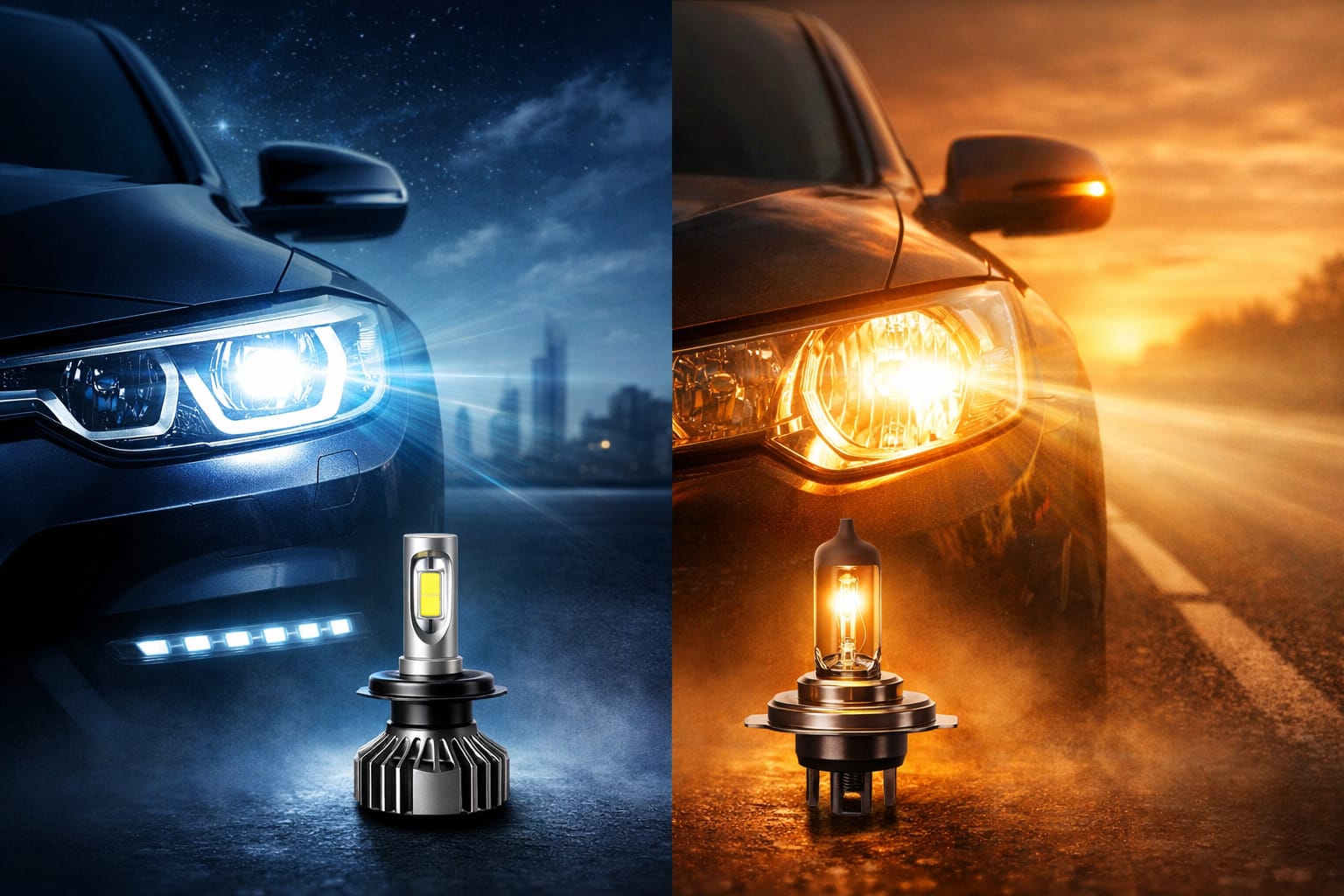
This nighttime visibility comparison demonstrates the practical differences between the two technologies.
Retrofitting Your Vehicle:
Replacing a halogen bulb is usually simple. In many vehicles, it is a quick plug-and-play job that can be done with basic tools. This simplicity is one reason halogen headlights remain popular among drivers seeking a quick, inexpensive replacement.
LED retrofits often require more preparation. Some vehicles accept them easily, while others require additional components, such as load resistors or decoder modules, or extra space behind the housing for cooling hardware. If you are new to automotive LED upgrades, the beginner’s guide to car LED lights is a useful place to start because it covers compatibility, wiring basics, and what to check before you buy.
Housing design matters, too. Reflector housings designed for halogen filaments do not always handle LED emitters well, which can result in uneven output or unwanted glare. Projector housings are often a better match. Even then, however, you should always verify the fitment and beam pattern before relying on the upgrade for daily driving.
Do not assume that every LED bulb is safe or legal just because it fits the socket. A poor retrofit can create glare, trigger dashboard warnings, or provide worse visibility than the halogen bulb you removed.
Cost Analysis:
Halogen bulbs are the cheaper option upfront. A basic pair often costs around $15-$40, making them attractive when you need a quick replacement without spending much.
LED headlight upgrades usually start at a higher price point, often landing somewhere between $50 and $300 per pair, depending on the build quality, output, cooling design, and brand reputation. This higher initial cost may seem significant, especially if your current bulbs are still functioning properly.
However, the long-term value can look very different. If you replace halogen bulbs several times over the course of several years, the total cost can start to approach that of one quality LED set. This is why the decision between LED and halogen headlights is often less about the initial cost and more about how long you plan to keep the vehicle.
Heat Generation and Thermal Management
Halogen bulbs run very hot because they depend on a glowing filament. This contributes to a shorter lifespan and can gradually damage nearby components, such as wiring, reflectors, and plastic parts.
Although LED headlights produce less heat at the light-emitting surface, they still require thermal management. Effective designs employ heat sinks or cooling fans to disperse heat away from the electronics. Without proper cooling, the performance and lifespan of LEDs can deteriorate quickly.
There is also one practical cold-weather detail to consider. Halogen headlights generate enough heat to melt snow or ice on the lens. However, some LED setups run cooler, which can make buildup more noticeable in harsh winter conditions.
Color Temperature and Real-World Visibility
Halogen headlights usually produce light around 3,200K, giving them a warmer, yellowish tone. Many drivers prefer this look because it feels familiar and can be more comfortable during long nighttime drives.
LED headlights are available across a wider color temperature range, typically from 3,000K to 6,500K. Lower values appear warmer, while 5,000 to 6,000 Kelvin produces a crisp white appearance that many people associate with modern factory lighting. This cooler appearance can improve contrast and help drivers more easily see road markings and obstacles. For a broader comparison of headlight technologies, check out our LED vs. HID headlights guide.
There is no single perfect color temperature for everyone. Some drivers prefer a warmer light, while others prefer a cooler, whiter beam. If you frequently drive on dark rural roads, a compact LED driving light can extend your visibility beyond what your standard headlights provide. For more information on vehicle lighting and safety, check out the National Highway Traffic Safety Administration.
Environmental Impact
Although halogen bulbs are simpler to manufacture, their shorter lifespan means more frequent replacements, more packaging waste, and more units moving through shipping and retail channels over time.
LED headlights generally need to be replaced less often and use less power. This makes them a more efficient long-term choice from a resource and waste perspective, especially for drivers who use their headlights frequently.
Neither option is completely impact-free, but if reducing energy use and waste is important to you, LEDs are usually the better choice in the long run.
Common Misconceptions
One common myth is that all LED headlights create dangerous glare. In reality, the real problem is usually poor beam control, bad aiming, or cheap, low-quality products. A well-matched, properly installed LED setup can perform cleanly and responsibly.
Another misconception is that all aftermarket LED bulbs perform the same. Build quality varies significantly. Some budget options may look impressive on a product page, but they deliver poor beam focus, weak durability, and electrical issues when used.
Some drivers also assume that newer technology is automatically incompatible with older vehicles. While compatibility issues can happen, modern automotive LED products are much more refined than early versions. The key is to choose a product that matches your housing, socket type, and electrical system.
Choosing the Right Upgrade Path
For many drivers, the decision between LED and halogen headlights depends on how the vehicle is used. If you only drive occasionally at night, want the lowest possible replacement cost, or plan to sell the car soon, halogen headlights may be the more practical choice.
However, if you regularly drive after dark, travel on rural roads, or desire a longer service life and stronger output, LED headlights are usually the better overall upgrade. Better visibility can improve reaction time and make nighttime driving feel less tiring.
Before making the switch, verify local rules and vehicle compatibility. Our guide on the legality of LED headlight conversion explains what to check in different regions. If you want to explore other upgrade options, this overview of automotive LED lighting upgrades covers a broader range. You can also browse the LED Knowledge Center for practical guides on LED technology, efficiency, and everyday lighting decisions.
What should you choose?
For most drivers, the decision between LED and halogen headlights comes down to simplicity versus long-term performance. Choose halogen if you want the simplest and cheapest replacement. Choose LED if you want stronger long-term performance and are willing to confirm compatibility before upgrading.
- Choose halogen for a low upfront cost and easy replacement.
- Choose halogen if your current housing works best with stock-style bulbs.
- Choose LED for better efficiency and a much longer lifespan.
- Choose LED for frequent night driving or darker rural roads.
- Check fitment, beam pattern, and local rules before choosing either option.
Key Takeaways
The tradeoff between LED and halogen headlights is really about choosing between a low upfront cost and stronger long-term performance. Halogen bulbs remain popular because they are inexpensive and easy to replace. LEDs, on the other hand, stand out for their brightness, efficiency, and durability.
The smartest choice depends on your vehicle, budget, and how often you drive at night. Instead of judging a headlight upgrade by lumen claims alone, focus on compatibility, beam quality, and proper aiming.
If you want a simple replacement, halogen may be sufficient. However, if you want a more significant visibility upgrade and plan to keep the car for years, a quality LED setup is usually a better investment.
Share this guide!
If you found it helpful, save it for later or share it with someone who is comparing headlight upgrades. It is especially useful for drivers trying to balance safety, cost, and compatibility.
Use the links below to share it.
Interested in learning more? Browse all related articles in our category section.
Pingback: LED Lights for Cars: Amazing Pros & Cons Revealed
Pingback: LED Car Lights Energy Savings: Ultimate Guide - NeoLEDHub
Pingback: LED Car Lighting Upgrades: Essential Types Revealed
Pingback: LED Headlights vs HID: Ultimate Comparison Guide
Pingback: Best LED Headlight Bulbs for Night Driving - NeoLEDHub
Pingback: CANBUS in Car LED Lighting: Essential Smart Guide
Pingback: Best LED Car Lighting Upgrades: What’s Worth Buying?
Pingback: Do LED Car Lights Save Energy? Power Use Explained
Pingback: LED Headlights vs HID: Ultimate Comparison Guide
Pingback: Car LED Headlight Brightness: How Many Lumens Do You Need?
Pingback: Best LED Fog Light Bulbs for Cars: Clear Vision - NeoLEDHub