LED Headlights vs HID: Which Is Better for Night Driving?
LED headlights are usually the better choice for most drivers because they turn on instantly, use less power, last longer, and are easier to maintain. HID headlights can still be excellent for night driving, but they usually make the most sense in vehicles already designed for xenon projector systems.
This LED headlights vs HID comparison breaks down brightness, beam pattern, lifespan, installation difficulty, cost, and legality so you can decide which headlight technology is actually the better fit for your car.
Quick Answer
LED headlights are usually the better choice for most drivers because they turn on instantly, use less power, last longer, and are easier to maintain. HID headlights can still perform very well for night driving, especially in vehicles with factory xenon projector systems, but they are usually less convenient for most modern upgrades.
- LEDs typically offer lower power consumption and a longer lifespan.
- HIDs can provide very strong output when housed properly.
- LEDs reach full brightness instantly, while HIDs require warm-up time.
- Retrofits for either system depend heavily on housing design, beam pattern, and local legality.
- For long-term ownership, LEDs are often the simpler choice.
In simple terms: choose LED headlights if you want the easiest long-term upgrade, lower power draw, instant brightness, and less maintenance. Choose HID headlights if your car already has a proper xenon projector setup and you want to preserve that factory-style beam.
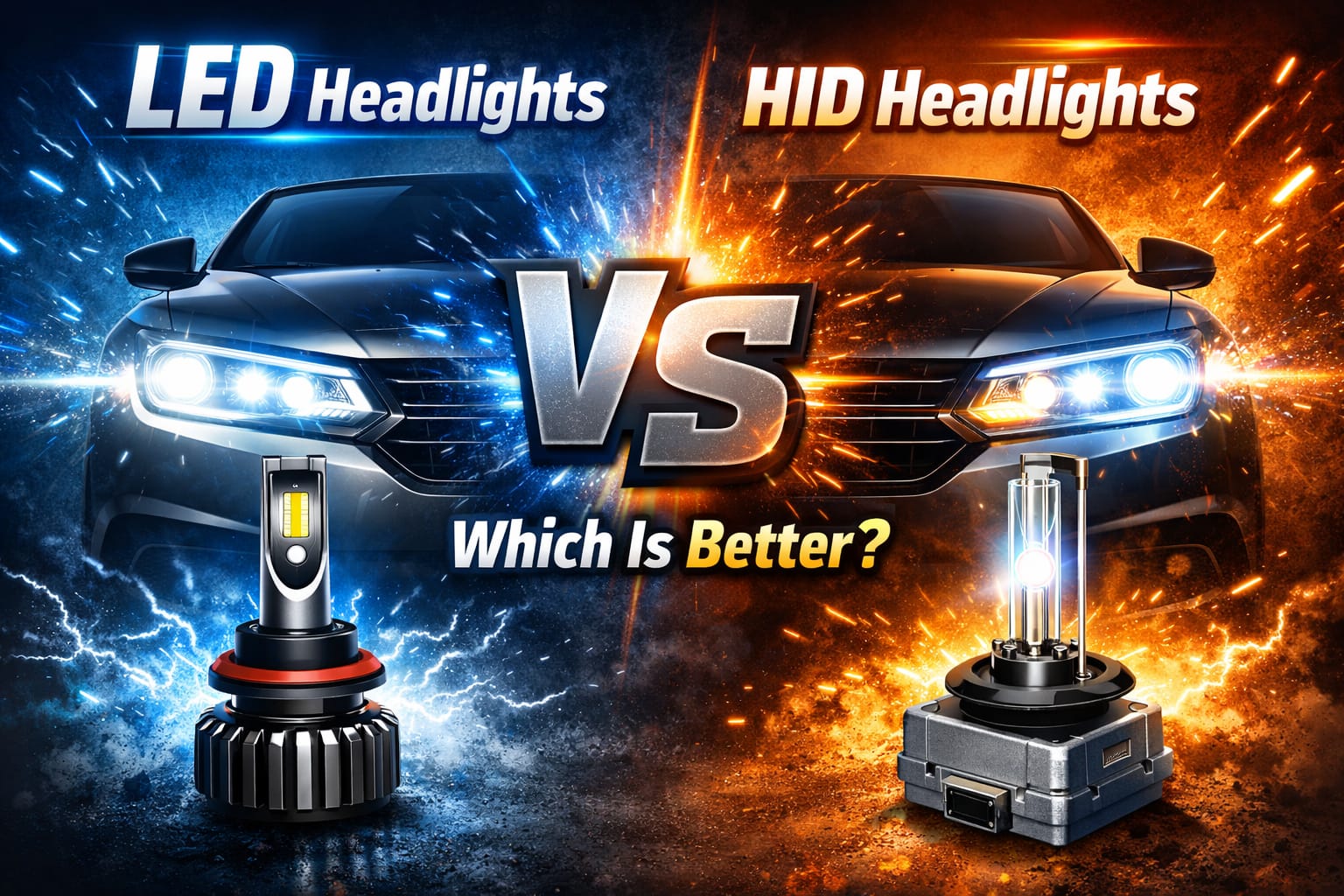
Table of Contents:
- Quick Answer
- LED Headlights vs HID: Key Technology Differences
- Which Is Brighter: LED or HID Headlights?
- Energy Efficiency
- Color Temperature and Visibility
- Installation and Retrofit Compatibility
- Lifespan and Durability
- LED vs HID Headlight Cost Over Time
- Heat Management
- Weather Performance
- Maintenance Needs
- Are LED or HID Headlight Retrofits Legal?
- Environmental Impact
- Should You Choose LED or HID Headlights?
- Key Takeaways
- Sharing This Guide
LED Headlights vs HID: Key Technology Differences
LED headlights create light through solid-state electronics. When an electrical current passes through the diode, the chip emits light directly. This direct process is one reason why LEDs are efficient, compact, and able to reach full brightness almost immediately.
HID (high-intensity discharge) headlights, often called xenon lights, work differently. They produce light by creating an electrical arc between electrodes inside a bulb filled with xenon gas and metal salts. Since this process requires high voltage to start and consistent regulation to remain stable, HID systems depend on ballasts and other supporting hardware. If you are considering them alongside older bulb types, our LED vs halogen headlights guide explains where each technology fits.
Operating Principles
LEDs convert electrical energy into visible light with relatively little waste. This is important for headlights because less wasted energy usually means lower power consumption, faster response times, and easier optical control inside the housing.
HID bulbs require a brief warm-up period before reaching full output. During startup, the ballast provides a high-voltage pulse to ignite the arc, and the bulb stabilizes over the next few seconds. This startup behavior is one of the clearest practical differences between the two systems.
Which Is Brighter: LED or HID Headlights?
For years, HID systems had a stronger reputation for raw brightness. A quality xenon setup can produce 3,000 to 3,500 lumens per bulb, which feels like a significant improvement over halogen lighting.
Modern LED headlights have largely closed that gap. Premium LED systems can now produce 3,000 to 4,000 lumens per bulb while using less power and reaching full brightness instantly. For drivers considering an upgrade, high-output LED headlight bulbs are a practical option because they combine brightness with built-in thermal management.
In real-world night driving, the brighter option is not always the one with the highest lumen claim. Usable visibility depends on how well the bulb, projector, reflector, and cutoff work together to place light on the road without creating glare.
Don’t judge a headlight upgrade by lumen claims alone. Beam shape, cutoff quality, housing compatibility, and glare control are just as important as headline brightness numbers.
Beam Pattern Quality
Good headlights do more than just provide brightness. They should also place light where the driver needs it while limiting glare for oncoming traffic. LEDs naturally emit directional light, making precise beam shaping easier when the housing is designed correctly.
However, HID bulbs emit light from an arc source, so the reflector or projector must work harder to control the beam. While a well-designed HID projector can perform extremely well, the result heavily depends on the quality of the housing and optics.
Energy Efficiency
Power draw is one of the biggest advantages that LEDs have over HID systems. Most HID headlights consume about 35 to 42 watts per bulb during normal operation, and the ballast adds to that consumption.
LED headlights often draw closer to 15 to 25 watts per bulb while delivering comparable usable light. This reduced power consumption decreases the electrical load on the vehicle, which is especially appealing in cars with lots of accessories or in electric vehicles (EVs), where efficiency matters more. For a broader look at the electrical side, our guide to energy savings from LED car lights explains the real-world impact in more detail.
Luminous Efficacy
Looking at lumens per watt provides a clearer picture of efficiency than brightness alone. Quality HID bulbs typically range from 80 to 95 lumens per watt, which is a solid performance for gas-discharge lighting.
Premium LED systems now often reach 100 to 130 lumens per watt. This higher efficacy helps explain why modern LED setups can match or surpass HID output while requiring less from the electrical system.
Color Temperature and Visibility
Color temperature affects the appearance and comfort level of light at night. HID headlights commonly fall within the 4,300 K to 6,000 K range, giving them a cool white to slightly blue-white appearance.
LED headlights, on the other hand, are available across a wider range, often from about 3,000 K to 6,500 K. Most aftermarket and factory systems aim for 5,000 to 6,000 K because this range provides a modern look and usually offers a crisp, high-contrast view of the road. Our color temperature guide clearly explains what those Kelvin values mean in practice.
Color Rendering Index
CRI measures how accurately a light source reveals colors compared with daylight. HID bulbs typically have a CRI of around 80 to 85, which is sufficient for strong nighttime visibility but not ideal.
LED systems vary more depending on quality. Budget options may have poor color rendering, while higher-quality LEDs can match or exceed HID performance. In real driving conditions, color accuracy is usually not the deciding factor unless you are comparing very low-quality products.
Installation and Retrofit Compatibility
HID installations are usually more involved because they require ballasts, additional wiring, and careful mounting. The system also deals with high-voltage startup, so clean installation and secure connections are more important than many first-time buyers expect.
LED conversions can be simpler, especially with modern plug-and-play designs that integrate the driver into the bulb assembly or use a compact external module. However, some setups still need extra room for heat sinks or fans. To protect the circuit and provide more stable power to the bulbs, consider upgrading to a dedicated LED relay harness kit.
If this is your first time upgrading your headlights, the Car LED Lights Beginner Guide is a useful place to start. It covers compatibility, common components, and important pre-ordering checks.
Compatibility Considerations
Some vehicles react poorly to headlight upgrades because the electrical system detects an unexpected load. This can trigger dashboard warnings, flickering, or CAN bus errors. Depending on the car, either HID or LED retrofits may require adapters, resistors, or decoders.
Housing design is also important. Reflector housings designed for halogen bulbs often have difficulty producing a clean pattern with aftermarket HID or LED conversions. Projector housings usually produce better results. Purpose-built assemblies are safer and more predictable than forcing the wrong bulb into the wrong optic.
A very bright bulb in the wrong housing can create dangerous glare, even if the product itself looks impressive. Always check the beam pattern and local legality before considering any retrofit a proper upgrade.
Lifespan and Durability
HID bulbs typically last between 2,000 and 3,000 hours before the light output decreases significantly. As they age, their brightness can fade and their color can shift, so they do not usually stay consistent over their full service life.
LED headlights have a much longer expected lifespan, often quoted in the 25,000- to 50,000-hour range for quality systems. Real-world performance depends on heat control and overall build quality, but good LEDs still tend to outlast HID bulbs by a wide margin.
Vibration and Shock Resistance
HID bulbs rely on a quartz capsule and internal electrodes, making them more vulnerable to vibration and impact over time. Rough roads, older suspensions, or off-road use can take a toll on that kind of hardware.
Because they lack a fragile arc tube or filament, LED systems generally cope better with shock and vibration. This makes them ideal for vehicles that experience frequent bumps, long commutes, or harsh driving conditions.
LED vs HID Headlight Cost Over Time
Initial pricing varies greatly by brand and vehicle, but HID kits can still appear to be a good value. A decent conversion setup typically costs between $150 and $400, whereas factory HID systems usually cost much more.
LED upgrades often cost more initially, especially if you purchase a high-quality kit with proper cooling and optical design. Even so, the price difference often narrows over time because LEDs typically last longer and require fewer replacement parts.
Replacement Costs
Replacing HID bulbs can cost anywhere from about $50 to $150 per bulb. Ballast failure can add another $100 to $300, depending on the vehicle and the source of the parts. Over years of ownership, these costs can add up faster than many buyers expect.
While LED systems do not always fail one part at a time, they usually require attention much less often. When you factor in replacement frequency, LEDs often end up being the more economical choice for long-term ownership.
Heat Management
HID bulbs run hot, and that heat builds up around the capsule, housing, and nearby components. While high temperatures are normal for HID operation, they also increase stress on lenses, seals, and surrounding materials.
LEDs are more efficient but not heat-free. The LED chip still needs to stay within a safe temperature range, which is why quality bulbs use heat sinks, fans, or braided cooling designs. Good thermal management is one of the biggest differences between cheap and reliable LED kits.
Thermal Efficiency
A large portion of HID input power is converted into heat. This is one reason why the system requires more energy overall and can subject the headlight assembly to greater thermal stress.
While LEDs still produce heat, they usually produce less for the same usable light output. The lower thermal load can help the housing and electrical connections last longer, especially in vehicles driven daily.
Weather Performance
In cold weather, HID lights can take longer to warm up and reach full brightness. This isn’t always a deal-breaker, but it can be frustrating on dark winter mornings when you need full brightness immediately.
LED headlights turn on instantly, even in low temperatures, which is a real practical advantage. However, the trade-off is that lower surface heat can sometimes allow snow or ice to build up on the lens more easily, unless the housing design compensates for it.
Moisture Resistance
Because HID systems run hotter, their heat can evaporate minor moisture inside the housing more quickly. This does not replace proper sealing but can reduce minor condensation issues.
LED systems rely more on the quality of the housing, venting, and seals to stay dry. In a well-built assembly, this is not a problem. However, in a poorly sealed assembly, moisture can become a bigger concern than the type of bulb itself.
Maintenance Needs
HID systems require more routine maintenance over time because the bulbs age, the brightness declines, and the ballasts can fail. Lens clarity also matters since haze or yellowing reduces the effectiveness of a powerful headlight system. A headlight lens restoration kit is a practical solution for restoring lost clarity without replacing the entire housing.
Once installed correctly, LED systems are usually easier to maintain. Aside from the occasional need to clean the lens and the rare cooling fan issue in some designs, they generally require less ongoing maintenance than HID setups.
Alignment Stability
Both lighting types still require proper aiming. Even a high-end system will perform poorly if it is pointed too low, too high, or unevenly across the road.
Whenever you service or replace headlight components, it is worth checking the alignment again. Proper aim improves visibility and helps avoid complaints about glare, which aligns with guidance from the National Highway Traffic Safety Administration.
Are LED or HID Headlight Retrofits Legal?
Legality is a major part of any headlight upgrade. Many regions care more about the final beam pattern, glare control, color, and whether the full setup meets local standards than about bulb marketing claims. This is why housing design and certification are so important.
If you are considering other upgrades, our guide to LED lights for cars covers a wider range of vehicle lighting options. The LED headlight conversion legality guide explains what to watch for before you buy, including retrofit-specific rules. Certification marks such as DOT, SAE, or ECE indicate that a product was designed with compliance in mind.
Inspection Requirements
In many regions, vehicle inspections include headlight checks. Inspectors may check the aim, brightness, cutoff quality, and color. Even a bright setup can fail if the beam is uneven or the modification is not approved.
In practice, both LED and HID retrofits face the same scrutiny. It’s far more important to choose quality components and ensure the beam pattern is safe than to chase the brightest product listing you can find.
Environmental Impact
Environmental impact is not just about electricity usage. HID bulbs contain materials that require proper disposal, and some versions contain hazardous substances, making recycling and end-of-life handling crucial.
LED systems generally contain fewer hazardous materials and have a much longer lifespan, meaning fewer replacements are needed over time. Their longer lifespan helps reduce waste, especially when the system is well-built and does not require repeated replacements.
Manufacturing Footprint
Both technologies require energy and precise manufacturing processes. HID bulbs rely on specialized capsules and ballast hardware, while LEDs require semiconductor fabrication and careful thermal design.
The long service life of LED systems spreads that manufacturing impact across many more hours of use. If you want to learn more about LED efficiency, lifespan, and technology, the LED Knowledge Center offers comprehensive guides to support your research.
Should You Choose LED or HID Headlights?
For most drivers, LED headlights are the better overall choice because they are efficient, fast, durable, and easier to live with over time. HID bulbs may still be a good option if your vehicle already has a strong projector-based xenon setup or if you prefer to stick with the factory system.
- Choose LED if you want lower power draw and less maintenance.
- Choose LED if instant full brightness is important to you.
- Choose HID if your vehicle already has a quality factory xenon system.
- Choose based on housing compatibility, not just bulb specs.
- Check the legality of either type of retrofit before buying.
Key Takeaways
Both LED headlights and HID systems can outperform halogen headlights, but they deliver that performance in different ways. HID systems still offer strong output, while LED systems usually win on efficiency, lifespan, startup speed, and day-to-day convenience.
The best choice depends on your housing and your vehicle’s electrical setup. It also depends on whether you care more about retrofit simplicity, long-term ownership costs, or preserving a factory-style xenon system. Always prioritize beam quality and legal compliance over claims of raw brightness.
If you are planning a headlight upgrade, take extra time to verify compatibility before buying. A well-matched system will make you feel safer, last longer, and perform far better than a powerful bulb in the wrong setup.
Sharing This Guide
If you found this guide helpful, save it for later or share it with someone who is comparing headlight upgrade options.
Use the links below to share.
Interested in learning more? Browse all related articles in our category section.