How LED Lighting Works (Beginner Guide)
Most people switch to a newer bulb, notice it turns on instantly, stays cooler, and uses less power, but still have no idea why it behaves so differently from an old incandescent lamp. That confusion matters because once you understand how led lighting works, it becomes much easier to choose the right bulb, avoid poor dimming performance, and understand what you are really paying for.
This beginner guide breaks the process into simple steps, from the tiny semiconductor inside the bulb to the driver, phosphor layer, and heat control around it. By the end, energy use, colour quality, and lifespan will make a lot more sense, whether you are replacing one lamp or planning a whole-home upgrade.
Contents
- Why the basics feel confusing
- Inside the everyday bulb
- The semiconductor core
- From current to visible light
- Why phosphor matters
- Brightness depends on design
- Heat control shapes lifespan
- Efficiency is more than wattage
- Colour consistency and binning
- Common myths and mistakes
- Quick checklist for buying
- Where smart features fit
- Key takeaways
- Sharing this guide
Why the basics feel confusing
A traditional bulb is easy to picture because it uses a glowing filament. An LED bulb hides most of its important parts inside a compact shell, so the process feels abstract at first. That is why people often ask whether the bulb is “burning” in some new way, when the real answer is that it uses a completely different method. If you are still unsure what modern LED bulbs actually are, start there and then come back to the working principle.
At the simplest level, how led lighting works comes down to controlled movement inside a tiny electronic component rather than heat from a wire. The bulb still needs household power, but it manages that power with a small driver, sends it to a diode, and then turns electrical energy into visible light far more efficiently than older technologies ever could.
How LED Lighting Works in Everyday Bulbs
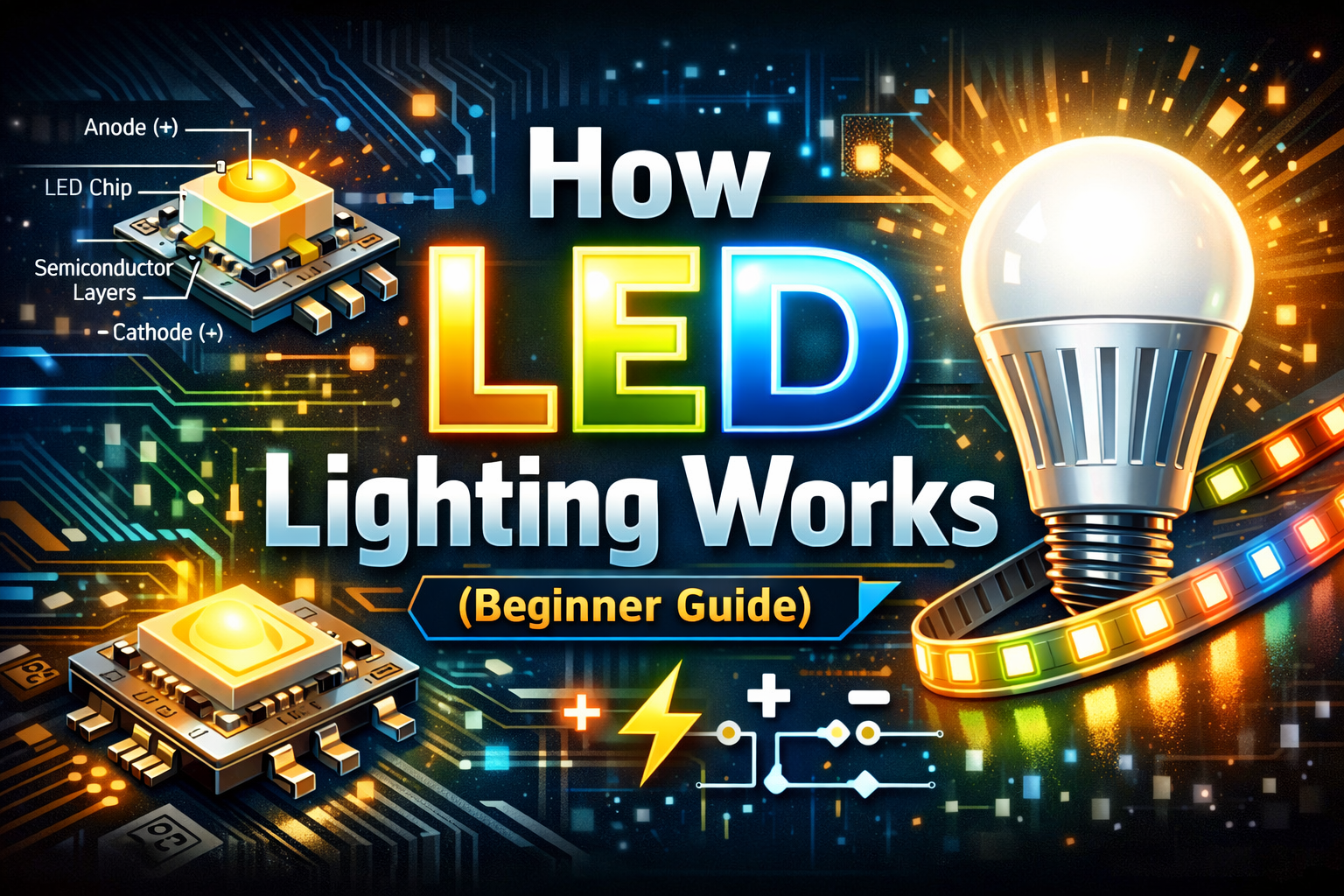
Think of the bulb as a small system rather than one glowing piece. The outer diffuser spreads light, the electronics regulate incoming power, the chip produces the original light, and the metal body helps remove heat. Seeing the bulb this way makes how led lighting works much easier to follow, because each part solves a different problem: output, control, colour, or cooling.
When a room feels harsh even with a decent bulb, the issue is not always brightness. Diffusion, colour temperature, and placement often shape comfort more than raw output alone.
For a warm everyday room such as a bedroom or living area, one practical option is a soft warm bulb for everyday comfort. A balanced soft-white output can reduce eye strain in spaces where you want steady, familiar light rather than a sharp task-oriented feel, especially when the rest of the fixture design is already simple and open.
The semiconductor core
At the center of the bulb sits a tiny semiconductor chip. This chip is built from materials designed to control how electrons move through it. Unlike a simple metal wire, a semiconductor can be engineered so current flows in a useful way and produces light as part of that movement. If you want a deeper look at package design and construction, this guide to common LED chip types gives helpful background.
This is the point where many “led technology explained” articles get too technical too quickly. You do not need advanced electronics to understand the principle. You only need to know that the chip is made to manage charge precisely, and that precision is the reason how led lighting works so differently from older bulbs that waste much more energy as unwanted heat. Once that idea clicks, the rest of the bulb starts to feel logical instead of mysterious.
From current to visible light
Once current reaches the chip, charge carriers move across a junction inside the diode. As they recombine, energy is released in the form of photons. Those photons are the actual light. That sounds scientific, but it answers the everyday question behind “how do led lights work” better than any vague description about efficiency or newer technology. The light comes from a controlled electronic interaction, not a hot element glowing white.
Because the process is targeted, much less energy is wasted. That is a big reason how led lighting works so well for homes, offices, and portable fixtures where lower power draw matters. It also explains why bulbs can stay relatively cool to the touch compared with incandescent options, even though the chip and electronics inside still produce heat that must be managed carefully.
Why phosphor matters
A common beginner misconception is that every white bulb naturally produces white light straight from the chip. In many cases, the chip first creates blue or near-blue light, and a phosphor coating converts part of that output into a broader spectrum that looks white to our eyes. That conversion step is a major reason the phrase “what is led lighting” cannot be answered with one sentence; the final light is the result of several layers working together.
Different phosphor formulas affect warmth, coolness, colour rendering, and efficiency. If you want the deeper material science behind that tuning, NeoLEDHub has a detailed explanation of how phosphor technology shapes white light. This is also where “led technology explained” starts to connect with real buying decisions, because colour quality changes how furniture, skin tones, and surfaces look in the room.
Brightness depends on design
People often compare only wattage, but output depends on the entire system: the chip, driver, optics, diffuser, and thermal design. Two bulbs can use similar power yet feel very different in practice because one spreads light more evenly or wastes less energy inside the housing. That broader system view is another part of how led lighting works in real products rather than in lab diagrams.
If you care about brightness, look first at lumens, beam behavior, and the space being lit. A narrow lamp over a desk has a different job from a ceiling bulb filling an entire room. When “how do led lights work” is framed only as a chip question, people miss the practical reality that fixture design strongly affects the result you actually see every night.

Heat control shapes lifespan
LED bulbs do create heat, just not in the same wasteful way as incandescent lamps. The chip and electronics need solid heat management so performance stays stable over time. Poor thermal design can shorten lifespan, shift colour, or reduce output sooner than expected. That is why how led lighting works cannot be separated from cooling. A bulb is only as reliable as its ability to move heat away from sensitive parts, especially inside compact housings and decorative fixtures.
A bulb installed in a fully enclosed fixture may run much hotter than the packaging suggests. Always check fixture compatibility before assuming the rated lifespan will apply in your setup.
If you want to see why fins, materials, and airflow matter, read this breakdown of LED heat sink and cooling design. It also helps explain why some cheap bulbs fail early even when their advertised wattage and brightness look competitive on the box.
Efficiency is more than wattage
A low watt number by itself does not tell you enough. Good efficiency is really about how many lumens you get for the power used, how much light is directed where it is useful, and whether the bulb maintains that performance over time. NeoLEDHub’s guide to lumens per watt and real-world efficiency is useful here, especially if packaging claims feel vague or inconsistent.
The U.S. Department of Energy LED lighting efficiency guidance is useful because it frames efficiency as a mix of lower consumption, long life, and real operating savings rather than a single number on the box. That is a practical lens for homeowners trying to compare options without getting buried in spec sheets.
The ENERGY STAR guide to LED lighting basics reinforces the same lesson from a consumer angle. Performance should be judged through output, longevity, and application, not just wattage. That wider view makes how led lighting works much easier to connect to cost savings over months and years, especially when replacing several bulbs at once.
Colour consistency and binning
Two bulbs with the same Kelvin rating can still look a little different. That is where binning becomes important. Manufacturers sort chips by output and colour characteristics so finished bulbs stay closer to a target appearance. If matching matters across several fixtures, this guide to LED binning and colour consistency explains why better products tend to look more uniform from lamp to lamp.
This section is also where “what is led lighting” becomes more than a simple on-off question. Quality includes colour quality, consistency, and how natural a room feels once several bulbs are installed together. When you understand how led lighting works at this level, you stop shopping only by watt replacement claims and start judging the experience the bulb will create.
Common myths and mistakes
One of the biggest mistakes is assuming every bulb behaves the same on a dimmer. Another is believing higher brightness always means harsher light. A third is expecting a cheap bulb in a poor fixture to last exactly as long as the packaging promise. When “led technology explained” is reduced to a few marketing phrases, buyers miss the system details that actually affect comfort and reliability. That confusion returns whenever people try to judge how led lighting works by appearance alone instead of by specs and installation conditions.
If dimming has been unreliable in your home, focus on compatibility first. The issue may be the driver, the dimmer, or the fixture, not the idea of LED itself.
For readers dealing with unstable dimming, a smooth dimming bulb for older switches can be a practical option because it is designed to avoid flicker in everyday use. That matters in bedrooms, media rooms, and evening spaces where small fluctuations feel distracting much faster than many people expect.
Quick checklist for buying
Once you understand how led lighting works, shopping gets simpler because you know what questions actually matter. Instead of guessing based on packaging graphics, focus on output, colour temperature, CRI, fixture type, and whether dimming or enclosure limits apply. NeoLEDHub’s broader LED lighting buying guide expands these points if you want a more product-focused next step. That practical lens is another reason how led lighting works should matter before you buy, not only after a bulb disappoints you at home.
- ✓ Check lumen output before looking at watt replacement claims
- ✓ Match colour temperature to the room, not to trend words on the box
- ✓ Confirm enclosed-fixture or dimmer compatibility before installing
- ✓ Prefer higher CRI when appearance and colour accuracy matter
- ✓ Think about beam spread and fixture shape, not only bulb shape
Buyers who want stronger output for kitchens, worktops, or detailed tasks may prefer a high output bulb for detailed tasks. A higher lumen bulb with solid CRI can help stabilize brightness where shadows and dull colour make work harder than it should be.
Where smart features fit
Smart features do not change the core physics of the bulb, but they do add another layer of control. Scheduling, app-based dimming, scenes, and voice commands sit on top of the same chip, driver, and thermal foundation described above. In other words, how led lighting works stays the same at the component level even when the user experience becomes more advanced. That is useful to remember when smart packaging makes ordinary control features sound like a completely different technology.
That is why smart shopping still starts with the basics. A connected bulb with poor colour, poor cooling, or poor compatibility is still a poor bulb. If you want to explore that next stage, visit the NeoLEDHub knowledge center for deeper technical topics, or browse our broader smart-home ideas through the related category section below. Understanding how led lighting works first helps every later upgrade make more sense.
Key Takeaways
The simplest way to understand how led lighting works is to see the bulb as a coordinated system. Power enters through the driver, the chip produces light through a semiconductor process, phosphor helps create usable white light, and the body manages heat so output remains dependable over time.
In practical terms, that means shopping smarter. Pay attention to lumens, CRI, colour temperature, compatibility, and fixture conditions before worrying about marketing claims. Once you know why the parts matter, you can match bulbs to rooms with far more confidence and fewer unpleasant surprises.
As homes keep moving toward efficient, connected, and more personalized setups, the people who understand how led lighting works will make better decisions on comfort, performance, and long-term value. The technology is advanced, but the buying logic becomes clearer the moment the basics click.
Sharing this guide
If you found this guide helpful, save it or share it with someone who’s still using old bulbs.
Interested in learning more? Browse all related articles in our category section.