Lighting Design for Open Floor Plans: Smart Zoning Guide
Good lighting design for open floor plans is not about making one large room equally bright from end to end. It is about helping each zone feel clear, comfortable, and connected without losing the visual flow that makes open layouts so appealing in the first place.
The best results come from combining ambient, task, and accent lighting in a way that reflects how the space is actually used. Kitchens need stronger work light, dining areas need focused but flattering light, and living zones usually feel better with softer layers and more control. When those layers are planned together, the whole floor plan feels more cohesive and much easier to live in.
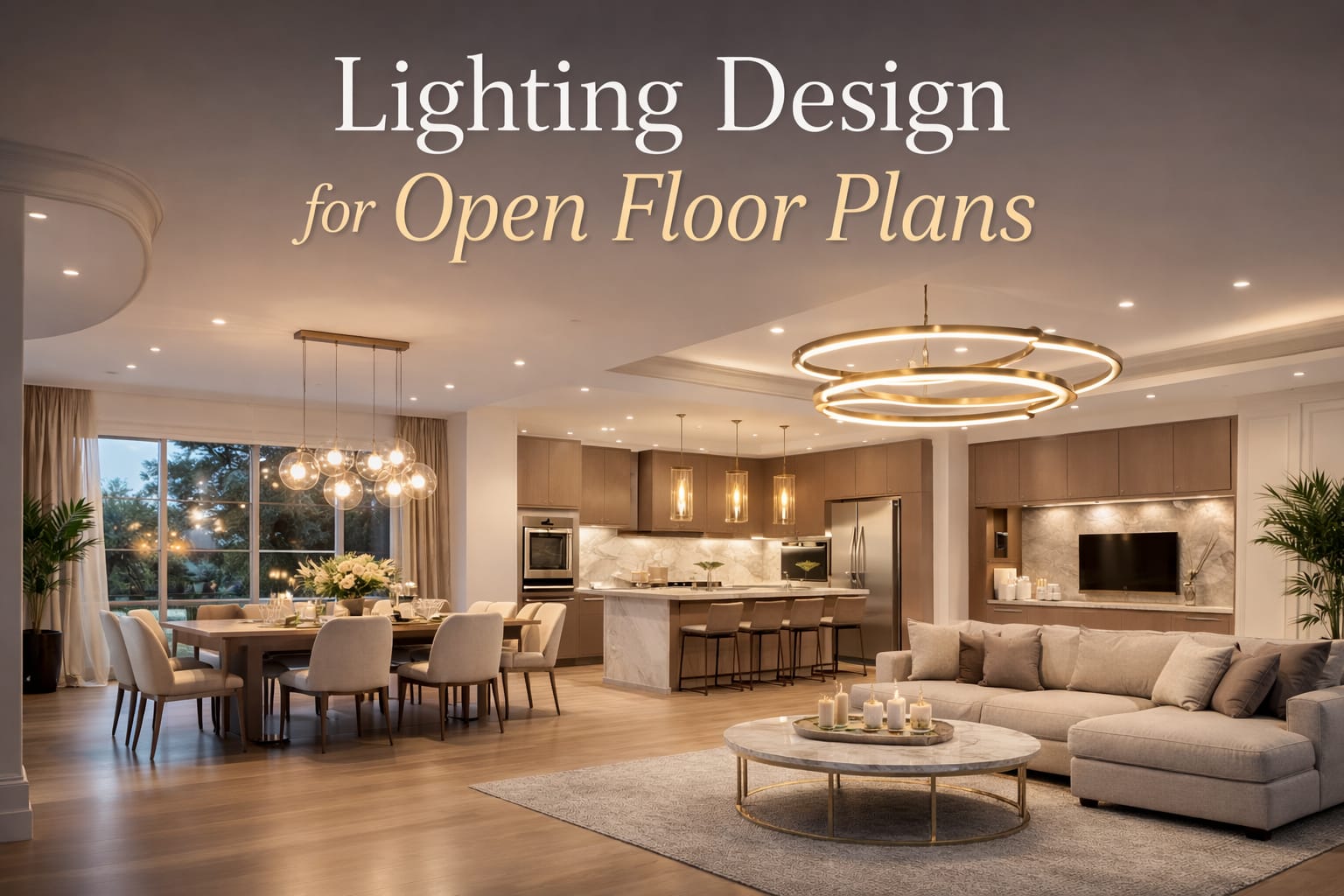
Table of Contents
- Define Each Zone First
- Coordinate Fixtures Across the Space
- Use Pendants to Anchor Key Areas
- Build a Strong Ambient Layer
- Add Task Light Where Work Happens
- Use Accent Lighting With Restraint
- Let the Ceiling Shape the Plan
- Keep Color Temperature Consistent
- Make Controls Easy to Use
- Check Glare and Sight Lines
- Prioritize the Budget in Phases
- Key Takeaways
- Sharing this guide
Define Each Zone First
The biggest challenge in lighting design for open floor plans is giving each area its own purpose without making the overall space feel chopped up. Light has to do some of the work that walls used to do. That means using different fixture types, brightness levels, and focal points to show where cooking, dining, relaxing, and working happen.
In practice, that usually means brighter light over the kitchen, more controlled light over the dining table, and softer layered light in the living area. Those differences help people read the room instinctively. The space still feels open, but it no longer feels undefined.
This is where lighting layout planning becomes especially important. If you place fixtures as though the whole room serves one function, the result often feels flat and confusing. If you plan by zone first and connection second, the room usually feels far more intentional.
Use Visual Anchors
A strong fixture can anchor a zone even when the floor plan is completely open. Pendants above an island, a chandelier above a dining table, or a floor-lamp grouping around a sofa arrangement all give the eye a clear center of gravity. That makes the layout easier to understand as soon as someone walks in.
If your space feels visually flat and lacks a clear focal point, a statement fixture can help. One practical option is a modern crystal pendant light that defines the dining or island zone while still fitting a contemporary open floor plans look.
Coordinate Fixtures Across the Space
Because open layouts expose multiple fixtures at once, coordination matters more than it does in closed rooms. That does not mean every fixture has to match exactly. It means the space should look like one well-thought-out system rather than three separate shopping trips.
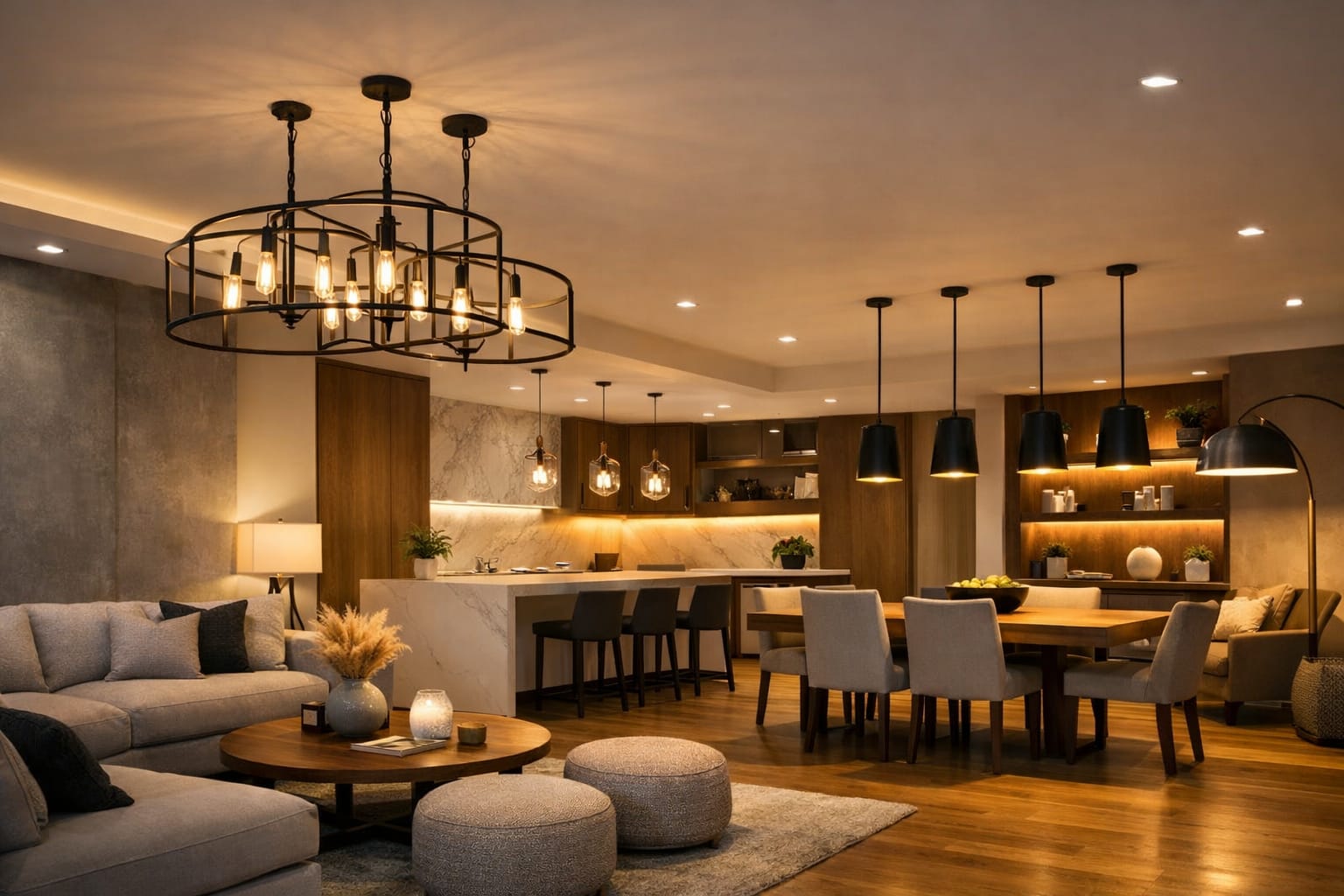
The easiest way to keep cohesion is to repeat something consistent across zones, such as finish, shape language, or material tone. You might combine matte black pendants in the kitchen with a matte black chandelier in the dining area and softer black-accent lamps in the living room. The fixtures do not need to be identical, but they should feel related.
This is one of the simplest lighting design fundamentals to get right early. If the finishes fight each other or the styles belong to different eras, the whole space can feel visually noisy before the lights are even turned on.
Choose Finishes With a Clear Hierarchy
A safe rule is to choose one dominant finish and, at most, one supporting finish. That keeps the room from feeling cluttered. It also helps to relate lighting finishes to nearby hardware, faucet finishes, furniture legs, or shelving details so the whole plan looks deliberate.
If you want mixed metals, use them with a clear hierarchy instead of letting them compete equally. One finish should lead, and the second should appear only where it adds contrast or emphasis.
Use Pendants to Anchor Key Areas
Pendant placement does a lot of the heavy lifting in lighting design for open floor plans because pendants are both functional and architectural. Over an island, they define the kitchen zone and add task light. Over a dining table, they create intimacy and visual emphasis without needing walls to frame the space.
For islands and counters, pendants are usually best hung around 30 to 36 inches above the surface. Dining tables often follow a similar range, though larger or more opaque shades may need small adjustments depending on glare and sight lines. The goal is to keep the fixture low enough to define the zone and high enough to avoid blocking views across the room.
Spacing matters too. Two pendants often suit shorter islands, while longer islands usually need three or more. The right spacing keeps the light balanced and avoids dark gaps or awkward crowding.
Leave Room to Adjust Hanging Height
If you are unsure about the final hanging height, adjustable pendants are worth considering. open floor plans rooms often reveal their best proportions only after furniture is in place. A little flexibility can save you from living with a fixture that feels slightly too low or too disconnected from the surface below it.
Track-based or cable-suspended systems can also work in layouts that change often, though they usually suit modern interiors better than classic or traditional schemes.
Build a Strong Ambient Layer
Ambient lighting is the layer that makes the whole floor plan usable. In open layouts, recessed lighting is often the easiest way to build that foundation because it spreads light broadly without filling the ceiling with bulky fixtures. Done well, it keeps circulation areas bright enough and supports every zone without drawing too much attention to itself.
That said, recessed lights alone rarely produce the best result. A room with only ceiling cans often looks flat, especially in the evening. A stronger plan combines ambient lighting with task and accent layers so the room has depth instead of one uniform wash.
This is exactly why our guide to ambient vs task vs accent lighting matters in open spaces. The more connected the floor plan is, the more important those layers become.
Add Dimming From the Start
Dimming is one of the most useful upgrades you can add to an open floor plan. A bright kitchen-level setting may feel perfect in the morning, but the same output can feel harsh when people are eating or relaxing later in the day. Dimmers let the same room shift with the hour instead of staying locked in one mode.
Separate dimming zones for the kitchen, dining, and living areas make a huge difference. In many homes, that matters more than adding another decorative fixture.
If you only make one control upgrade, make it separate dimmers for the main zones. That single change can make an open layout feel far more flexible without a major remodel.
Add Task Light Where Work Happens
Task lighting is where function becomes specific. In open floor plans, the kitchen usually needs the strongest task layer because cooking, prep, and cleanup demand clarity and contrast. Under-cabinet strips, island pendants, and sometimes directional ceiling lights handle that better than general ambient light alone.
Living areas are more variable. A reading corner may need a focused floor lamp, while a media zone may need very little task light at all. If the open layout includes a desk, homework counter, or hobby table, that area should get its own dedicated layer instead of borrowing weak spill light from nearby zones.
This is also where room-specific guidance becomes useful. If a work zone is part of the plan, our guide to lighting for home offices can help you avoid under-lighting that section just because it sits inside a larger open room.
Use Portable Lamps to Fill Gaps
Portable lamps still matter in open layouts. Floor lamps and table lamps soften living zones and create a more residential feel than recessed lighting alone. They are especially helpful if the room layout may change later or if you want better layering without opening walls or rewiring ceilings.
Rechargeable or cordless task lights can also help in awkward corners, though hardwired or plug-in options are usually better for everyday primary use.
Use Accent Lighting With Restraint
Accent lighting is what stops an open floor plan from feeling too plain. Once ambient and task layers are working, accent fixtures can highlight shelving, artwork, textured walls, niches, or architectural details. They create rhythm across the room and make the space feel more designed instead of merely illuminated.
The key is restraint. In open layouts, too many accent effects can create visual clutter because everything is visible at once. A few strong focal points usually work better than trying to highlight every surface.
Accent lighting also works well as a lower evening layer. When bright kitchen task lighting is no longer needed, shelf lighting, wall washing, or soft lamp light can keep the room feeling alive without pushing the whole floor plan back to daytime brightness.
Highlight One or Two Features
If your open space has a fireplace wall, textured finish, shelving run, or artwork grouping, that area is often the best candidate for accent treatment. Grazing light across a textured surface or a soft wash across built-in shelving gives the room a sense of depth that recessed downlights cannot create on their own.
That kind of visual depth matters even more in large connected rooms, where flat lighting can make the entire space feel less inviting than it should.
Let the Ceiling Shape the Plan
Ceiling height changes almost every decision in lighting design for open floor plans. Standard-height ceilings usually need a more restrained mix of recessed lighting, flush or semi-flush fixtures, and carefully scaled pendants. Higher ceilings allow more dramatic pendants and chandeliers, but they also require stronger output and smarter spacing so the room does not feel underlit at floor level.
If the space includes vaulted sections, beam details, or split-height transitions, those features should influence both fixture type and placement. The room will feel much better if the lighting works with the ceiling geometry instead of ignoring it.
That is why lighting for high ceilings often overlaps with open floor plans strategy. Once the room expands vertically as well as horizontally, fixture scale and beam control matter much more.
Integrate Light With the Architecture
Cove lighting, beam-mounted systems, and perimeter uplighting can add a lot in open floor plans because they support the architecture instead of just filling the ceiling with point sources. Indirect light also tends to feel more comfortable during long evenings, especially in large spaces where glare carries farther.
When the architecture gives you a chance to hide the light source, it is often worth using it.
Keep Color Temperature Consistent
Because open floor plans keep multiple areas in view at the same time, bulb color consistency matters more than many people expect. A warm living zone next to an overly cool kitchen can look disconnected even if the fixture styles match perfectly. Keeping the whole space within a sensible range usually creates a more polished result.
That does not mean every bulb must be identical. A subtle difference can work. For example, a kitchen may feel slightly better with a cleaner white light while the living area stays a little warmer. The trick is to keep the shift gentle enough that it feels intentional rather than mismatched.
High CRI matters here too. If one zone renders colors well and another does not, the inconsistency becomes visible across the room. Our article on lighting psychology and mood also connects closely to this, because color tone affects how inviting or energizing a shared space feels.
Make Future Bulb Replacements Easier
One easy way to protect consistency is to record your bulb specs when you first install them. That makes future replacements much easier. Open rooms reveal inconsistencies quickly, and one mismatched bulb can stand out more than people expect.
Buying complete matching sets for visible fixtures is usually worth it, especially for pendants and chandeliers.
Make Controls Easy to Use
Control matters almost as much as fixture choice in lighting design for open floor plans. The same connected room may be used for breakfast, work, entertaining, watching TV, and late-night cleanup in a single day. Without good controls, even well-chosen fixtures can feel inconvenient.
The best setup usually separates the main layers into usable zones, then gives you fast ways to call up common scenes. A bright cooking scene, a softer dinner scene, and a relaxed evening scene often cover most real-life use. Smart switches, dimmers, and voice control can help, but even well-planned manual controls go a long way.
The important part is usability. If the controls are too complicated, people stop using the lighting the way it was designed.
Use Simple Scenes and Automation
Automation is especially useful in open rooms because one scene change can rebalance a large part of the home. Timed evening dimming, occupancy-based transitions in circulation areas, or simple voice scenes can make the layout feel much more responsive and polished.
For readers who want to keep learning after this article, the LED Knowledge Center is a good next step for control, fixture, and planning topics across the wider site.
Check Glare and Sight Lines
Open floor plans create long sight lines, and that changes how lighting feels. A pendant that looks beautiful from below may cause glare from the sofa. A polished floor can bounce too much light upward. A bright kitchen zone can dominate the room when someone is trying to relax nearby. These are not minor details. They shape whether the room feels comfortable every day.
This is why fixture height, bulb shielding, and furniture orientation all matter together. If someone seated in the living room keeps seeing the brightest source in the space directly in their line of sight, the room will feel more tiring than it should.
Our guide to common placement mistakes is especially relevant here, because open layouts make small positioning problems much more visible.
Do not judge glare only while standing. In open floor plans rooms, the most annoying problems often show up when you sit down and look across the space at night.
Manage Reflections Across the Room
Glossy surfaces, polished floors, and large windows can all amplify brightness in ways that are easy to miss during planning. At night, windows often behave like mirrors, and strong interior lighting can create distracting reflections. In open floor plans rooms, where glazing is often extensive, that effect can be stronger than expected.
Managing reflections is less about reducing light everywhere and more about directing it better. Shielded bulbs, dimming, and smarter aiming usually help more than simply lowering overall output.
Prioritize the Budget in Phases
Open floor plans can get expensive quickly because one large space often needs several lighting roles at once. The smartest budget approach is usually to prioritize the zones that affect daily life the most. Kitchens and dining areas tend to offer the biggest payoff first because poor lighting there is noticed immediately.
It also helps to think in phases. Get the ambient and task layers right first, then add accent and decorative upgrades later if needed. That approach usually produces a better result than spending heavily on one statement fixture while leaving the rest of the room under-planned.
A well-balanced plan does not always mean the most expensive fixtures. It means choosing the right pieces in the right places and making sure they work together over time.
Know When DIY Stops Making Sense
Replacing visible fixtures and adding portable lamps can be realistic DIY upgrades. But once new wiring, new control locations, or major zoning changes are involved, professional input becomes much more valuable. open floor plans rooms are unforgiving when the electrical planning is off.
A short consultation can often prevent expensive mistakes, especially in large rooms where one poor decision affects several living zones at once.
Want to keep building the bigger picture? The LED Knowledge Center brings together practical lighting guides, room-by-room planning advice, and technical explanations that help you connect fixture choices with real-life use.
Key Takeaways
Good lighting design for open floor plans works best when each zone feels purposeful while the whole room still feels visually connected. That usually means layering ambient, task, and accent light instead of relying on a single ceiling-wide solution.
Start with the kitchen, dining area, and main living zone, then focus on fixture coordination, dimming, and sight lines. Those decisions usually have a bigger impact on comfort than decorative upgrades alone.
If you treat the layout as a connected set of lighting zones rather than one oversized room, the space will usually look better, function better, and stay more adaptable over time.
Sharing this guide
If you found this guide helpful, you can save it for later or share it with a friend. It is especially useful for homeowners planning a new layout, a renovation, or a full lighting refresh.
Share using the links below
Interested in learning more? Browse related articles in our Lighting Guides category.
Pingback: Lighting for Narrow Hallways: Essential Guide Now
Pingback: Ambient vs Task vs Accent Lighting: Which Type? - NeoLEDHub
Pingback: Common Lighting Placement Mistakes - NeoLEDHub
Pingback: How Many Lumens Per Room? (Full Guide) - NeoLEDHub
Pingback: Lighting for High Ceilings: Best Ideas - NeoLEDHub
Pingback: Common Lighting Placement Mistakes: Fixes for Each Room