LED vs Incandescent Electricity Cost: Real Savings
Understanding the true LED vs incandescent electricity cost differences helps homeowners make informed lighting decisions based on actual financial data rather than vague efficiency claims. This comprehensive analysis examines wattage consumption, annual operating expenses, lifetime costs, and return on investment using real-world calculations demonstrating exactly how much money LED technology saves compared to traditional incandescent bulbs across various usage scenarios throughout residential applications.
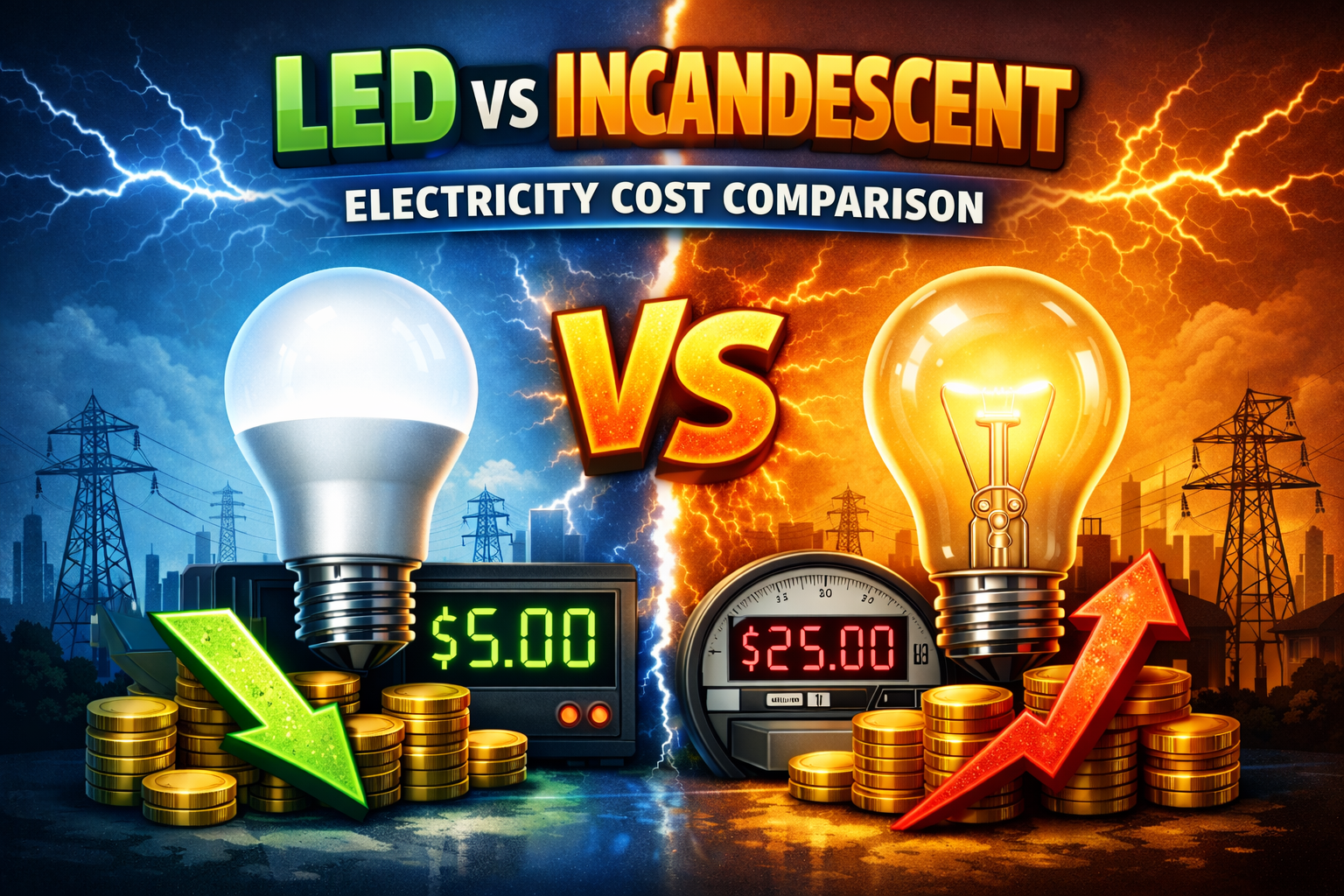
Table of Contents
Wattage Comparison
The fundamental LED vs incandescent electricity cost difference stems from dramatic wattage consumption difference between technologies producing identical light output. A standard 60-watt incandescent bulb produces approximately 800 lumens while consuming 60 watts of electricity. An equivalent LED bulb produces the same 800 lumens while consuming only 8-10 watts, representing an 83-85% reduction in power draw for identical brightness levels throughout residential applications.
This efficiency gap widens across different brightness levels. A 40-watt incandescent (450 lumens) requires only 4-6 watt LED replacement. A 75-watt incandescent (1100 lumens) needs 10-13 watt LED equivalent. A 100-watt incandescent (1600 lumens) converts to 13-18 watt LED. These wattage consumption difference ratios demonstrate consistent 80-85% efficiency advantages regardless of brightness requirements throughout various lighting applications requiring different illumination levels.
If you want a dependable option, a solid example is ge a19 led light bulbs, which is known for stable long-term performance.
Specialty Bulbs
Higher-wattage specialty incandescent bulbs show even more dramatic operating cost comparison differences. A 150-watt incandescent flood lamp consuming 150 watts converts to 20-25 watt LED equivalent saving 125 watts per hour of operation. Recessed lighting using 65-watt BR30 incandescent bulbs reduces to 9-11 watt LED alternatives saving 54-56 watts per fixture. These substantial reductions multiply across multiple fixtures creating significant cumulative savings throughout entire homes.
Three-way bulbs offering multiple brightness levels demonstrate consistent efficiency advantages across all settings. A 50/100/150-watt three-way incandescent converts to 7/14/21-watt LED equivalent maintaining 85% efficiency improvement at each brightness level. Dimmer-compatible LEDs preserve efficiency advantages throughout dimming ranges unlike some older technologies showing degraded performance at reduced output settings throughout varied usage requiring adjustable illumination. Understanding these fundamentals helps evaluate annual savings potential across different scenarios.
Annual Costs
Calculating precise annual figures demonstrates exactly the LED vs incandescent electricity cost differences in typical residential scenarios. A single 60-watt incandescent bulb operating three hours daily consumes 65.7 kWh annually (60 watts × 3 hours × 365 days ÷ 1000). At $0.15 per kWh average national electricity rate, this single bulb costs $9.86 annually in energy expenses alone excluding purchase and replacement costs throughout operational periods.
An 8-watt LED equivalent consumes 8.76 kWh costing $1.31 annually, saving $8.55 per bulb per year through reduced energy consumption. This operating cost comparison reveals that LED bulbs cost 87% less to operate annually than incandescent equivalents at identical usage hours. Extended usage amplifies savings proportionally with five hours daily operation increasing annual costs to $16.43 for incandescent versus $2.19 for LED, saving $14.24 per bulb annually throughout higher-use applications.
Higher-wattage fixtures generate proportionally greater savings demonstrating the LED vs incandescent electricity cost advantages scaling with power consumption. A 100-watt incandescent bulb operating three hours daily costs $16.43 annually compared to $2.63 for 14-watt LED equivalent, saving $13.80 per bulb. Outdoor security lighting operating 10 hours daily using 150-watt incandescent costs $82.13 annually versus $13.69 for 23-watt LED equivalent, saving $68.44 per fixture demonstrating dramatic savings in high-usage applications.
Monthly Breakdown
Monthly operating cost comparison provides more tangible perspective on ongoing expenses. A 60-watt incandescent at three hours daily costs $0.82 monthly versus $0.11 for LED equivalent, saving $0.71 monthly per bulb. While individual bulb savings appear modest, multiplying across 40-50 household bulbs creates substantial cumulative monthly savings reaching $28-36 through complete LED conversion throughout residential installations.
Seasonal variations affect monthly costs with winter months requiring increased lighting due to shorter daylight hours. Summer usage declines as extended daylight reduces artificial lighting requirements. These seasonal patterns create variable monthly expenses though annual totals remain consistent regardless of distribution throughout calendar years. Understanding these variations helps homeowners budget appropriately while recognizing consistent annual savings despite monthly fluctuations throughout changing seasons.
Usage Scenarios
Actual usage hours significantly affect the LED vs incandescent electricity cost calculations across different household scenarios. Low-use fixtures like closets or guest rooms operating under one hour daily generate minimal annual savings of $1-3 per bulb despite percentage savings remaining constant. Medium-use fixtures including bedrooms and dining rooms operating 2-4 hours daily provide moderate savings of $6-12 annually per bulb throughout typical residential patterns.
High-use fixtures including living room lamps, kitchen overhead lighting, and outdoor security lights operating 5-12 hours daily generate maximum savings of $15-70 per bulb annually. These high-traffic locations provide fastest payback periods and greatest annual returns justifying premium LED investments even before addressing lower-priority locations throughout phased conversion projects. Smart home integration enables automated control systems optimizing usage patterns further.
Always-on applications demonstrate most dramatic operating cost comparison differences. Emergency exit lighting, night lights, or refrigerator bulbs operating 24 hours daily create extreme consumption differences. A 7-watt incandescent night light costs $9.20 annually versus $0.53 for 0.4-watt LED equivalent, saving $8.67 per fixture. These continuous-use applications achieve LED payback within weeks rather than months making conversion extremely cost-effective regardless of electricity rates.
Room Specific
Kitchen lighting using twelve 60-watt incandescent bulbs operating five hours daily consumes 1,314 kWh annually costing $197.10 in electricity. LED conversion to 8-watt equivalents reduces consumption to 175 kWh costing $26.28, saving $170.82 annually demonstrating significant wattage consumption difference impact. Living rooms with eight fixtures operating five hours save approximately $114.72 annually through LED adoption throughout high-traffic common spaces.
Bedroom lighting operating three hours daily per five fixtures saves approximately $42.75 annually. Bathrooms with four fixtures at two hours daily save $19.20 annually. Hallway and outdoor fixtures operating longer hours generate disproportionate savings despite fewer fixtures. Prioritizing conversion based on actual room usage patterns maximizes initial return even before completing whole-home conversions throughout remaining lower-priority locations requiring strategic implementation planning.

Electricity Rates
Regional electricity rates significantly impact LED vs incandescent electricity cost calculations with prices varying from $0.09 per kWh in Louisiana to $0.35 per kWh in Hawaii creating substantial differences in absolute dollar savings. Higher-rate regions benefit more from wattage consumption difference making LED adoption more financially compelling than lower-rate areas achieving smaller absolute savings despite identical percentage reductions throughout varied geographic markets.
Time-of-use pricing structures charge different rates based on consumption timing with peak hours costing significantly more than off-peak periods. Households predominantly using lighting during expensive evening peak hours save more through LED conversion than those with primarily off-peak usage. Some utility companies offer tiered pricing where rates increase as consumption exceeds thresholds. LED adoption helps avoid expensive higher tiers by reducing total household consumption throughout billing cycles.
Electricity rates generally increase over time due to infrastructure costs and inflation. Historical data shows average 2-3% annual rate increases meaning LED savings grow over time as rates rise. The operating cost comparison calculated using current rates underestimates long-term cumulative benefits as future rate increases apply to larger energy differences between technologies. This compounding effect increases LED value proposition beyond simple static calculations throughout extended operational periods. According to U.S. Department of Energy LED lighting efficiency guidance, proper technology selection optimizes long-term savings.
Rate Structures
Flat-rate pricing charges consistent per-kWh costs regardless of usage timing or volume simplifying lifetime cost analysis calculations. Tiered pricing increases rates as consumption rises incentivizing conservation through LED adoption keeping usage within lower-cost brackets. Time-of-use pricing varies rates by time of day with peak evening hours when lighting usage concentrates charging premium rates amplifying LED savings during expensive periods.
Demand charges assessed on peak usage rates create additional savings through LED conversion reducing maximum instantaneous power draw. Commercial and industrial customers facing demand charges benefit particularly from LED wattage consumption difference reducing peak loads lowering monthly demand charges beyond simple energy savings. Understanding specific utility rate structures helps calculate accurate savings projections matching actual billing methodologies throughout various pricing schemes.
Lifetime Expenses
Extended operational lifespans create dramatic LED vs incandescent electricity cost differences throughout complete bulb lifetimes. Incandescent bulbs last approximately 1,000 hours requiring replacement every 11 months at three hours daily usage. LEDs last 25,000-50,000 hours operating 23-46 years at three hours daily usage. Over a 25-year period representing one LED lifespan, incandescent bulbs require approximately 25 replacements creating cumulative costs beyond initial purchase prices.
A single 60-watt incandescent bulb operating three hours daily over 25 years consumes 1,643 kWh costing $246.45 at $0.15 per kWh. Add 25 bulb purchases at $1.50 each ($37.50) for total lifetime expenses of $283.95. An 8-watt LED equivalent consuming 219 kWh costs $32.85 in electricity plus one bulb purchase at $5 for total lifetime expenses of $37.85, saving $246.10 per fixture throughout complete operational lifespans demonstrating compelling long-term advantages.
Higher-usage scenarios amplify lifetime savings proportionally. A fixture operating five hours daily generates lifetime incandescent costs of $473.25 versus LED costs of $63.08, saving $410.17 per fixture. Ten-hour daily usage creates incandescent costs of $946.50 versus LED costs of $126.17, saving $820.33 per fixture. These lifetime cost analysis figures demonstrate LED value extends far beyond annual savings into exceptional long-term financial benefits throughout extended residential occupancy. Comprehensive comparisons available through detailed technology evaluations examining multiple factors.
Present Value
Net present value analysis discounting future savings to present value using appropriate discount rates demonstrates LED investments generate positive returns comparable to other household efficiency improvements. Using 3% discount rate, a typical LED bulb generates $150-200 net present value over its lifetime representing substantial return on $5-8 initial investment justifying adoption from purely financial perspectives.
These calculations support LED adoption based exclusively on economic merit ignoring non-monetary benefits. Including improved light quality, reduced maintenance, instant-on performance, and dimming capabilities increases total value proposition beyond quantifiable savings alone. Environmental benefits including reduced carbon emissions provide societal advantages though typically excluded from individual household financial analyses focusing on personal economic returns throughout decision-making processes.
Replacement Frequency
Frequent incandescent replacement creates hidden costs affecting the LED vs incandescent electricity cost comparison beyond simple energy expenses. A fixture requiring annual bulb replacement demands ongoing attention, ladder work, and disposal efforts throughout years. These maintenance requirements consume time and create fall risks particularly for high-ceiling fixtures, cathedral ceilings, or exterior building-mounted lights posing access challenges.
LED longevity eliminating replacement for 25+ years provides significant practical advantages beyond dollar savings. Difficult-access locations benefit particularly from extended lifespan avoiding dangerous ladder work. Elderly homeowners or those with mobility limitations appreciate reduced maintenance demands. Commercial applications in retail or office environments avoid business disruption from frequent relamping requiring equipment and labor throughout operational hours affecting productivity.
Bulk purchasing incandescent replacements requires storage space and inventory management tracking stock to avoid outages. LED longevity eliminates these logistics converting episodic replacement cycles into occasional single-bulb purchases. Reduced packaging waste from 25+ incandescent replacements versus single LED purchase provides environmental benefits complementing operational efficiency advantages throughout complete lifecycle considerations extending beyond simple operating cost comparison calculations.
Labor Costs
Commercial applications facing professional relamping labor costs experience even greater LED advantages. Electricians charging $50-100 per hour make incandescent replacement expensive beyond bulb costs alone. A 50-bulb commercial installation requiring annual relamping costs $200-500 in labor annually. LED conversion eliminating relamping for 25 years saves $5,000-12,500 in labor costs alone excluding energy and bulb purchase savings throughout operational periods.
Residential DIY labor while unpaid still consumes valuable time better spent on other activities. Valuing personal time at even minimum wage levels demonstrates LED longevity provides measurable savings beyond electricity costs alone. These hidden benefits often go unquantified though contribute meaningfully to total value proposition justifying LED adoption from comprehensive perspectives accounting for all costs throughout complete ownership experiences.
Total Ownership Cost
Comprehensive lifetime cost analysis including purchase prices, energy consumption, and replacement costs reveals true LED vs incandescent electricity cost differences. A typical household with 45 bulbs operating average three hours daily incurs the following 25-year costs. Incandescent: 45 bulbs × $283.95 lifetime cost = $12,777.75 total. LED: 45 bulbs × $37.85 lifetime cost = $1,703.25 total. Total 25-year savings: $11,074.50 through complete LED conversion throughout typical residential installations.
These substantial savings exclude secondary benefits including reduced air conditioning loads from LED minimal heat generation in hot climates. Incandescent bulbs converting 90% of energy into heat contribute to cooling loads during warm months. LED minimal heat generation reduces cooling requirements creating additional savings beyond direct lighting energy consumption. These compounding benefits increase total value particularly in hot climates with substantial cooling loads throughout extended summer periods. Reference ENERGY STAR guide to LED lighting basics for additional information.
Larger homes with 60-75 bulbs generate proportionally greater savings approaching $15,000-20,000 over 25 years through complete LED conversion. Smaller apartments with 20-25 bulbs still achieve $5,000-7,000 savings justifying investment despite reduced scale. These figures represent ongoing cumulative benefits continuing throughout LED lifespans creating substantial long-term value regardless of household size throughout varied residential configurations.
Investment Perspective
Viewing LED conversion as investment rather than expense changes decision-making calculus. A $200-400 whole-home conversion investment generating $11,000+ returns over 25 years represents exceptional return on investment exceeding most financial instruments available to average households. Annual returns approximate 30-50% factoring all savings creating compelling financial justification beyond environmental or convenience motivations.
These returns assume stable electricity rates though actual benefits likely exceed projections as rates increase over time. Conservative estimates using current rates understate true long-term value as future rate increases amplify savings proportionally. This built-in inflation hedge protects against rising energy costs creating additional security beyond nominal return calculations throughout uncertain future pricing environments.
Payback Period
Simple payback calculations demonstrate how quickly LED investments recover through the LED vs incandescent electricity cost savings. A $5 LED bulb replacing 60-watt incandescent used three hours daily saves $8.55 annually achieving payback in seven months. Higher-usage fixtures pay back faster with five-hour daily use achieving six-month payback. Lower-usage fixtures require longer payback though still provide positive returns within 12-18 months under most circumstances.
After initial payback, LED bulbs provide pure profit through ongoing energy savings continuing throughout 15-25 year lifespans. A single LED bulb saves approximately $200-500 over its lifetime after recovering initial investment. Whole-home conversion investments of $200-400 generate lifetime savings of $10,000-15,000 creating exceptional long-term returns justifying initial outlays from purely economic perspectives throughout extended periods.
Geographic regions with high electricity costs achieve faster payback periods and higher cumulative savings. Hawaii residents paying $0.35 per kWh achieve payback in 3-4 months compared to Louisiana residents paying $0.09 per kWh requiring 12-15 months. Despite different timelines, both scenarios generate positive returns justifying adoption regardless of local rates though high-cost regions experience more compelling immediate benefits throughout initial operating cost comparison periods.
Accelerated Payback
Utility rebate programs offering $2-5 per LED bulb accelerate payback periods dramatically. A $5 LED receiving $3 rebate creates net $2 investment achieving payback in under three months at typical usage. Some utilities offer free LED bulbs eliminating upfront costs creating immediate savings from installation moment. These incentive programs make LED adoption financially compelling even for budget-conscious households initially hesitant about higher purchase prices.
Bulk purchasing discounts reduce per-bulb costs improving payback calculations. Multi-packs offering 20-30% discounts compared to single-bulb purchases decrease initial investments accelerating return timelines. Strategic purchasing timing seasonal sales or promotional periods minimizes upfront costs maximizing financial returns throughout LED adoption projects spanning entire residential installations requiring coordinated procurement strategies.
Brightness Equivalents
Understanding lumen output ensures LED vs incandescent electricity cost comparisons use truly equivalent brightness levels. Lumens measure actual light output while watts measure power consumption. Incandescent bulbs historically labeled by wattage created consumer confusion when transitioning to LEDs producing identical lumens at dramatically different wattages requiring education about proper equivalency matching.
A 40-watt incandescent produces 450 lumens. A 60-watt produces 800 lumens. A 75-watt produces 1,100 lumens. A 100-watt produces 1,600 lumens. LED replacements should match these lumen outputs rather than wattages ensuring identical brightness. Packaging clearly indicates both lumens and incandescent equivalent wattage helping consumers select proper replacements without requiring technical understanding of photometric measurements throughout purchasing decisions.
Over-lamping using higher-output LEDs than needed wastes energy though still provides dramatic savings compared to incandescent alternatives. A 1,600-lumen LED (100-watt equivalent) consuming 18 watts costs more to operate than 800-lumen LED (60-watt equivalent) consuming 8 watts though both use far less than equivalent incandescent options. Matching brightness to actual requirements optimizes efficiency throughout wattage consumption difference calculations ensuring appropriate illumination without excess throughout residential applications.
Color Temperature
Color temperature measured in Kelvin affects perceived brightness and ambiance though doesn’t impact operating cost comparison calculations directly. Incandescent bulbs produce warm 2700K light. LEDs offer choices from warm 2700K matching incandescent to cool 5000K+ resembling daylight. Selecting appropriate color temperature ensures satisfaction with LED conversion avoiding returns or dissatisfaction undermining financial benefits throughout adoption processes.
Warm white 2700-3000K LEDs provide closest incandescent match suitable for living areas and bedrooms. Neutral white 3500-4000K works well for kitchens and bathrooms. Cool white 5000K+ suits task-oriented spaces like workshops or garages. Matching color temperature to room function ensures LED adoption enhances rather than compromises living experiences throughout residential spaces requiring varied lighting characteristics.
Environmental Costs
Beyond personal finances, the LED vs incandescent electricity cost differences create environmental impacts through reduced power generation requirements. A single LED bulb replacing incandescent over 25-year lifespan prevents approximately 1,500 pounds of CO2 emissions assuming average grid electricity generation mix. Whole-home conversion preventing 30-40 tons of CO2 emissions equals removing a car from roads for 7-8 years demonstrating substantial environmental advantages.
Reduced electricity generation decreases coal, natural gas, and petroleum consumption powering electric generation plants. This reduced fuel consumption conserves finite natural resources while decreasing associated mining, drilling, and transportation environmental impacts. Lower generation requirements reduce power plant emissions including sulfur dioxide, nitrogen oxides, and particulate matter improving air quality beyond greenhouse gas reductions throughout regional environmental quality improvements.
Peak demand reduction through widespread LED adoption helps utilities avoid constructing new generation capacity deferring billions in infrastructure investments. Reduced peak loads improve grid reliability decreasing blackout risks during high-demand periods. These systemic benefits create value for all electricity consumers through improved service reliability and deferred rate increases funding new generation facilities throughout interconnected electrical grids. Additional resources available at comprehensive knowledge centers provide detailed guidance.
Carbon Pricing
Future carbon pricing policies internalizing environmental costs of emissions may increase electricity rates particularly for fossil-fuel generation. LED adoption provides hedge against potential carbon taxes or cap-and-trade systems increasing generation costs passed to consumers. Lower consumption reduces exposure to potential future carbon-related rate increases creating additional financial protection beyond current lifetime cost analysis calculations.
Renewable energy integration benefits from LED efficiency reducing overall household consumption making rooftop solar or community solar participation more economically viable. Lower consumption requires smaller solar arrays reducing installation costs improving payback periods. LED adoption complements renewable energy strategies creating synergistic benefits advancing both efficiency and clean generation throughout comprehensive sustainability approaches addressing residential energy consumption.
Calculation Examples
Practical examples demonstrate how to calculate the LED vs incandescent electricity cost differences for specific situations. Example 1: Kitchen with 12 bulbs operating 5 hours daily. Incandescent (60W each): 12 × 60W × 5 hours × 365 days ÷ 1000 = 1,314 kWh × $0.15 = $197.10 annually. LED (8W each): 12 × 8W × 5 hours × 365 days ÷ 1000 = 175 kWh × $0.15 = $26.28 annually. Annual savings: $170.82 throughout high-use spaces.
Example 2: Outdoor security light operating 10 hours daily. Incandescent (150W): 150W × 10 hours × 365 days ÷ 1000 = 548 kWh × $0.15 = $82.13 annually. LED (23W): 23W × 10 hours × 365 days ÷ 1000 = 84 kWh × $0.15 = $12.60 annually. Annual savings: $69.53. Lifetime savings (25 years): $1,738 per fixture demonstrating exceptional returns in continuous-use applications throughout extended periods.
Example 3: Whole-home conversion, 45 bulbs averaging 3 hours daily. Incandescent total: 45 × $9.86 = $443.70 annually. LED total: 45 × $1.31 = $58.95 annually. Annual savings: $384.75. Lifetime savings (25 years): $9,619 excluding replacement bulb costs adding approximately $1,400 additional savings creating total benefits exceeding $11,000 throughout complete LED conversion demonstrating compelling financial advantages across entire residential installations.
Custom Calculations
Calculate personal savings using this formula: (Incandescent watts – LED watts) × Daily hours × 365 days ÷ 1000 × Local electricity rate = Annual savings per bulb. Multiply by number of bulbs for total household savings. For lifetime savings, multiply annual savings by 25 years and add incandescent replacement costs (approximately 25 bulbs at $1.50 each = $37.50 per fixture throughout extended periods).
Online calculators simplify these computations accepting inputs for bulb counts, usage hours, and local electricity rates generating instant savings projections. These tools help homeowners evaluate LED conversion benefits matching specific circumstances rather than relying on generalized estimates potentially misrepresenting actual financial outcomes. Accurate custom calculations support informed decision-making throughout LED adoption planning processes requiring personalized analyses.
Looking for a broader explanation of why modern lighting reduces electricity bills overall? See our complete LED energy savings guide covering long-term efficiency advantages and everyday household benefits.
Sharing this guide
If you found this guide helpful, you can save it for later or share it with a friend. It’s especially useful for beginners, homeowners, and DIY users.
Share using the links below
Interested in learning more? Browse all related articles in our category section.
Pingback: Monthly Savings Switching to LEDs: Smart Home Guide