LED Lights Safe for Cars: Complete Safety Analysis
Many vehicle owners wonder if LED lights safe for cars really provides the reliability and safety promised by manufacturers. The short answer is yes, when properly installed and certified. However, understanding the technical requirements, regulatory compliance, and potential risks helps you make informed decisions about upgrading your vehicle’s lighting system while maintaining safety standards that protect both you and other road users.
Table of Contents
- Understanding the technology
- Regulatory compliance overview
- Electrical system impact
- Heat management considerations
- Electromagnetic interference
- Beam pattern safety
- Installation risks
- Quality certifications
- Comparison with halogen bulbs
- Longevity and reliability
- Legal considerations
- Choosing safe products
- Professional installation benefits
- Sharing this guide
Understanding the Technology
LED technology operates fundamentally differently from traditional incandescent bulbs, using semiconductor materials that emit light when electrical current passes through them. This solid-state design makes LED lights safe for cars because they contain no fragile filaments that can break, no toxic gases like those found in HID systems, and no pressurized components that could pose explosion risks during accidents.
The automotive LED safety profile includes several inherent advantages over older technologies. LEDs reach full brightness instantly without warm-up periods, improving reaction time for brake lights and turn signals. They generate directional light output that reduces wasted illumination, and their low power consumption decreases strain on vehicle electrical systems while reducing fuel consumption through lighter alternator loads.
Modern LED assemblies incorporate sophisticated driver circuits that regulate current flow, preventing voltage spikes that could damage sensitive electronic components. These drivers also include thermal protection features that shut down the LED if temperatures exceed safe operating limits, preventing fire hazards and component failure that could leave drivers without critical lighting during nighttime operation.
Regulatory Compliance Overview
Understanding whether LED lights safe for cars meet regulatory requirements starts with recognizing the governing bodies that establish automotive lighting standards. In North America, the Department of Transportation enforces Federal Motor Vehicle Safety Standard 108, which specifies photometric requirements, beam patterns, and acceptable color ranges for all vehicle lighting applications.
European markets follow Economic Commission for Europe regulations, particularly ECE R48, R87, and R112, which establish comparable but distinct requirements. These LED bulb regulations ensure that aftermarket products deliver performance matching or exceeding original equipment specifications without creating hazards through excessive glare, improper color temperature, or inadequate illumination patterns that compromise visibility.
According to the Society of Automotive Engineers, certified LED products must undergo rigorous testing including vibration resistance, thermal cycling, humidity exposure, and photometric verification before receiving approval for road use. Products lacking these certifications may function initially but often fail prematurely or create safety hazards that justify their prohibition in many jurisdictions.
Electrical System Impact
Evaluating automotive LED safety includes examining how these components interact with vehicle electrical architecture. LED bulbs typically consume 60 to 80 percent less power than equivalent halogen bulbs, which sounds beneficial but can trigger fault codes in modern vehicles equipped with bulb-out detection systems that monitor current draw to identify failed lamps.
Quality LED products designed for automotive applications include load resistors or CANBUS-compatible circuits that mimic traditional bulb current signatures, preventing false error messages while maintaining the efficiency advantages of LED technology. If you want a dependable option, a solid example is LED load resistor kit for eliminating false error signals, which offers consistent results over time. Inferior products lacking these features may cause dashboard warnings, disable automatic lighting systems, or prevent proper dimming function in vehicles with pulse-width modulation control.
The reduced electrical load from LED conversion affects battery charging characteristics in vehicles with marginal alternator capacity. While this generally proves beneficial by reducing wear on charging system components, extremely old vehicles with failing alternators may experience voltage regulation issues if total electrical load drops below the alternator’s minimum effective operating range, though such scenarios remain rare in modern applications.
Heat Management Considerations
Although LEDs generate less total heat than halogen bulbs, the question of whether LED lights safe for cars includes understanding thermal management requirements. LEDs concentrate heat in small semiconductor junctions rather than radiating it outward like incandescent filaments, necessitating effective heat sinking to maintain junction temperatures within safe operating ranges that ensure long-term reliability.
Premium LED bulbs incorporate aluminum heat sinks with thermal management systems including passive fins or active cooling fans that dissipate heat away from sensitive LED chips and driver electronics. Inadequate cooling causes rapid performance degradation, color shifting toward blue spectrum, reduced light output, and eventual complete failure that leaves drivers without illumination during critical situations.
Installation considerations for car LED installation include ensuring adequate airflow around heat sink assemblies and verifying that dust covers seal properly after bulb replacement. Trapped heat accelerates failure rates while moisture intrusion corrodes electrical connections and fogs reflector surfaces, compromising both safety and performance regardless of initial product quality or certification status.
Electromagnetic Interference
A critical aspect of automotive LED safety involves electromagnetic compatibility with vehicle electronics and radio systems. LED driver circuits use high-frequency switching to regulate current efficiently, potentially generating electromagnetic interference that disrupts AM radio reception, GPS navigation, keyless entry systems, and advanced driver assistance features including adaptive cruise control and collision avoidance radar.
Certified LED products incorporate EMI filtering components including ferrite cores, bypass capacitors, and shielded wiring that suppress electromagnetic emissions within limits established by FCC regulations and international standards. Budget alternatives often omit these components to reduce manufacturing costs, resulting in products that may technically illuminate roadways but create interference problems affecting vehicle safety systems. Another practical alternative is LED CANBUS decoder for preventing dashboard error codes, which performs reliably in everyday use.
Testing for electromagnetic interference requires specialized equipment beyond typical consumer access, making certification markings the primary method for verifying compliant products. If installing LED bulbs causes radio static, navigation errors, or dashboard warning lights unrelated to bulb function, electromagnetic interference likely explains these symptoms and indicates the product fails to meet automotive LED safety standards.
Beam Pattern Safety
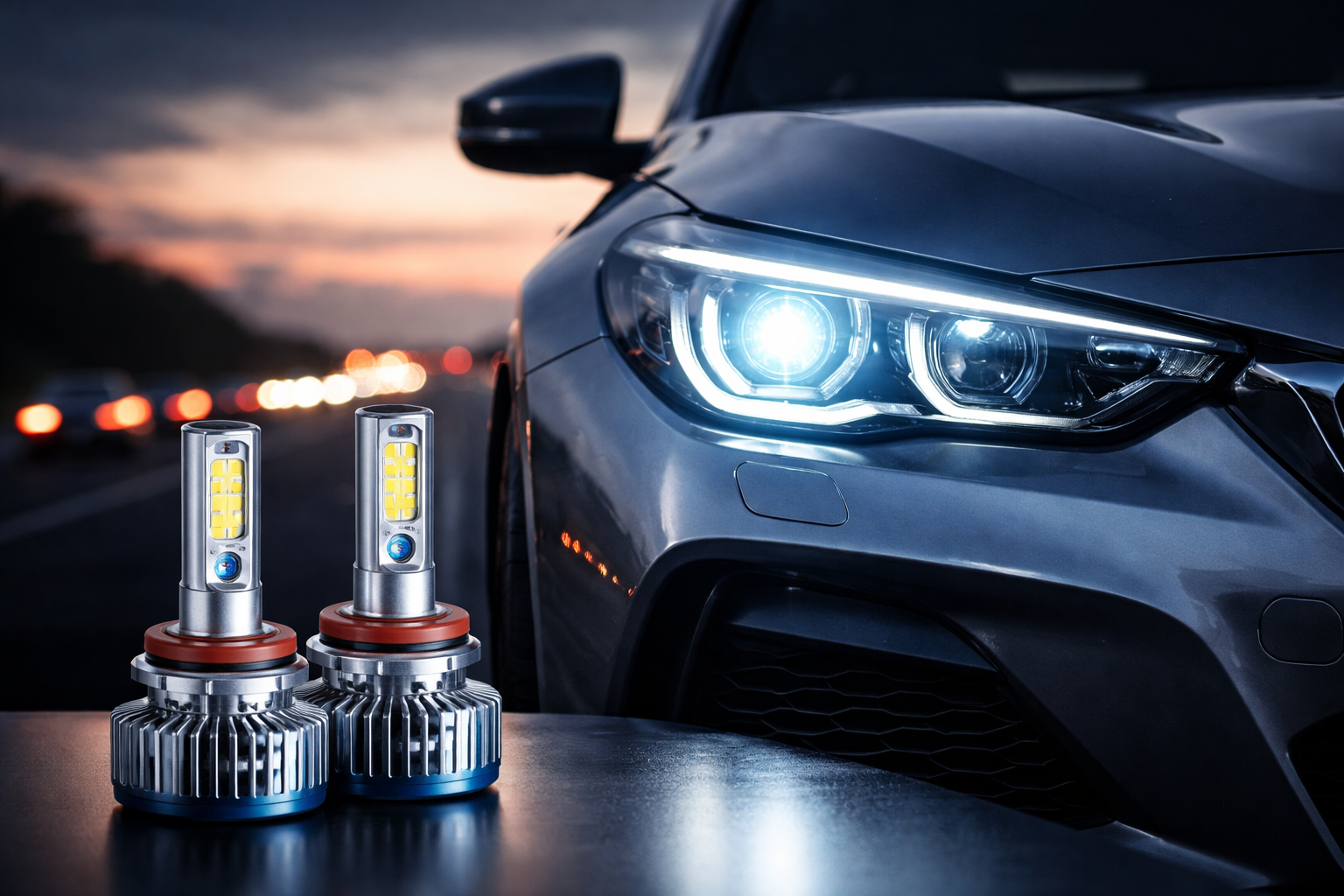
Determining if LED lights safe for cars extends beyond the bulbs themselves to include how they interact with existing headlight housings. Halogen reflector assemblies position the filament precisely at the focal point of carefully designed reflectors that control light distribution. LED chips occupying different physical positions create scattered beam patterns that blind oncoming drivers while providing inadequate forward illumination.
Quality LED replacements engineer chip placement to match original filament locations, maintaining proper beam geometry that complies with photometric requirements. However, even perfectly positioned LEDs may produce suboptimal results in reflector housings optimized for the omnidirectional output of incandescent sources versus the directional emission characteristics of LED technology.
Projector-style headlight assemblies generally accommodate LED retrofits more successfully than reflector designs because the projector lens reshapes light regardless of source characteristics. Vehicle owners with reflector headlights should consider complete housing upgrades to LED-specific assemblies rather than simple bulb replacement if maximum safety and legal compliance matter, though this significantly increases conversion costs beyond basic car LED installation expenses.
Installation Risks
Physical installation of LED bulbs presents several safety considerations affecting whether LED lights safe for cars in specific applications. Many LED assemblies include large heat sinks or cooling fans that may not fit within tight headlight housing spaces, forcing improper seating that leaves bulbs loose, prevents dust cover installation, or causes contact with moving components including steering linkages and suspension parts.
Electrical connections require careful attention during car LED installation to prevent short circuits, corrosion, and intermittent contact that creates flickering or complete failure. Some LED bulbs include external driver modules requiring mounting locations that protect them from water, heat, and physical damage while maintaining proper wire routing that avoids pinch points and moving parts.
Improper installation compromises automotive LED safety through multiple failure modes including water intrusion that corrodes electrical connections, inadequate heat dissipation causing premature failure, mechanical interference that damages steering or suspension components, and electrical shorts that drain batteries or trigger vehicle fires in extreme cases involving poorly designed products combined with installation errors.
Quality Certifications
Verifying whether LED lights safe for cars requires examining certification markings that indicate compliance with established standards. DOT approval in the United States, ECE certification in Europe, and SAE compliance markings all signal that products underwent independent testing verifying their safety, performance, and regulatory conformance rather than relying solely on manufacturer claims.
LED bulb regulations require specific testing protocols including photometric measurements across multiple test points, beam pattern analysis, color temperature verification, vibration resistance, thermal cycling between extreme temperatures, and electromagnetic compatibility screening. Products displaying certification marks without actually completing these tests commit fraud that exposes buyers to safety risks and potential legal liability.
Counterfeit certification markings proliferate in the automotive LED market, particularly among ultra-low-cost imports sold through online marketplaces. Legitimate manufacturers provide detailed specification sheets, test reports, and warranty coverage backed by established companies with verifiable business addresses. Absence of this documentation suggests products may lack genuine certification regardless of markings stamped on packaging or bulb assemblies.
Comparison with Halogen Bulbs
Comparing automotive LED safety against traditional halogen technology reveals several important distinctions. Halogen bulbs operate at extremely high temperatures exceeding 400 degrees Fahrenheit, creating fire risks if they contact flammable materials and causing severe burns during bulb replacement. LED alternatives remain relatively cool to touch, eliminating these thermal hazards while reducing risks of housing damage from sustained high temperatures.
Halogen bulbs contain pressurized inert gas that can cause the bulb to explode if the glass envelope gets scratched or contaminated with skin oils during handling. This explosion risk, while relatively uncommon, poses injury potential from glass shards. LED bulbs contain no pressurized components or fragile glass envelopes, making them inherently safer during installation, operation, and eventual disposal.
The instant-on characteristic of LEDs provides safety advantages over halogens that require brief warm-up periods to reach full brightness. This proves particularly important for brake lights and turn signals where immediate full-intensity illumination alerts following drivers more quickly. Research indicates this can reduce rear-end collision rates by providing additional milliseconds of reaction time during emergency braking situations.
Longevity and Reliability
Long-term reliability factors into whether LED lights safe for cars beyond initial installation safety. Quality LED bulbs typically last 25,000 to 50,000 hours compared to 500 to 1,000 hours for halogen alternatives, dramatically reducing the frequency of bulb changes that require tools, time, and sometimes professional service for vehicles with difficult-to-access headlight assemblies.
This extended lifespan enhances automotive LED safety by reducing the likelihood of bulb failure during critical driving situations. Sudden headlight failure on dark rural highways or during adverse weather creates dangerous scenarios that LED technology largely eliminates through superior durability. However, this assumes proper installation with adequate thermal management and certified products rather than bargain alternatives prone to premature failure.
LED degradation patterns differ from halogen burnout characteristics. Halogens typically fail suddenly with complete loss of illumination, while LEDs gradually dim over thousands of hours before eventual failure. This gradual decline allows drivers to schedule replacement proactively rather than experiencing unexpected total darkness, though very slow degradation may go unnoticed until output drops significantly below safe levels. For a more permanent upgrade, many users switch to LED fog light bulbs for improved low-visibility driving, which is known for stable long-term performance.
Legal Considerations
Legal aspects of car LED installation significantly impact whether LED lights safe for cars in jurisdictions with strict enforcement of lighting regulations. Many regions prohibit aftermarket LED conversions in headlight applications unless the complete assembly receives certification rather than just the replacement bulb, reasoning that housing-bulb combinations determine actual road performance beyond individual component specifications.
Vehicle inspections in numerous states include headlight aim verification and beam pattern assessment that reject vehicles with improper conversions regardless of bulb quality. Failed inspections prevent vehicle registration, requiring expensive restoration to original specifications or complete housing replacement with certified LED assemblies. These legal requirements exist because improperly executed LED bulb regulations compliance attempts create public safety hazards through excessive glare.
Liability concerns extend beyond traffic citations to include civil liability if your modified lighting contributes to accidents. Insurance companies may deny claims or pursue subrogation if investigations reveal that non-compliant lighting modifications played any role in collision causation, potentially exposing vehicle owners to significant financial damages beyond the minor cost savings from choosing uncertified products over legitimate alternatives.
Choosing Safe Products
Selecting products that ensure LED lights safe for cars requires evaluating specifications beyond marketing claims and low prices. Reputable manufacturers publish detailed technical specifications including actual lumen output with testing methodology, beam pattern photographs, thermal management details, electromagnetic compatibility certification, and warranty terms backed by established companies rather than anonymous offshore sellers.
Brand reputation matters significantly in the automotive LED market where quality varies enormously between premium manufacturers and budget alternatives. Established lighting companies like Philips, Osram, and PIAA invest heavily in research, testing, and certification compliance, while unknown brands often prioritize cost reduction over performance and safety. The price premium for reputable products typically represents genuine value through superior reliability and legal compliance.
Customer reviews provide valuable insights when evaluating automotive LED safety, particularly reviews from owners of your specific vehicle model. Compatibility issues vary between vehicles, so products performing excellently in one application may prove inadequate in another due to housing design differences, electrical system variations, or physical fitment constraints that product specifications fail to address comprehensively.
Professional Installation Benefits
Professional installation addresses many concerns about whether LED lights safe for cars through expert assessment of compatibility, proper execution of car LED installation procedures, and verification of beam patterns and electrical function. Experienced technicians identify potential problems including inadequate heat sink clearance, electrical system incompatibility, and beam pattern deficiencies before they cause safety issues or legal complications.
Many reputable shops refuse to install uncertified LED conversion products specifically because of liability concerns and professional standards requiring compliant installations. This refusal, while potentially frustrating for consumers seeking budget options, actually protects vehicle owners from products likely to fail inspections, cause accidents through improper beam patterns, or create electrical problems affecting vehicle reliability and safety systems.
Professional installation typically includes headlight aiming services using proper equipment to verify that beam patterns comply with regulatory requirements after LED conversion. This service prevents glare problems that endanger other drivers while ensuring your upgraded lighting delivers maximum visibility benefits, making professional installation worthwhile despite additional cost compared to DIY approaches using online tutorials and basic hand tools.
Sharing this Guide
If you found this guide helpful, you can save it for later or share it with a friend. It’s especially useful for beginners, homeowners, and DIY users.
Share using the links below
Interested in learning more? Browse all related articles in our category section.
Pingback: LED Car Lights Legal? Complete 2026 Country Guide
Pingback: Colored LED Lights on Cars: Essential Legal Guide
Pingback: Are LED Underglow Lights Legal? Essential Guide - NeoLEDHub