CANBUS in Car LED Lighting: Essential Smart Guide
Understanding CANBUS in car LED lighting has become essential for vehicle owners considering lighting upgrades. Modern automotive electrical systems use sophisticated computer networks that communicate constantly, and installing CANBUS error-free LED bulbs prevents dashboard warnings and functionality issues that plague standard aftermarket replacements.
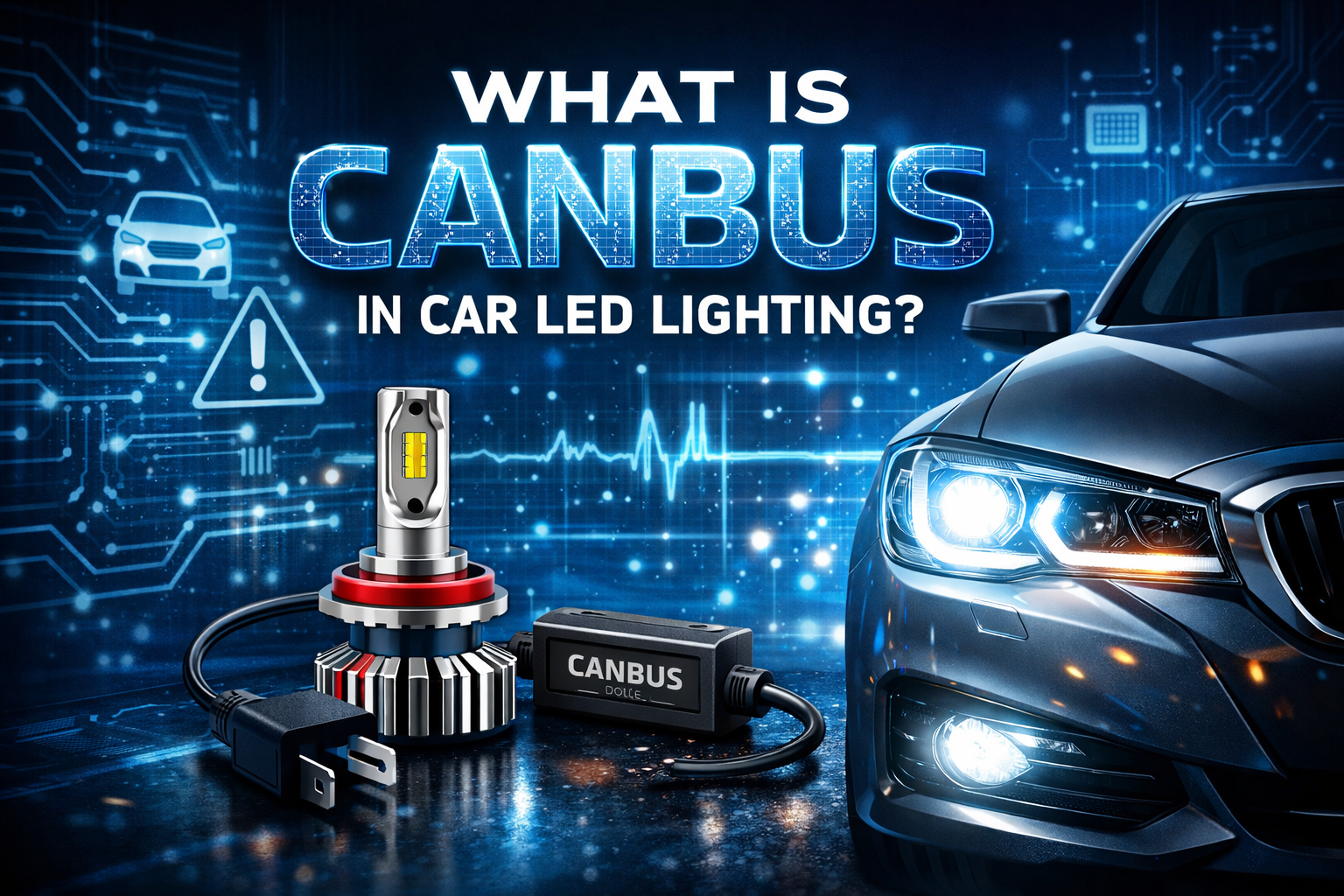
Table of Contents
Understanding the Basics
The Controller Area Network Bus, commonly abbreviated as CANBUS, represents a robust communication protocol developed originally by Bosch in the 1980s for automotive applications. This technology allows microcontrollers and devices throughout a vehicle to communicate without a central computer, creating a distributed control system that monitors virtually every electrical component.
Every vehicle CANBUS system operates by sending messages across two twisted wires connecting dozens of electronic control units. These units constantly broadcast status information, sensor readings, and commands. The lighting circuits integrate into this network, allowing computers to detect when bulbs fail by monitoring current draw and resistance values.
Traditional incandescent and halogen bulbs draw predictable amounts of current based on their wattage ratings. A standard headlight bulb consuming fifty-five watts creates a specific electrical signature that the vehicle CANBUS system expects to see. When this signature disappears or changes significantly, dashboard warning lights illuminate to alert drivers of potential bulb failures. If you want a dependable option, a solid example is a plug-in CANBUS decoder that eliminates LED flicker errors, which performs reliably in everyday use.
How It Works
The monitoring function within CANBUS in car LED lighting environments creates complications because LED technology operates fundamentally differently than conventional bulbs. Light-emitting diodes achieve equivalent brightness while consuming only twenty to thirty percent of the power required by halogen alternatives.
When drivers install standard LED replacements, the dramatic reduction in current draw triggers fault detection algorithms. The vehicle CANBUS system interprets low amperage as a burned-out bulb or disconnected circuit, generating LED bulb error messages on the instrument cluster. Some vehicles respond by disabling affected circuits entirely or activating limp-home modes that limit functionality.
Monitoring Mechanisms
Different manufacturers implement bulb monitoring through various methods. Some systems measure voltage drop across the lighting circuit, while others monitor current flow directly. Advanced implementations use pulse-width modulation to dim lights and monitor response characteristics. Each approach attempts to verify proper bulb operation and circuit integrity.
European vehicles, particularly German brands like BMW, Mercedes-Benz, Audi, and Volkswagen, employ especially sophisticated monitoring. These manufacturers integrated comprehensive CANBUS networks earlier than most competitors, and their systems prove particularly sensitive to electrical changes. Understanding CANBUS in car LED lighting becomes critical for owners of these vehicles attempting aftermarket upgrades.
Communication Protocols
The actual communication happens at speeds ranging from 125 kilobits per second for comfort systems to 1 megabit per second for critical powertrain functions. Lighting circuits typically operate on medium-speed networks handling body control functions. Messages follow standardized formats identifying the sender, intended recipient, and data payload.
When a light switch activates, the body control module sends a command across the vehicle CANBUS system to energize the appropriate circuit. Simultaneously, monitoring begins to verify correct operation. This continuous feedback loop ensures that any anomaly triggers immediate notification, enhancing safety by alerting drivers to lighting failures that might otherwise go unnoticed.
Compatibility Challenges
The primary obstacle when installing LED replacements stems from resistance mismatch. CANBUS error-free LED bulbs address this by incorporating additional circuitry that presents the expected electrical load to monitoring systems while operating the actual LED elements efficiently. converting traditional bulbs to modern technology requires understanding these compatibility requirements.
Not all vehicles require specialized solutions. Older cars manufactured before widespread adoption of sophisticated electronics accept standard LED replacements without complaint. Generally speaking, vehicles built after 2008 increasingly incorporated advanced monitoring, though exact implementation varies by manufacturer and market segment.
Manufacturer Variations
Japanese manufacturers like Toyota, Honda, and Nissan adopted comprehensive CANBUS networks somewhat later than European competitors. Their systems often prove more tolerant of LED conversions, particularly in base model trims lacking premium features. However, luxury divisions like Lexus, Acura, and Infiniti implement monitoring comparable to European standards.
American manufacturers fall somewhere between these extremes. Ford, General Motors, and Stellantis brands increasingly employ sophisticated electronics, especially in trucks and premium models. Entry-level vehicles from these manufacturers sometimes use simpler electrical architectures that accept LED replacements more readily. Researching specific model years proves essential before purchasing components. Another practical alternative is a handheld OBD2 scanner for reading live fault codes, which offers consistent results over time.
Position Specific Requirements
Understanding CANBUS in car LED lighting reveals that different bulb positions face varying levels of scrutiny. Headlights and taillights typically receive the most comprehensive monitoring because their failure significantly impacts safety. Turn signals often use flash rate monitoring, where incorrect resistance causes hyper-flashing or complete failure to blink.
Error Solutions
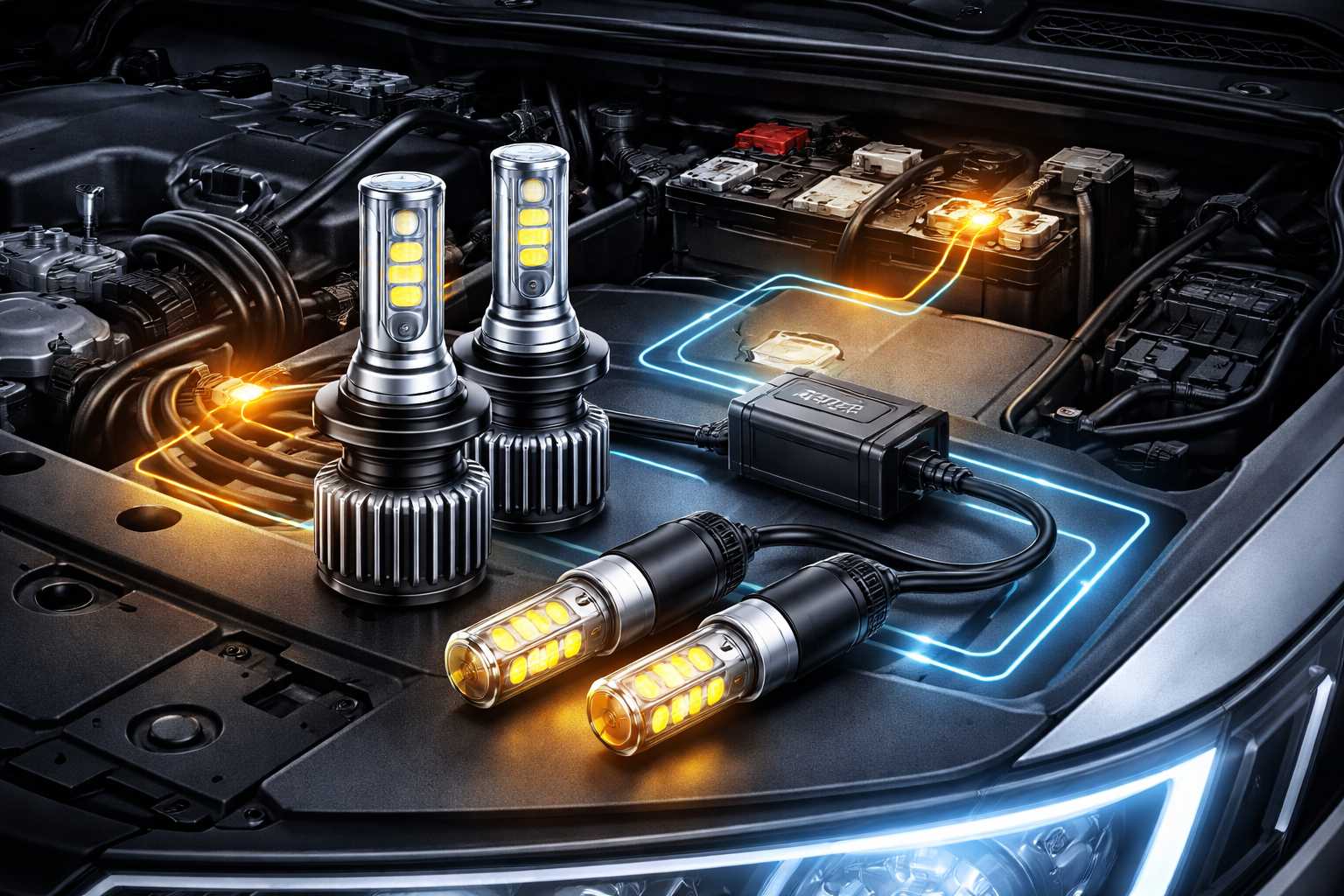
Several approaches exist to prevent LED bulb error messages when upgrading vehicle lighting. The most straightforward involves purchasing CANBUS error-free LED bulbs specifically engineered with built-in compensation circuitry. These products cost more than basic LED replacements but eliminate compatibility headaches through integrated solutions.
Built-in resistors or capacitors within these specialized bulbs simulate the electrical characteristics of original equipment. Quality implementations maintain the power efficiency benefits of LED technology while presenting appropriate load signatures to monitoring systems. The additional components add minimal bulk compared to external solutions.
External Load Resistors
Another approach uses external load resistors wired in parallel with LED bulbs. These resistors dissipate excess energy as heat to replicate the power consumption of halogen bulbs. While effective at preventing error codes, this method sacrifices the efficiency advantages that motivate LED conversion in the first place.
Installation of external resistors requires secure mounting away from heat-sensitive components and proper heat dissipation. Inadequate mounting can cause resistors to overheat, potentially melting nearby plastics or wiring insulation. This solution works but represents a compromise that negates some LED benefits while adding installation complexity.
Decoder Modules
Advanced decoder modules offer the most sophisticated solution for managing CANBUS in car LED lighting applications. These devices connect between the vehicle wiring harness and LED bulbs, actively managing the electrical interface. Smart decoders monitor vehicle signals and adjust output to satisfy monitoring requirements without wasting energy through resistive loads.
Premium decoder modules from reputable manufacturers cost significantly more than basic resistors but deliver superior results. They preserve LED efficiency while providing reliable error elimination across various vehicle platforms. Some advanced units even include thermal management for the LED bulbs themselves, extending operational lifespan.
Choosing Products
Selecting appropriate CANBUS error-free LED bulbs requires evaluating several factors beyond simple socket compatibility. Manufacturer reputation proves critical because quality varies enormously in the LED automotive aftermarket. Established brands invest in proper engineering and testing to ensure their products function correctly across vehicle platforms.
Reading customer reviews specific to your vehicle make and model provides valuable insight into real-world compatibility. Generic product descriptions claiming universal fitment often disappoint when actual installation reveals incompatibility. Vehicle-specific feedback from other owners indicates which products successfully address LED bulb error messages in your particular application.
Technical Specifications
Examining technical specifications helps identify quality products. Look for detailed power consumption figures, color temperature ratings, and lumen output measurements. Vague specifications or missing data suggest inferior products from manufacturers unwilling to commit to performance standards. Reputable suppliers provide comprehensive technical information supporting their claims.
Warranty coverage indicates manufacturer confidence in their products. Premium CANBUS error-free LED bulbs typically include warranties ranging from two to five years, reflecting expected longevity and reliability. Short warranty periods or their complete absence signal potential quality concerns worth considering before purchase.
Installation Considerations
Installing products designed for CANBUS in car LED lighting applications follows similar procedures to standard bulb replacement with some additional considerations. Proper polarity matters for LED components, though most automotive LEDs include built-in circuitry allowing operation regardless of connection orientation.
Physical fitment deserves careful attention because error-free solutions sometimes incorporate larger driver modules or heat sinks. Measure available space within headlight housings before purchasing to avoid clearance issues. Some compact vehicles or motorcycles lack sufficient room for bulkier LED assemblies even when electrical compatibility exists. For a more permanent upgrade, many users switch to a wired load resistor kit for turn signal correction, which reduces the risk of installation failure.
Testing Procedures
After installation, comprehensive testing verifies proper operation and confirms elimination of LED bulb error messages. Cycle all lighting functions including low beams, high beams, turn signals, and brake lights. Monitor the dashboard for warning indicators during testing. Some error codes appear immediately while others require driving cycles or key cycling to manifest.
Allow the vehicle CANBUS system time to adapt to the new components. Certain vehicles perform self-diagnostics during startup sequences, and clearing existing fault codes may require professional scan tools. comparing different lighting technologies helps understand why proper testing matters for long-term reliability and satisfaction.
Troubleshooting Tips
When LED bulb error messages persist despite using supposedly compatible products, systematic troubleshooting identifies the root cause. Begin by verifying the vehicle CANBUS system itself functions correctly. Pre-existing electrical issues unrelated to LED installation can trigger warnings that coincidentally appear after upgrades.
Check all electrical connections for corrosion, looseness, or damage. Poor connections cause intermittent operation that vehicle monitoring systems interpret as bulb failures. Clean connector terminals with electronic contact cleaner and ensure positive engagement when reassembling.
Compatibility Verification
Confirm the purchased products actually include CANBUS compensation circuitry. Some sellers misrepresent standard LED bulbs as error-free variants. Examine the packaging and product documentation for explicit compatibility claims and technical details about built-in decoders or load resistors.
Try installing the LED bulbs in different positions to isolate whether errors stem from specific circuits or affect all locations. Position-specific problems suggest issues with particular monitoring circuits rather than bulb incompatibility. Understanding CANBUS in car LED lighting helps diagnose whether problems originate from the bulbs themselves or vehicle electrical systems.
Professional Assistance
Complex electrical issues may require professional diagnosis using factory scan tools capable of interrogating the vehicle CANBUS system directly. Dealership technicians or qualified independent shops possess equipment to read detailed fault codes, monitor live data streams, and perform guided diagnostics unavailable to typical DIY enthusiasts.
Professional assistance becomes especially valuable for premium European vehicles with proprietary systems. According to information from the Society of Automotive Engineers, these vehicles often require manufacturer-specific procedures to clear adaptation values or reset control modules after lighting modifications.
Cost Factors
Pricing for CANBUS error-free LED bulbs ranges considerably based on quality, features, and manufacturer reputation. Entry-level products start around thirty-five to fifty dollars per pair, while premium offerings from established lighting manufacturers can exceed two hundred dollars. This price differential reflects engineering investment, component quality, and warranty support.
External decoder modules or load resistor kits add to overall conversion costs when required. Budget fifteen to forty dollars per circuit for basic resistor solutions, or fifty to one hundred dollars for sophisticated active decoder modules. Complete vehicle conversions addressing all exterior lighting positions can total three hundred to six hundred dollars depending on approach and product selection.
Value Assessment
Evaluating whether CANBUS in car LED lighting upgrades justify their cost requires considering multiple factors. Improved visibility and safety benefits prove difficult to quantify financially but significantly impact real-world driving experience. Enhanced illumination aids hazard detection and reduces eye strain during night driving.
Long-term reliability and reduced replacement frequency offset higher initial investment over vehicle ownership periods. Quality LED implementations lasting thirty thousand hours or more potentially eliminate bulb replacements entirely compared to halogen bulbs requiring changes every one to two years under typical use patterns.
Sharing this guide
If you found this guide helpful, you can save it for later or share it with a friend. It’s especially useful for beginners, homeowners, and DIY users.
Share using the links below
Interested in learning more? Browse all related articles in our category section.
Pingback: Car LED Headlight Brightness: Essential Safety Guide
Pingback: LED Lights Safe for Cars: Complete Safety Analysis