Smart Home Lighting: Pros and Cons — Is It Worth It?
Smart home lighting changes how you control lighting in everyday spaces. It adds app control, automation, voice commands, and more flexible scheduling. While it can make a home feel more convenient, efficient, and personalized, it also introduces extra costs, setup decisions, and long-term platform considerations.
This guide breaks down the real pros and cons of smart home lighting, helping you decide if connected bulbs, switches, and fixtures are right for your home, budget, and daily routine.
Quick Answer
Smart home lighting is worth considering if you want easier control, automation, and greater flexibility. However, it is not always the best fit for every home.
- It adds remote control, scheduling, scenes, and voice integration.
- When used with LEDs, timers, and sensors, it can reduce wasted energy.
- However, it usually costs more upfront than standard lighting.
- Some systems depend on apps, hubs, or stable internet connections.
- Compatibility, privacy, and long-term support are more important than many buyers expect.
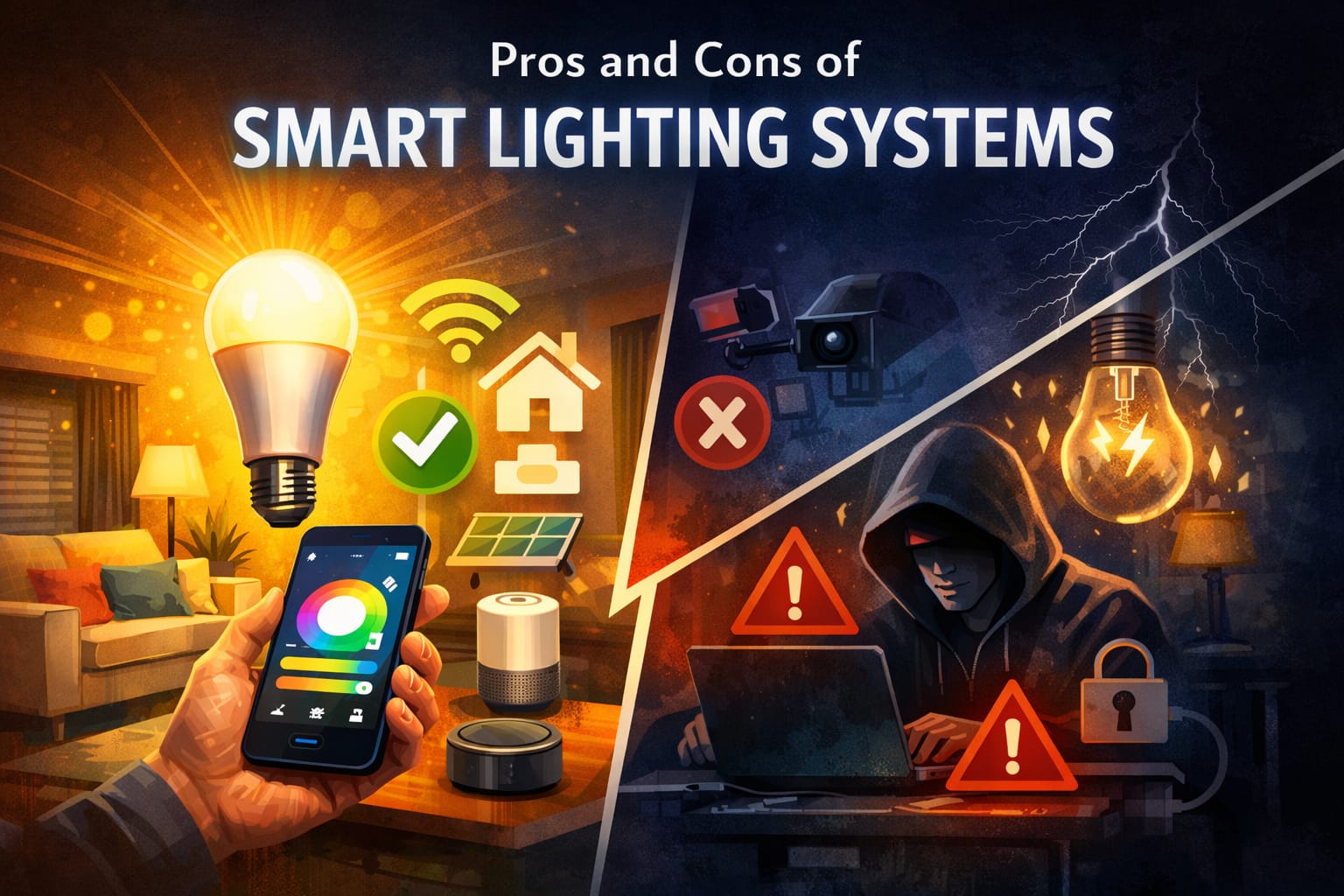
Table of Contents:
What Is Smart Home Lighting?
Smart home lighting transforms standard lighting into a connected system that can be controlled via apps, voice assistants, schedules, sensors, or automation routines. Rather than relying solely on a wall switch, you can adjust brightness, color temperature, timing, and grouped scenes using a phone, tablet, smart speaker, or hub.
In practical terms, smart lighting makes light more responsive to your routine. Bulbs, switches, strips, and fixtures can react to motion, follow sunrise and sunset, dim automatically at night, or work as part of a larger smart home setup. The real advantage is not just remote control but also the ability to make lighting behave in a useful and personalized way throughout the day.
How It Works
Most systems use Wi-Fi, Bluetooth, Zigbee, Z-Wave, or Matter to connect light bulbs, switches, sensors, and controllers. Some products connect directly to your home network, while others require a hub to coordinate multiple devices. For a broader overview of how these pieces fit together, check out our complete smart lighting systems guide.
This category includes smart bulbs, LED strips, recessed lighting, lamps, switches, plugs, and fully integrated fixtures. Once connected, these devices can respond to schedules, occupancy triggers, voice commands, or app-based controls from almost anywhere.
What You’re Really Buying
You’re not just buying light output. You are also buying a control system and a software experience. Often, you are also buying an ecosystem with its own rules, compatibility limits, and update cycle. This is why smart home lighting can feel either impressively useful or unnecessarily complicated, depending on your setup.
While the hardware matters, the long-term experience depends just as much on the app, the reliability of the connection, and how well the product works with other devices in your home. A good smart lighting system should be simple to use once set up. However, achieving that simplicity usually depends on choosing products that match your home, habits, and desired level of control.
Main Benefits
The biggest appeal of smart home lighting is the increased control it gives you over how, when, and where light is used. When planned well, this added control can improve comfort, convenience, and energy efficiency.
It can also make lighting more adaptable to real-life situations. For example, you can brighten task areas, soften a room in the evening, automate lights for security purposes, or create scenes that match different activities — all without changing the physical setup. When used properly, smart lighting adds more than just features. It makes everyday lighting more flexible and easier to manage, aligning it better with how a space is actually used.
Remote Control from Anywhere
One of the clearest advantages is remote access. If you leave home and forget to turn off the kitchen lights, for example, you can usually fix it from your phone. This feature is also useful for travel, second homes, or simply to check if the lights are on when you are away.
This flexibility also improves daily comfort. You can dim a room without getting up, control multiple lights at once, or make quick adjustments from the comfort of your bed, sofa, or another floor of the house. A dependable starting point is a smart LED A19 bulb with tunable white light and color control, a common choice for indoor use.
More Personalization
Smart lighting makes it easier to customize a room for any occasion. You can adjust the brightness, shift between warm and cool tones, and use colored lighting to highlight entertainment areas. Compared with a standard on-off switch, the difference in flexibility is significant.
This level of control is practical as well as aesthetic. For example, brighter, cooler lighting may be better for cooking or cleaning, while warmer, lower-output light is often more relaxing in the evening.
Convenience and Automation
Smart home lighting is often most compelling in terms of convenience. Automating simple tasks can remove a surprising amount of friction from everyday life.
For example, lights can turn on when you enter a room, dim gradually at night, switch off when no one is around, or follow routines that match your work, sleep, or travel schedules. These small changes can make a home feel more responsive and reduce the need for constant manual adjustments. The best automation is unobtrusive. It simply makes lighting work in the background with less effort from you.
Schedules and Routines
You can program lights to turn on gradually in the morning, switch off automatically at bedtime, or follow sunset and sunrise schedules. Outdoor lights can be set to turn on in the evening without anyone flipping a switch. Indoor lights can also follow patterns that make a home appear occupied while you’re away.
Motion sensors and occupancy routines can make hallways, closets, bathrooms, and entryways feel much more responsive. When used well, these features save time and reduce unnecessary energy use.
If you are new to smart home lighting, start with one room and a few simple routines. A smaller setup is easier to troubleshoot and helps you determine which features you will actually use.
Voice Control and Scenes
Voice assistants such as Alexa, Google Assistant, and Siri let you control the lights hands-free. This is useful when you’re cooking, carrying bags, helping children, or when you simply don’t want to walk across the room to reach a switch.
Scenes make things easier by grouping multiple settings into one command. For example, a movie scene might dim the ceiling lights while leaving accent lighting on, and a reading scene could brighten one area without flooding the whole room. If you are comparing connection methods, our guide to Wi-Fi versus Bluetooth implementations explains some of the key trade-offs.
Costs and Savings
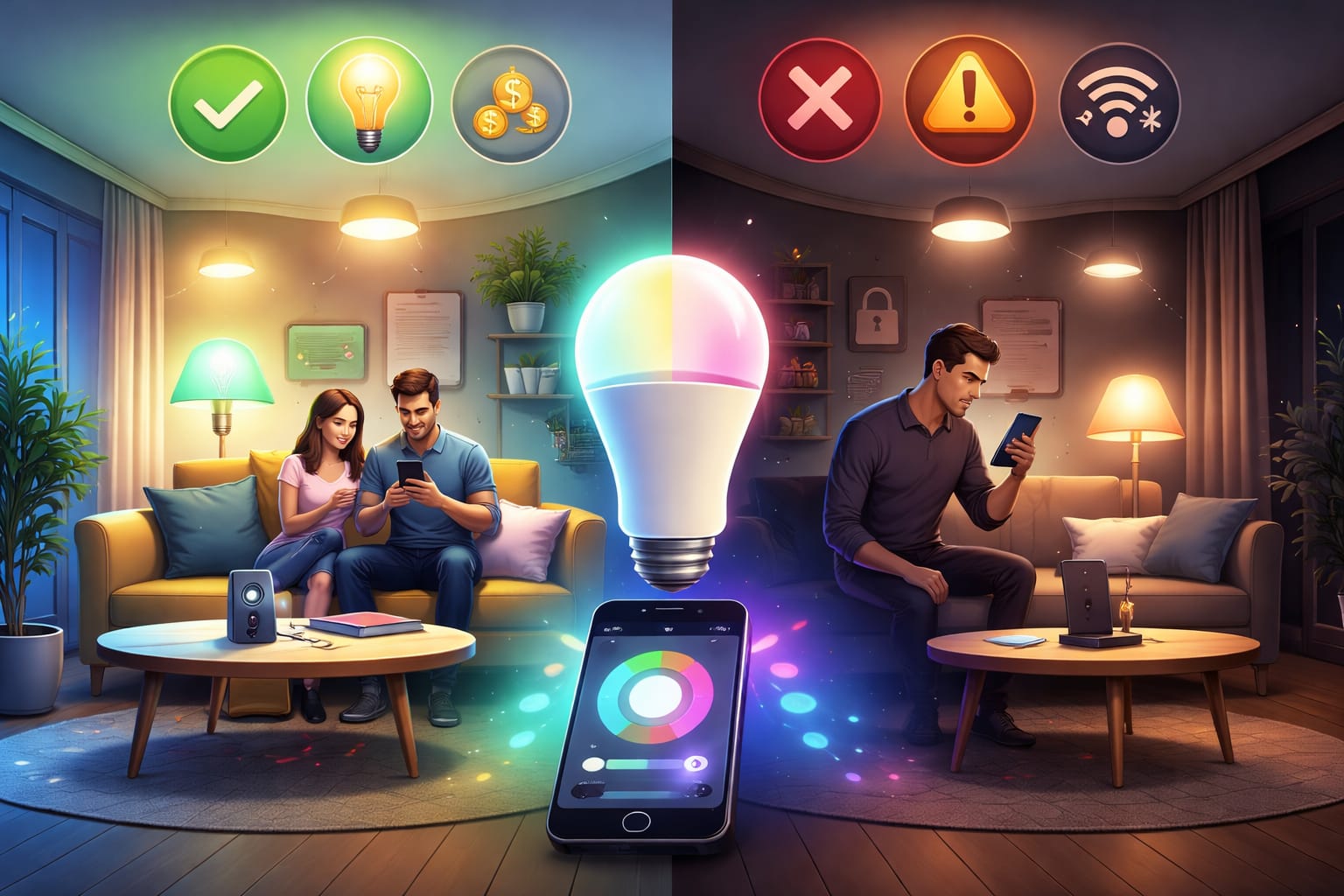
Cost is one of the biggest reasons people hesitate. While smart home lighting can save energy, it also requires a higher upfront investment than standard bulbs and switches. Smart bulbs, hubs, sensors, and smart switches usually cost more individually, and the total rises quickly if you want to upgrade several rooms instead of just one fixture.
That higher initial cost does not automatically mean poor value, but it does change how the upgrade should be judged. In most cases, smart lighting makes the most sense when you are paying not only for lower energy use, but also for better control, scheduling, scenes, convenience, and automation that you will actually use on a regular basis.
Savings are real, but they are usually indirect rather than dramatic. Efficient LED hardware, dimming, occupancy sensing, and routines that switch lights off automatically can reduce wasted electricity over time. However, the financial return depends heavily on how often lights are used, how many fixtures are involved, and whether the system helps prevent lights from being left on unnecessarily.
For that reason, smart home lighting is often better viewed as a practical lifestyle upgrade with some efficiency benefits, rather than as a purchase justified by energy savings alone. Buyers usually get the best value when they start with the areas they use most and focus on features that solve a real everyday problem.
Upfront Costs
Smart bulbs usually cost far more than basic LED bulbs, and the cost adds up quickly for a whole-home setup. If you also need hubs, sensors, smart switches, or compatible accessories, the total cost can increase rapidly. For some homes, especially larger ones, a full upgrade can cost hundreds or even thousands of dollars.
However, the upgrade does not have to happen all at once. Many people start with the rooms they use most and expand later. The downside is that a piecemeal setup may delay some of the benefits of a full system that make smart lighting attractive in the first place.
Long-Term Savings
Most smart lighting products use LED technology, which is highly efficient compared to incandescent and halogen lighting. With scheduling, dimming, and sensor-based control, you can reduce wasted energy from lights being left on unnecessarily.
Total savings depend on how often your lights are used and how much electricity costs, but the efficiency benefits are real. The U.S. Department of Energy also acknowledges the value of LED lighting in reducing residential energy use. However, savings alone do not always justify the upgrade unless you also value automation and convenience.
Technology Barriers
The features that make smart home lighting useful can also make it frustrating. Apps, firmware, wireless signals, and device settings create potential points of failure that standard lighting does not have.
A system may be more difficult to enjoy if pairing is unreliable, the app is confusing, or the lights depend too heavily on internet access or cloud services. Even with good hardware, a weak network or poorly designed app can make the experience inconsistent. One of the biggest trade-offs with smart lighting is that more capability often means more complexity, and not every home or user benefits equally from that extra layer.
Network dependence
Some systems rely heavily on cloud services and stable internet access for remote features and certain automations. If your network is unreliable or struggles with many connected devices, you may experience slower response times, pairing issues, or dropouts.
This does not make smart lighting a bad choice, but it does mean that your home network becomes part of the lighting experience. In some cases, a smart light switch with app and voice control may be a more stable option than replacing every bulb individually.
Learning Curve
Not every app is user-friendly, and not every household wants to deal with automation menus, device groups, or firmware updates. Some users enjoy tinkering with settings and building routines. Others just want the light to turn on instantly every time, without having to think about it.
Family members and guests may also find smart controls less intuitive than a traditional wall switch. The difference between a device’s capabilities and ease of use is one of the most common trade-offs with smart home lighting.
Compatibility and installation
Although compatibility problems are one of the least exciting aspects of shopping for smart lighting, they are very important. A system that looks great on paper can be frustrating if it doesn’t work well with the rest of your home.
Not every product works equally well with every app, voice assistant, hub, or wiring setup. Some switches require neutral wires, some bulbs are incompatible with older dimmers, and some brands offer limited features when mixed with other ecosystems. Installation can also vary from simple to more involved, depending on whether you choose bulbs, switches, sensors, or full fixtures. Checking these details before buying is one of the easiest ways to avoid wasting money and having setup problems later.
Brand and Protocol Compatibility
Different brands use different protocols, apps, and ecosystem rules. Some products work well together, while others require additional hardware or offer limited features when mixed. This is why buyers sometimes end up locked into one platform, even if they originally wanted more flexibility.
Although newer standards such as Matter aim to make cross-brand control easier, compatibility is still imperfect across product types. It’s worth doing your research before buying to avoid discovering limitations after investing in several devices.
Home Setup Limitations
Some homes are easier to upgrade than others. Older wiring, incompatible dimmers, enclosed fixtures, ceiling fans, and multi-way switch setups can render certain products ineffective. If your current LEDs flicker or behave unpredictably, our guide on why LED lights flicker and how to fix it may help you identify the cause.
Renters usually have an easier time with smart bulbs and plug-in products, while homeowners may achieve better long-term results with smart switches or more permanent fixtures. The right choice often depends as much on your home as on the product itself.
Smart switches are not always a simple swap. If you are unsure about neutral wires, multi-way circuits, or electrical safety, it is better to hire a qualified electrician than risk damaging the switch or circuit.
Privacy and Security
Privacy and security are easy to overlook when shopping, but they’re important factors in smart home lighting. Connected devices can collect usage data, and internet-connected systems always carry some level of security risk.
Some brands collect information about schedules, app activity, and device usage, which can reveal more about daily routines than many buyers expect. Security also depends on whether the manufacturer provides regular updates and whether users maintain strong passwords and current firmware. Although smart lighting is usually low-risk compared with more sensitive devices, it still becomes part of your connected home. Therefore, brand trust and long-term support matter.
Data Collection
Some manufacturers gather data about device use, schedules, and app activity. On its own, this may not seem serious, but combined, the data can reveal patterns about occupancy, daily routines, and household habits. Privacy policies also vary widely from one brand to another.
If privacy is important to you, check to see if a system relies heavily on cloud services or offers more local control. Our guide to local versus cloud processing architectures explains why this difference matters.
Account and Device Security
Poor passwords, outdated firmware, and abandoned products can create security vulnerabilities. While smart lighting itself is not usually a major threat, any connected device adds another entry point that requires proper maintenance.
A reputable brand that provides regular updates and clear support policies is usually safer than an inexpensive product with unclear long-term backing. In smart home lighting, support quality is almost as important as hardware quality.
Reliability and longevity
A standard light bulb is easy to replace. Smart home lighting is different because the light source is only one part of the product. The system’s usefulness depends on software, cloud services, chips, and manufacturer support.
Even if the LED lasts for years, the smart features may not. A product can become less reliable if the app deteriorates, the brand stops updating it, or the platform changes over time. This is why long-term value in smart lighting is not only about the rated lifespan. It’s also about whether the product remains stable, supported, and easy to use after the initial setup period.
Product Lifespan
While LED elements can last a long time, smart features may fail earlier than the light source itself. Electronics, wireless radios, power supplies, and app integration create more opportunities for a product to become obsolete before the LED wears out.
This is one reason many buyers prefer established brands. While a product with stronger quality control and better software support may cost more initially, it often provides a more stable long-term experience. To ensure a complete upgrade path, many people choose smart Wi-Fi bulbs that work with Alexa and Google Home, as broad compatibility makes replacements easier later on.
Vendor dependence
A smart lighting product can become less useful if the app is updated, the brand stops supporting it, or a cloud service is shut down. Dependence on the manufacturer is one of the clearest disadvantages of smart lighting compared with traditional lighting, which works without subscriptions, accounts, or updates.
Local control systems can mitigate some of that risk, but they may require more setup and planning. There is no perfect option; only different trade-offs between convenience, independence, and simplicity exist.
Environmental Impact
Although smart home lighting can promote lower energy usage, it introduces electronics that will eventually need to be replaced or recycled. While the overall environmental picture is positive, it is not completely one-sided.
On the positive side, most smart lighting uses efficient LED technology and reduces waste through dimming, scheduling, occupancy sensing, and better control. However, these products contain more components than standard bulbs and may need to be replaced sooner if software support ends or compatibility becomes an issue. A system’s environmental benefit is strongest when it is efficient and durable enough to remain useful for a long time.
Efficiency benefits
LED-based smart lighting uses less electricity than older bulb technologies, and automation can reduce waste even further. Dimming, occupancy sensing, and schedules make it easier to use only the light you need.
In homes where lights are often left on by accident, the savings can be more noticeable. Over time, reducing unnecessary use can lower electricity bills and the environmental impact tied to power generation.
Electronic Waste Concerns
Smart bulbs and fixtures contain more electronics than standard bulbs, which makes disposal more complex. Circuit boards, chips, and other components may require proper e-waste handling rather than normal household disposal.
Frequent replacement also undermines the sustainability argument. For example, if a product is discarded because the app is no longer supported or the platform becomes outdated, the lighting hardware may still have a useful life left. This makes product longevity, repairability, and brand support more important than they initially seem, especially for buyers who care about reducing waste over time.
The Future of Smart Home Lighting
This category is still evolving, and future improvements will likely focus on greater compatibility, more advanced automation, and easier setup. This is good news for those interested in smart lighting who have been hesitant due to current issues.
The most significant progress will likely stem from streamlining processes rather than introducing endless new features. Buyers want systems that are easier to install and understand and that rely less on trial and error. As platforms mature, smart lighting should become more practical for ordinary households, rather than seeming mainly suited to enthusiasts.
Smarter Automation
More systems are moving toward adaptive routines, improved presence detection, and lighting that responds naturally to the time of day and household patterns. Features linked to sleep support, circadian-friendly lighting, and cross-device automation will likely become more prevalent.
At the same time, better user interfaces will make these features easier to use and require less manual setup. The most valuable change will be automation that feels genuinely helpful instead of complicated. When lighting responds intelligently without constant adjustment, smart home lighting becomes a seamless part of daily life instead of a novelty.
Better Standards and Lower Friction
As standards improve and more brands support shared ecosystems, buyers should encounter fewer compatibility issues. Lower prices and a wider selection of products will also make smart home lighting easier to try without requiring a major financial commitment.
However, better standards will not erase all differences between brands. Build quality, software support, app design, and reliability will still distinguish superior products from inferior ones. However, the baseline experience should improve, meaning it will become easier to choose a system that works well without requiring as much technical research or brand loyalty.
What should you choose?
Smart home lighting is ideal if you want more control, use your lights frequently, or expect automation to improve your routine.
- Choose smart bulbs if you want easy installation and flexibility that is suitable for renters.
- Choose smart switches if you want wall-switch control and a cleaner everyday experience.
- Choose hub-based or local control systems if reliability and privacy matter more than simplicity.
- Start small if you are unsure, especially with one room or one lighting use case.
- Skip the upgrade for now if you mostly want basic on/off lighting and don’t need automation.
Key Takeaways
Smart home lighting offers real benefits, including remote control, automation, scenes, and more personalized lighting settings. It can make a home feel more efficient and easier to manage, especially when paired with LED technology and practical routines.
However, the trade-offs matter just as much: higher upfront costs, more setup decisions, possible compatibility issues, and dependence on apps, networks, or brand support. The best results usually come from choosing products that match your home, your level of comfort with technology, and the features that you will genuinely use.
For many households, smart home lighting is worthwhile when it solves a real problem rather than simply providing novelty. A small-scale, thoughtful start is often the easiest way to decide whether a larger upgrade makes sense later on.
Share this guide!
If you found this guide helpful, feel free to save it for later or share it with a friend. This guide is especially useful for beginners, homeowners, and DIY enthusiasts.
Share using the links below.
Interested in learning more? Browse all related articles in our category section.
Pingback: Smart Lighting Setup: Easy Step-by-Step Guide - NeoLEDHub
Pingback: Smart Hub for Lighting: Essential Guide & Benefits
Pingback: Lighting Design for Staircases: Complete Guide - NeoLEDHub
Pingback: Living Room LED Lights: Perfect Guide - NeoLEDHub
Pingback: Smart Lighting Setup: How to Get Started Step by Step
Pingback: Do You Need a Smart Hub for Lighting? What to Know First - NeoLEDHub