Best Dimmable LED Bulbs for Living Rooms: Warm & Cozy Picks
The best dimmable LED bulbs for living rooms are warm, comfortable, bright enough for the fixture, and easy to adjust at night. For most homes, start with 2700K to 3000K, 800 to 1,600 lumens for main fixtures, and CRI 90+ if you want colors, décor, and skin tones to look natural.
This guide helps you choose LED light bulbs for your living room without making the space too harsh, too dim, too cold, or difficult to control. It covers brightness, warm light, dimming, bulb shape, smart features, CRI, and how to choose the best option for different living room setups.
Quick Answer
Best overall choice: a warm-white, dimmable LED bulb in the 2700K to 3000K range, with enough brightness for the fixture and smooth dimming for evening use. In most living rooms, comfort matters more than maximum brightness.
- Choose 2700K to 3000K for a warm, relaxed atmosphere.
- Use 800 to 1,600 lumens for main fixtures, depending on room size and fixture type.
- Pick dimmable bulbs first if you use the living room for TV, reading, relaxing, or entertaining.
- Look for CRI 90+ if color quality, skin tones, artwork, plants, or décor matter.
- Use A19 bulbs for most lamps, BR30 or PAR-style bulbs for recessed cans, and smart bulbs if you want scenes or app control.
For exposed lamps and decorative fixtures, warm filament LED bulbs for living room lamps can create a softer, cozier look than plain white bulbs.
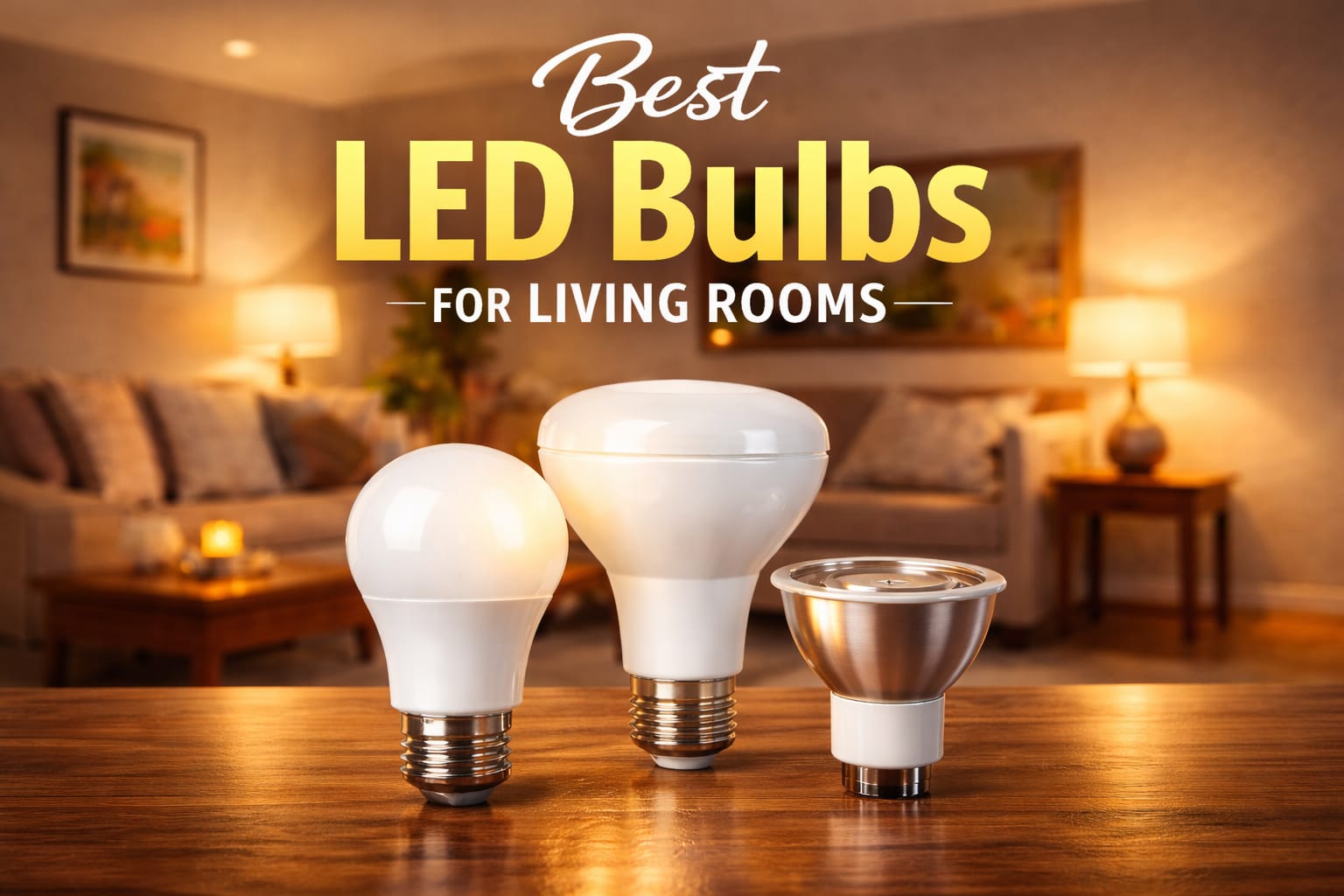
Table of Contents:
- Quick Answer
- What Matters Most in Living Room LED Bulbs
- How Bright Should Living Room LED Bulbs Be?
- Best Color Temperature for Living Rooms
- Are Dimmable LED Bulbs Worth It for Living Rooms?
- A19 vs BR30 vs PAR: Which Bulb Shape Fits Your Fixture?
- Smart vs Standard LED Bulbs for Living Rooms
- CRI, Comfort and Long-Term Value
- Common Mistakes to Avoid
- Which LED Bulb Should You Choose?
- FAQ
- Key Takeaways
- Sharing This Guide
What Matters Most in Living Room LED Bulbs
Living rooms are rarely used for just one purpose. The same space may need to feel relaxing in the evening, bright enough for reading, comfortable for conversation, and flattering enough to show off furniture, fabrics, artwork, plants, and skin tones. That is why the best LED bulbs for living rooms usually balance warmth, brightness, dimming, and fixture compatibility instead of focusing only on the highest lumen number.
A bulb that looks fine in a hallway may feel too harsh above a sofa. A bulb that looks cozy in a table lamp may not be bright enough for a ceiling fixture. Good living room LED lighting usually comes from a combination of overhead lights, table lamps, floor lamps, sconces, and accent lighting rather than one powerful bulb trying to do everything.
If you are unfamiliar with the basics, our guide to what LED bulbs are is a useful starting point. For this living room guide, the most important buying factors are brightness, color temperature, dimming performance, CRI, bulb shape, base size, and whether the bulb works safely with your fixture.
If you only change one thing, choose warm dimmable bulbs before chasing maximum brightness. In a living room, adjustability often improves comfort more than extra lumens.
How Bright Should Living Room LED Bulbs Be?
Brightness has a bigger impact on comfort than many people realize. Living rooms often feel unpleasant not because the bulbs are technically wrong, but because the light is too concentrated, uneven, or too strong for how the room is used at night. Bright LED bulbs can work well in a living room, but they need to match the fixture and be distributed across the room intelligently.
As a general rule, bulbs in the 800- to 1,600-lumen range work well for many main living room fixtures. Table lamps and floor lamps often work better at lower brightness levels because the light is closer to eye level. Start with around 20 lumens per square foot for general living room lighting, then adjust based on ceiling height, shade design, natural daylight, wall color, and how many light sources the room already has.
Small living rooms can often feel comfortable with several lower-output bulbs instead of one intense overhead fixture. Larger living rooms, especially spaces over 250 to 300 square feet, usually need multiple lighting zones: one for general light, one near seating, and possibly another for shelves, artwork, or background ambience.
Simple brightness guide:
- Table lamps: lower to moderate brightness, depending on shade and seating distance.
- Main ceiling fixtures: usually 800 to 1,600 lumens per bulb, depending on how many sockets the fixture has.
- Large living rooms: use several zones instead of one very bright central bulb.
- TV areas: avoid strong direct glare and use softer side or background lighting.
If a living room feels too bright, the problem is often distribution rather than total lumens. Several moderate light sources usually provide better comfort than one very bright overhead bulb.
Best Color Temperature for Living Rooms
Color temperature immediately shapes the mood of the room. For most living rooms, the safest range is 2700K to 3000K because it creates a soft, warm atmosphere without making the space feel too yellow, dull, or cold. This is the range most people should start with when choosing warm light bulbs for a living room.
If your living room doubles as a workspace, gets heavy daytime use, or has a very modern interior, 3000K to 3500K can feel cleaner and more practical while still avoiding the harshness of cool white light. Warmer bulbs usually work best in evening-focused rooms, traditional interiors, spaces with wood tones, and rooms with soft furnishings. Neutral whites often work better when the living room needs to be both practical and cozy.
If you want a deeper explanation of how different color temperature options affect mood and comfort, read our guide on how light color changes comfort and atmosphere. Bedrooms usually lean even warmer than living rooms, so our guide to LED bulbs for bedrooms is also a useful comparison if you are choosing bulbs for several rooms at once.
Best quick choice: choose 2700K if the living room is mostly used at night, 3000K if you want a warm but slightly cleaner look, and 3500K only if the room also works as a daytime activity or work area.
Are Dimmable LED Bulbs Worth It for Living Rooms?
Yes. If there is one feature worth prioritizing in a living room, it is dimming. A bulb that works beautifully at full brightness may still feel too strong during movies, late evenings, relaxed conversations, or quiet nights when you want the room to feel softer and calmer.
Dimmable LED bulbs make a living room more flexible because the same fixture can support different activities. You can use brighter light for reading or cleaning, medium light for guests, and low light for TV or evening relaxation. This is especially useful in shared spaces where one fixed brightness level rarely works all day.
High-quality dimmable LEDs should dim smoothly without flickering, buzzing, cutting out, or shifting to an unpleasant color. The catch is compatibility. Even if a bulb is advertised as dimmable, it may perform poorly with the wrong wall dimmer. If you run into problems, our guide on why LED bulbs do not dim properly explains the most common causes and solutions.
Do not assume that every dimmable bulb will work perfectly with your current switch. If you use a wall dimmer, check bulb and dimmer compatibility before buying several bulbs for the same room.
In rooms where lighting changes frequently throughout the day, smooth dimming often matters more than maximum brightness. This is one of the clearest differences between a bulb that merely works and one that actually improves the living room.
A19 vs BR30 vs PAR: Which Bulb Shape Fits Your Fixture?
Even the best bulb can be the wrong choice if it does not suit the fixture. Living rooms often use several fixture types, so bulb shape matters more here than in simpler rooms. A19 bulbs work well in many table lamps, floor lamps, and basic ceiling fixtures. Globe bulbs suit exposed decorative fixtures. BR30 and PAR-style bulbs are usually better for recessed cans because they direct light downward instead of wasting output sideways.
If your living room relies heavily on recessed lighting, check out our guide to the best LED bulbs for recessed lighting. It goes into more detail about beam spread, trim glare, and fit, which are especially important when the light comes from the ceiling.
If you are having comfort issues with a can-light setup, wider beam bulbs are often the solution. In that case, BR30 wide-beam LED bulbs for recessed living room lights can spread light more evenly and reduce the harsh spotlight effect that some living rooms end up with.
Match the bulb to the fixture:
- A19: most table lamps, floor lamps, and common fixtures.
- Globe: exposed decorative fixtures where the bulb is visible.
- BR30: recessed cans where wider, softer coverage is helpful.
- PAR: more directional light where you want a controlled beam.
- Filament: decorative lamps and fixtures where the bulb appearance matters.
Also check the base size and fixture rating before buying. The correct color temperature and brightness will not help if the bulb does not fit, overheats, flickers, or sits awkwardly in the fixture.
Smart vs Standard LED Bulbs for Living Rooms
Smart bulbs are not essential, but they make a lot of sense in living rooms because scenes, schedules, grouped control, and dimming presets are actually useful in this space. If you often switch between reading, watching TV, entertaining guests, and low evening lighting, app or voice control can be genuinely useful rather than just a gimmick.
Standard bulbs still win for simplicity, lower cost, and fewer setup worries. For many people, a good warm-white dimmable bulb is all they need. However, if you want automation, grouped dimming, or easy control without rewiring, smart LED bulbs for scenes and grouped dimming can be a practical upgrade, especially in spaces with several lamps or mixed fixtures.
The best choice depends on how much control you want. Standard bulbs are better if you prefer a simple wall switch and fixed lighting. Smart bulbs are better if you regularly change brightness, color tone, schedules, or room mood.
CRI, Comfort and Long-Term Value
CRI tells you how accurately a bulb reveals color. In living rooms, this matters more than many people expect because the room often contains artwork, photos, fabrics, wood finishes, plants, and skin tones at the same time. A bulb with poor color quality can make the whole room feel flatter, duller, or less inviting, even when the brightness looks technically fine.
For general living room use, CRI 80 is acceptable, but CRI 90 or higher usually looks better. This is especially true for warm light bulbs, where lower-quality products can sometimes look muddy or yellow. Better CRI often improves visual comfort because the room feels more natural and less tiring under the light.
Budget matters, but the cheapest bulb is rarely the best value for a living room. This is one of the rooms where poor dimming, weak color quality, harsh light, or buzzing becomes obvious quickly. Mid-range bulbs often offer the best balance of comfort, reliability, and light quality without forcing you into expensive smart home features unless you want them.
Energy savings also matter over time, especially in rooms with several bulbs that are used for long periods every day. If you want to examine the numbers more closely, our guide on LED energy savings explains how long-term costs compare with older lighting technologies.
If you want to understand how brightness, dimming, efficiency, and bulb specifications fit together before buying, the NeoLEDHub LED Knowledge Center is a good place to continue learning.
Common Mistakes to Avoid
The most common mistake is choosing bulbs that are too cool or too bright for evening use. A bulb may look impressive in a product listing but feel unpleasant once installed above a sofa or in a lamp beside the TV. Living room LED lighting should usually be chosen for comfort first and brightness second.
Another common error is ignoring fixture type. Recessed cans, exposed lamps, sconces, chandeliers, and decorative pendants all behave differently. Using the wrong beam spread or bulb shape can lead to glare, patchy light, or inadequate coverage, even if the bulb itself is high quality.
The last big mistake is treating the whole room as if one type of bulb can solve everything. Living rooms usually feel best when overhead fixtures, lamps, and accent lights each serve slightly different purposes. If you want to learn more about combining these layers, our guide on ambient, task, and accent lighting is worth reading.
Do not assume that every LED bulb is safe for enclosed fixtures. If a living room fixture is fully enclosed, check the bulb packaging or product specifications before installing it.
Which LED Bulb Should You Choose?
For most living rooms, the best choice is a warm or neutral white, dimmable LED bulb that is bright enough for the fixture and has good color quality. Beyond that, the right choice depends on how you use the space.
- For a cozy evening living room: choose 2700K warm white dimmable bulbs.
- For mixed daytime and evening use: choose 3000K to 3500K bulbs, especially in brighter or more modern rooms.
- For TV and relaxing: use dimmable bulbs and avoid strong direct glare from overhead fixtures.
- For reading: add a lamp near the seating area instead of making the entire room brighter.
- For recessed cans: choose BR30 or PAR-style bulbs that fit the fixture and beam angle.
- For exposed lamps: choose warm filament or globe-style bulbs if the bulb appearance matters.
- For app control and scenes: choose smart LED bulbs, especially if the room has several lamps.
- For color quality: choose CRI 90+ bulbs if décor, artwork, plants, or skin tones matter.
FAQ
What color LED bulb is best for a living room?
For most living rooms, 2700K to 3000K is the best color temperature. It feels warm, relaxed, and comfortable without making the room look too yellow or too cold.
Are dimmable LED bulbs better for living rooms?
Yes, dimmable LED bulbs are usually better for living rooms because the room is used in different ways throughout the day. Dimming lets you use brighter light for activity and softer light for TV, relaxing, or evening use.
How many lumens do I need for a living room?
Many living room main fixtures work well with bulbs in the 800- to 1,600-lumen range, but the right amount depends on room size, ceiling height, shade design, and how many lamps or fixtures are used together.
Are smart bulbs worth it in a living room?
Smart bulbs are worth it if you want scenes, schedules, app control, or grouped dimming across several lamps. If you only use one wall switch and rarely adjust the mood, standard dimmable LED bulbs are usually enough.
Key Takeaways
The best dimmable LED bulbs for living rooms are warm or neutral white, comfortable on the eyes, bright enough for the fixture, and easy to adjust for different times of day. For most homes, 2700K to 3000K, 800 to 1,600 lumens for main fixtures, and CRI 90+ are strong starting points.
A good living room setup usually comes from layered lighting rather than one harsh central source. Bulb shape, dimmer compatibility, CRI, fixture type, and beam spread all affect how comfortable the room feels.
For the safest recommendation, start with a quality warm-white dimmable LED bulb, then adjust based on room size, fixture type, and whether you need smart control, recessed lighting, or decorative filament bulbs.
Sharing This Guide
If this guide helped you choose the right bulbs for your living room, save it for later or share it with someone who is planning to upgrade their lighting.
Use the links below to share.
Interested in learning more? Browse all related articles in our LED bulbs category section.