COB LED Strip Lights: Benefits, Uses, and Buying Guide
Modern LED lighting technology has come a long way, and COB LED strip lights are one of the clearest examples of that progress. Using chip-on-board technology, they create a smooth, dot-free line of light that looks cleaner and more refined than many traditional strip lights.
This makes them ideal for kitchens, shelves, coves, displays, and other spaces where the strip itself may be visible. Understanding how they work, where they perform best, and what to watch for during installation can help you choose the right setup for your project.
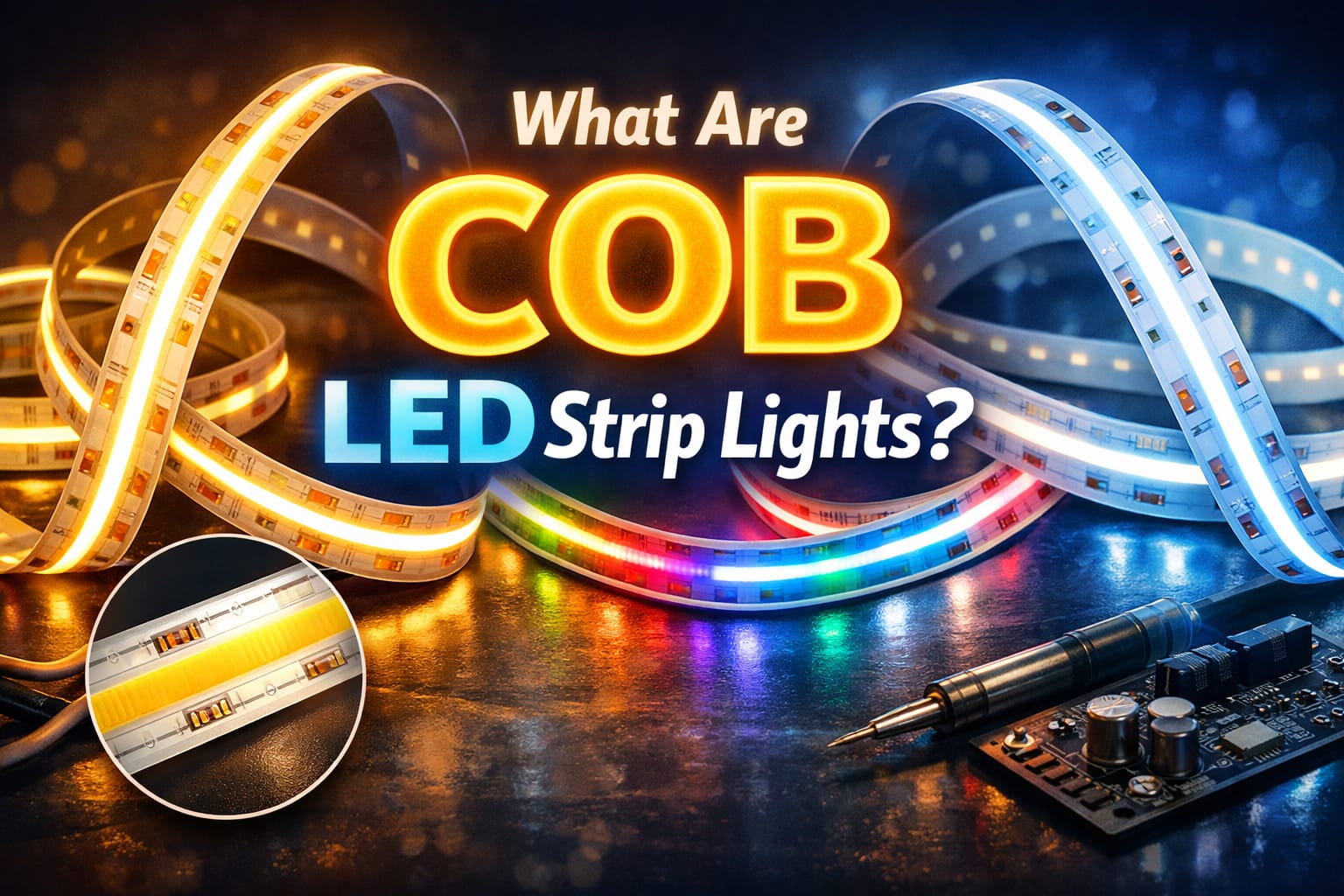
Table of Contents
- Understanding the Basics
- How COB Technology Works
- Key advantages
- Comparing COB vs. Traditional Strips
- Installation Considerations
- Color temperature options
- Power requirements
- Dimming capabilities
- Best applications
- Maintenance and Longevity
- Cost analysis
- Common mistakes to avoid
- Future Developments
- Key takeaways
- Share this guide
Understanding the Basics
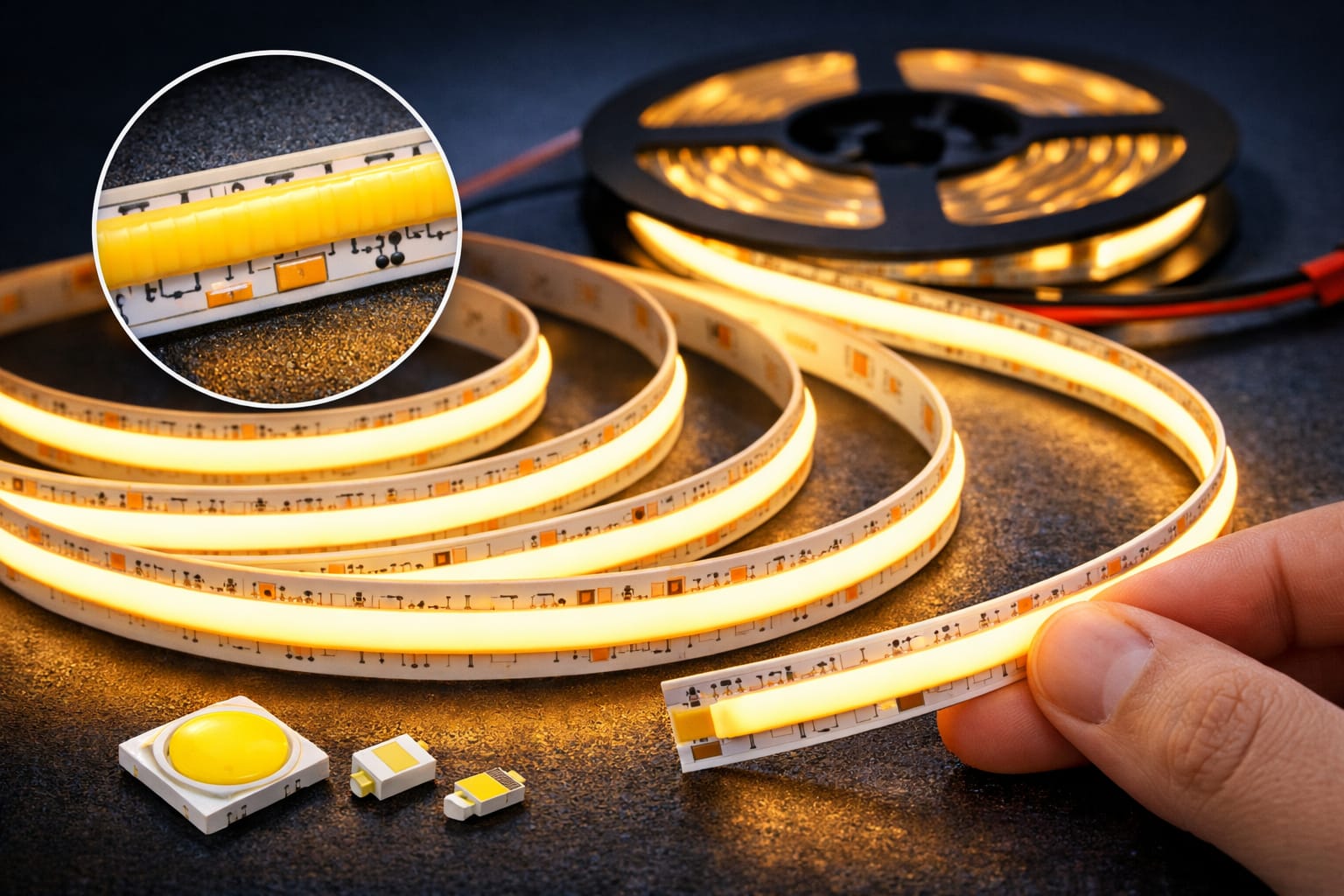
When you first compare modern strip lighting options, COB products stand out because they eliminate the dotted look common to many standard LED strips. Rather than spacing individual diodes apart, COB products place a dense array of LED chips directly onto the board, creating a much smoother line of light.
This manufacturing method is known as chip-on-board (COB) technology. Dozens or even hundreds of miniature chips are mounted closely together so that each chip still emits light independently; however, the output blends into what looks like one continuous source. The result is uniform illumination with far fewer visible hotspots or gaps.
This difference is most noticeable in places where the strip is exposed or reflected by glossy materials. In those situations, visible LED dots can make an installation appear harsher and less polished. If you are new to strip lighting, our beginner’s guide is a useful starting point before moving on to more advanced options, such as COB.
In living areas, bedrooms, and decorative applications, the smoother output can significantly improve comfort. For example, a warm white COB strip can deliver a softer, more continuous glow without the visible points that often distract from the overall lighting design.
How COB Technology Works
COB LED strip lights differ from standard SMD strips in that the LED chips are mounted more densely and directly on the circuit board. Then, they are coated with a phosphor layer that creates a smooth, dotless line of light. This high-density construction reduces the visible spacing between light sources, making COB strips appear far more continuous and refined when exposed or reflected nearby. This is especially valuable on glossy surfaces, such as granite countertops, tile, glass, and lacquered finishes, where traditional, dotted strips tend to look harsher and more obvious.
In practice, COB performance is not just about “more chips.” The dense layout changes the visual result, while the strip’s electrical design and thermal behavior determine whether that smooth appearance remains consistent throughout. In higher-quality products, greater chip density helps minimize hotspots and dark gaps. However, it also requires stable power and adequate heat management to maintain brightness, color consistency, and long-term reliability.
Key advantages
The biggest advantage is visual quality. Traditional strips often create a dotted pattern that becomes obvious when the strip is exposed, reflected in shiny materials, or installed close to eye level. COB LED strip lights solve this problem by producing a much more continuous glow, making an installation look cleaner and more premium immediately.
They also tend to deliver broader, more even light distribution. Many models offer beam angles ranging from 180 to 270 degrees, which reduces harsh shadow lines and improves coverage in applications such as under-cabinet lighting, coves, shelves, and display areas.
If the strip will be visible, a smooth COB light line matters more than raw brightness alone. In many decorative installations, appearance is just as important as output.
Another benefit is thermal behavior. Since the light is spread across a dense chip layout, heat can be managed more effectively when the strip is paired with a proper mounting surface or aluminum channel. This helps support a longer service life; many quality products are rated for 50,000 hours or more under suitable conditions.
Many COB models also offer excellent color rendering performance. Products with a CRI above 90 reproduce colors more accurately. This is valuable in kitchens, bathrooms, retail displays, and other spaces where the quality of light affects the appearance of objects, finishes, and skin tones.
COB vs. traditional strips comparison:
Standard SMD LED strips use separate LED packages spaced along the circuit board. This design works well for many projects, but the gaps between LEDs often create a dotted effect. COB strips eliminate much of that visual interruption, which is why they are often preferred for premium accent lighting and exposed installations.
The power usage per meter is similar when comparing products with roughly equal brightness. However, the light often feels smoother and more usable with COB technology. In some cases, the superior optical performance allows you to achieve the desired look without increasing the output as much as you would with a more directional strip.
However, traditional strips may still be easier to customize for certain projects because cut points and accessory compatibility are often more familiar and widely available. Some COB products can be cut at frequent intervals, but this varies by manufacturer. Therefore, it is worth checking before buying if your installation requires short segments or tight layout flexibility.
For color-changing applications, the choice becomes more nuanced. COB designs can produce very smooth color blending. However, if you are interested in advanced RGB formats and effect control, our guide to different color-changing technologies explains the practical differences between those options.
Installation Considerations
The most important mistake to avoid when installing COB strips is treating them like a cosmetic accessory instead of an electrical component. LED strips generate real heat, so aluminum channels are often the best upgrade. They improve the finished look, distribute light more evenly, add durability, and act as an efficient heat sink. This is especially important for COB strips because a strip that looks seamless when new can deteriorate more quickly if it runs hot in an enclosed space or on a poor mounting surface.
The second big issue is run planning. Before installation, check the strip’s maximum run, power supply sizing, and exact cut points. Long runs are more vulnerable to voltage drop, dim ends, and inconsistency. An undersized or incompatible power supply can cause flicker and eyestrain. A good rule is to size the power supply with at least 20% headroom, to cut only at the marked copper pads, and to treat corners, connectors, and power injection points as part of the lighting design, not afterthoughts.
Color temperature options
COB LED strip lights are available in a wide range of color temperatures: warm white (around 2700K), neutral white (near 4000K), and cool white (up to 6500K). Warm tones tend to work best in living rooms, bedrooms, and hospitality spaces, while cooler tones are usually better for task lighting, offices, and work areas.
Tunable white versions add flexibility by allowing you to shift between warmer and cooler tones with a compatible controller. Because the chips are packed so closely together, these transitions often appear smoother and less segmented than those of some traditional strip products.
Product quality also affects color consistency. Better strips maintain tighter tolerances from one reel to another, which is important in larger rooms or commercial spaces, where mismatched tones are easily noticeable. According to the U.S. Department of Energy, LED lighting quality is not only about efficiency, but also about factors such as color appearance and visual comfort.
Power requirements
Most COB LED strip lights run on low-voltage DC systems, typically 12V or 24V. For longer runs, 24V is often the better choice because it reduces the required current for the same power level. This helps limit voltage drop and makes wiring more manageable.
Actual power draw depends on chip density and brightness level. Lower-output strips may use around eight watts per meter, while stronger models can use up to 20 watts or more per meter. To correctly size the driver, multiply the strip wattage by the total length, then add extra headroom, typically around 20 percent.
In longer installations, poor power regulation can cause flicker, dim ends, or uneven brightness. This can make even a high-quality strip appear cheap. Using a regulated 24V driver is one of the easiest ways to improve consistency and reduce these issues.
Do not size a power supply exactly to the strip’s rated wattage. Operating without a safety margin increases heat and stress on the driver, especially during extended daily use.
Dimming capabilities
COB strips typically respond well to different dimming methods, including pulse-width modulation (PWM) and constant-current approaches. Pulse-width modulation (PWM) is especially common because it allows for a wide dimming range while maintaining a stable output. Quality products often allow brightness to be reduced very low without obvious flicker or major color shift.
However, compatibility matters. The dimmer, controller, power supply, and strip must be designed to work together. Some systems are built for wall dimmers, while others rely on wireless remotes, apps, or smart home controls. Checking for compatibility before purchasing can save you a lot of frustration later on.
The best products dim smoothly across the range, keeping the light stable and comfortable. This is important in hospitality spaces, bedrooms, media rooms, and any environment where lighting quality affects mood as much as visibility.
The best applications
COB strip lighting is most effective in places where people can see the strip or its reflection. This makes it ideal for under-cabinet kitchen lighting, display cases, shelving, cove lighting, stair details, bookshelves, and TV bias lighting because the smooth light line appears cleaner and more sophisticated than a dotted strip. COB strip lighting is also an excellent choice for reflective finishes because its continuous glow prevents the installation from looking busy or cheap.
COB strip lighting also shines in applications where presentation quality matters as much as illumination. In retail spaces, jewelry stores, galleries, food displays, and hospitality venues, high-CRI strip lighting makes colors appear more accurate, and diffused light generally improves visual comfort and reduces harsh glare. This is why COB is often the better option when the goal is achieving a premium-looking result rather than simply adding more light.
Maintenance and Longevity
One practical benefit of COB LED strip lights is that they require minimal maintenance once properly installed. The covered chip surface helps protect against dust and light contamination, unlike more exposed designs. In most cases, occasional cleaning with a soft, dry cloth is enough to maintain optimal output.
Quality products can last well beyond 50,000 hours when paired with proper thermal management. With around eight hours of daily use, that can translate to many years of service. Like other LEDs, COB LED strip lights usually lose brightness gradually over time rather than failing all at once.
Heat remains the biggest long-term risk. Strips installed in aluminum channels or well-ventilated spaces generally hold up better than strips in enclosed, high-temperature cavities. Controlling ambient conditions does a lot to preserve both lifespan and color stability.
Cost analysis:
COB products typically cost more upfront than standard LED strip lights. This price difference often reflects higher chip density, more demanding manufacturing processes, and superior optical performance. In many cases, the difference is worthwhile if the strip will be visible or if the installation needs to look clean and professional.
The long-term value depends on more than the initial price. Energy use, lifespan, replacement frequency, installation labor, and visual quality all matter. In decorative and commercial settings, the smoother finish can justify the extra cost, even when the electrical savings are modest.
For smaller residential projects, the difference may only be tens of dollars. For larger commercial installations, however, the price gap can be much more significant. The real question is whether the application benefits enough from the seamless appearance and improved presentation to justify the upgrade.
Common mistakes to avoid:
One common error is underestimating power needs. If the driver is undersized for the full strip length, the far end of the strip may dim or behave inconsistently. Always calculate the total wattage carefully, and allow enough safety headroom for stable operation.
Another frequent mistake is cutting the strip in the wrong place. COB products do not all have the same cut intervals; cutting between marked points can permanently break the circuit. It is essential to check the strip markings before installation.
Another area people often overlook is moisture protection. Even if the strip surface is somewhat water-resistant, the connectors and solder joints are often the weak point. Proper sealing at every connection is necessary in bathrooms, kitchens, and other humid areas.
The biggest long-term mistake is poor thermal planning. Mounting the strip in an enclosed space with no airflow will shorten its lifespan and reduce brightness over time. Good heat management is one of the easiest ways to protect your investment.
Future developments
COB LED strip lights are continually improving. New materials and phosphor formulations are improving color rendering, and tighter manufacturing control is making them more consistent from reel to reel. These improvements will make COB LED strip lights even more appealing in spaces where light quality is critical.
Smart integration is another clear growth area. More products are arriving with built-in wireless control, tunable white capability, and greater compatibility with broader home automation ecosystems. As these features become more common, COB strips will be able to offer premium light quality and flexible control.
Improvements in thermal design and efficiency could allow for brighter output from the same footprint or lower power draw for the same visual result. If you would like to explore related topics and product types further, our LED Knowledge Center is a great place to start.
Key takeaways:
COB LED strip lights stand out because they emit a smooth, dot-free line of light, which looks cleaner than that of many traditional strip lights. This makes them ideal for visible applications where reflections, exposed mounting, or overall presentation are important.
For the best results, focus on the full system rather than the strip alone. Good surface preparation, correct power sizing, proper cutting, and aluminum channels where needed can greatly improve appearance and lifespan.
As LED products continue to improve, COB designs will likely become even more popular for use in homes, retail spaces, and architectural lighting. If you want a more seamless, professional finish, COB LED strip lights are often one of the strongest upgrades available for strip lighting.
Share this guide!
If you found this guide helpful for understanding COB strip lighting, feel free to save or share it with someone planning a lighting project. It can be especially useful for DIY users, homeowners, and anyone comparing strip types.
Interested in learning more? Browse all related articles in our category section.