Best LED Lights for Large Rooms: Ceiling, Recessed & Lamp Options
For most large rooms, the best LED setup is not one ultra-bright bulb. Start with a wide-spread ceiling fixture or recessed lighting for even coverage, then add a floor lamp or secondary light for dark corners, seating areas, and task zones.
This guide helps you choose LED lights for large rooms based on room size, ceiling height, lumen output, color temperature, fixture type, and how the space is actually used. If you are still comparing the basics before choosing a fixture, this LED lighting buying guide can help you understand the main terms before you buy.
Quick Answer
The best LED lights for large rooms usually combine one strong main source with targeted support lighting. For open rooms, start with a high-lumen ceiling fixture. For long or wide rooms, recessed lighting often gives better coverage. For dark corners or seating areas, add a tall floor lamp or secondary LED light.
- Choose a wide-spread ceiling light if the room needs a simple central upgrade.
- Choose recessed lighting if the room is long, wide, or unevenly lit.
- Add a floor lamp if corners, reading chairs, or seating areas still feel dim.
- Use dimmable or smart lighting if the room changes from daytime use to evening relaxation.
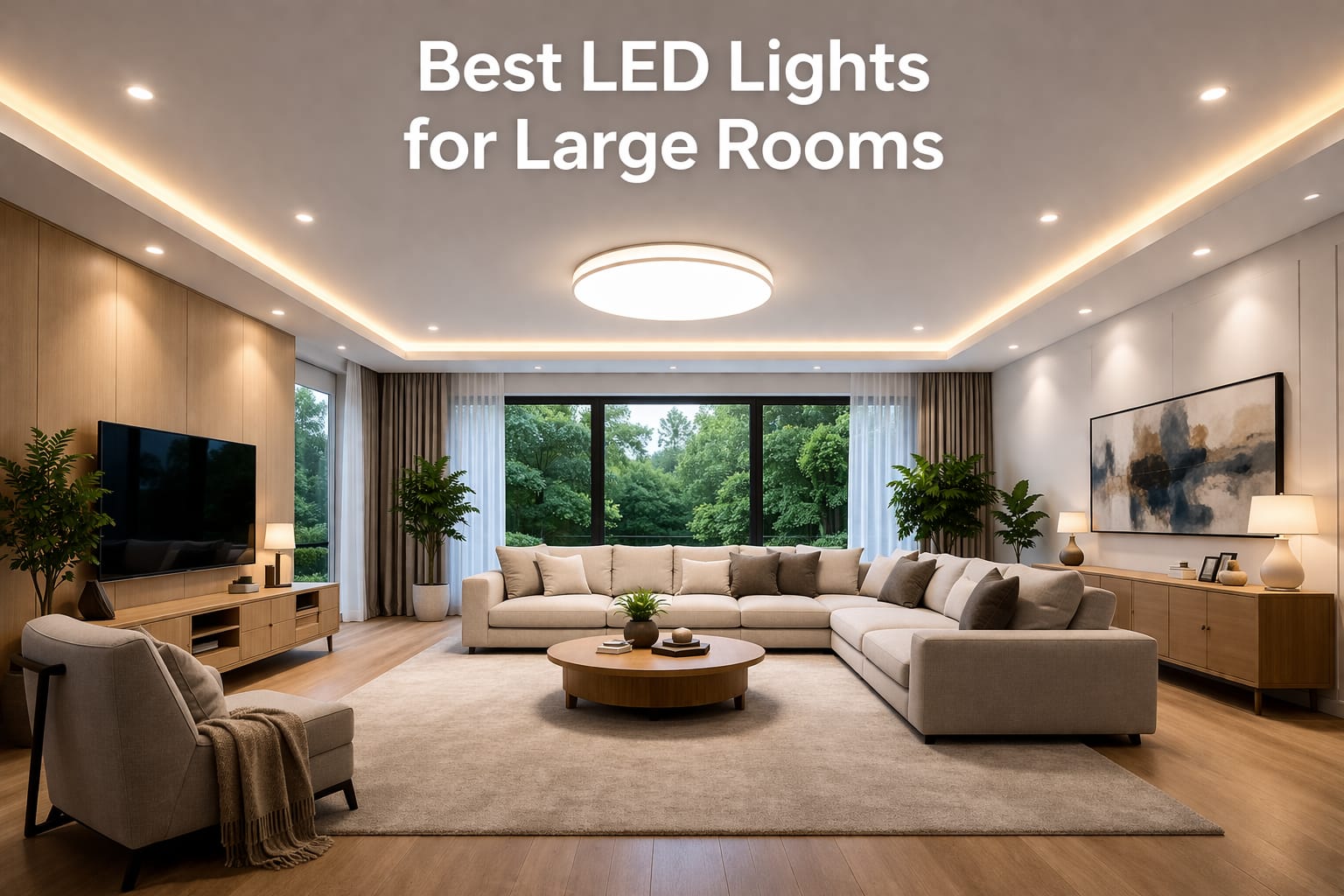
Table of Contents:
- Quick Answer
- Why Large Rooms Feel Dim
- How Many Lumens Do You Need for a Large Room?
- Best LED Setup for a Large Room
- Ceiling Lights vs Recessed Lights for Large Rooms
- Layered Lighting for Full Coverage
- Color Temperature, Dimming and Smart Controls
- Mistakes That Cause Bad Coverage
- Which LED Light Setup Should You Choose?
- Key Takeaways
- Sharing This Guide
Why Large Rooms Feel Dim
A large room can look spacious during the day but feel poorly lit at night. In many homes, the problem is not just a weak bulb. It is a mix of room size, ceiling height, dark finishes, furniture placement, and one central fixture that is trying to cover too much space.
Large rooms also spread light differently than smaller rooms. Open floor plans, dark floors, deep sofas, tall ceilings, and wide walkways can make the edges of the room feel disconnected. That is why bright lighting for big rooms depends on coverage first and brightness second.
A single ceiling light may look strong directly underneath but fade quickly near the walls. A better setup spreads useful light across the center, corners, seating areas, and pathways, so the entire room feels usable instead of bright in one spot and dull everywhere else.
Before buying anything new, stand in the darkest corner of the room at night. If that area feels disconnected from the rest of the space, you probably need a wider lighting layout rather than just a slightly brighter bulb.
How Many Lumens Do You Need for a Large Room?
When choosing LED lights for a large room, lumens matter more than watts. Watts tell you how much energy a bulb uses, while lumens tell you how much light it produces. If that difference is still confusing, this guide to lumens vs watts explains why a high-wattage equivalent is not the same as a good lighting plan.
As a practical starting point, a large living room or family room often needs enough ambient light for walking, cleaning, reading casually, and using the space without dark zones. The exact number depends on the square footage, ceiling height, wall color, furniture, and how much natural light the room gets during the day.
A low-ceiling room may feel bright with fewer lumens because the light does not travel as far. A vaulted or open-plan room may need more output or more fixtures because the light spreads upward and outward before reaching the areas people actually use. For rooms where ceiling height is the main challenge, this guide to lighting for high ceilings goes deeper into fixture height, spread, and placement.
Simple lumen rule:
- Use more total lumens for tall ceilings, dark walls, and open layouts.
- Use wider distribution when the room feels dim at the edges.
- Use layered lighting when one fixture makes the center bright but leaves corners weak.
- Use dimming if the room needs both bright daytime light and softer evening light.
The key is not to chase the highest lumen number blindly. High-lumen LED lights for large rooms work best when the output is spread across the room through the right fixture type, beam spread, and support lighting.
Best LED Setup for a Large Room
The strongest setup usually starts with a main ambient light source. In a wide living room, family room, open lounge, or large bedroom, this is often a ceiling fixture, chandelier-style light, flush mount, semi-flush mount, or recessed layout that gives the room its baseline brightness.
The main fixture should not only look good from below. It should spread light across seating areas, walkways, tables, and the far side of the room. If a fixture is too narrow, the room can feel dramatic but not practical. If it is too harsh, the center can feel intense while the edges still look dull.
For many large rooms, the most reliable plan is a strong overhead source plus one or two secondary lights. That gives you enough brightness for daily use while letting you soften the room at night. It also makes the space feel more expensive because the light comes from more than one direction.
If your room only feels bright directly under the fixture, the fixture may have enough output but poor distribution. In that case, a wider fixture, recessed layout, or support lamp can help more than simply increasing lumens.
Ceiling Lights vs Recessed Lights for Large Rooms
A large ceiling fixture is often the easiest upgrade because it can replace an existing central light. It works especially well when the room is open, symmetrical, and not extremely long. Look for a fixture that spreads light outward rather than sending most of the brightness straight down.
Recessed lighting is usually better when the room is long, wide, or visually divided into zones. Instead of depending on one bright point in the middle, recessed lights spread output across several positions. This can make a large room feel wider, cleaner, and more evenly lit. If you want a distributed setup instead of one central fixture, a 12-pack of dimmable recessed LED lights is the kind of option that fits this use case better than a single small ceiling light.
The best choice depends on the room. If you want the fastest upgrade, a larger ceiling fixture may be enough. If the far end of the room always looks dim, or if the space includes several seating zones, a distributed recessed layout can feel more natural.
Choose ceiling lighting when:
- The room has one clear center point.
- You want a simple replacement for an existing fixture.
- The ceiling is not extremely high or uneven.
- You want one decorative light to define the room.
Choose recessed lighting when:
- The room is long, wide, or open-plan.
- The center is bright but the edges stay dim.
- You want even coverage without one dominant fixture.
- The room needs different zones for relaxing, reading, working, or entertaining.
Layered Lighting for Full Coverage
Layered lighting is the easiest way to make a large room feel balanced. Instead of asking one fixture to do everything, you use different types of light for different jobs: ambient light for the whole room, task light for reading or working, and accent light for corners, walls, or decorative areas. This guide to ambient, task and accent lighting explains those layers in more detail if you want to plan the room more carefully.
This is especially helpful in large living rooms, family rooms, open-plan spaces, and rooms with several seating areas. A ceiling light can provide the main brightness, while a floor lamp fills a dark corner, a table lamp supports a reading chair, and wall-adjacent lighting softens the edges of the room.
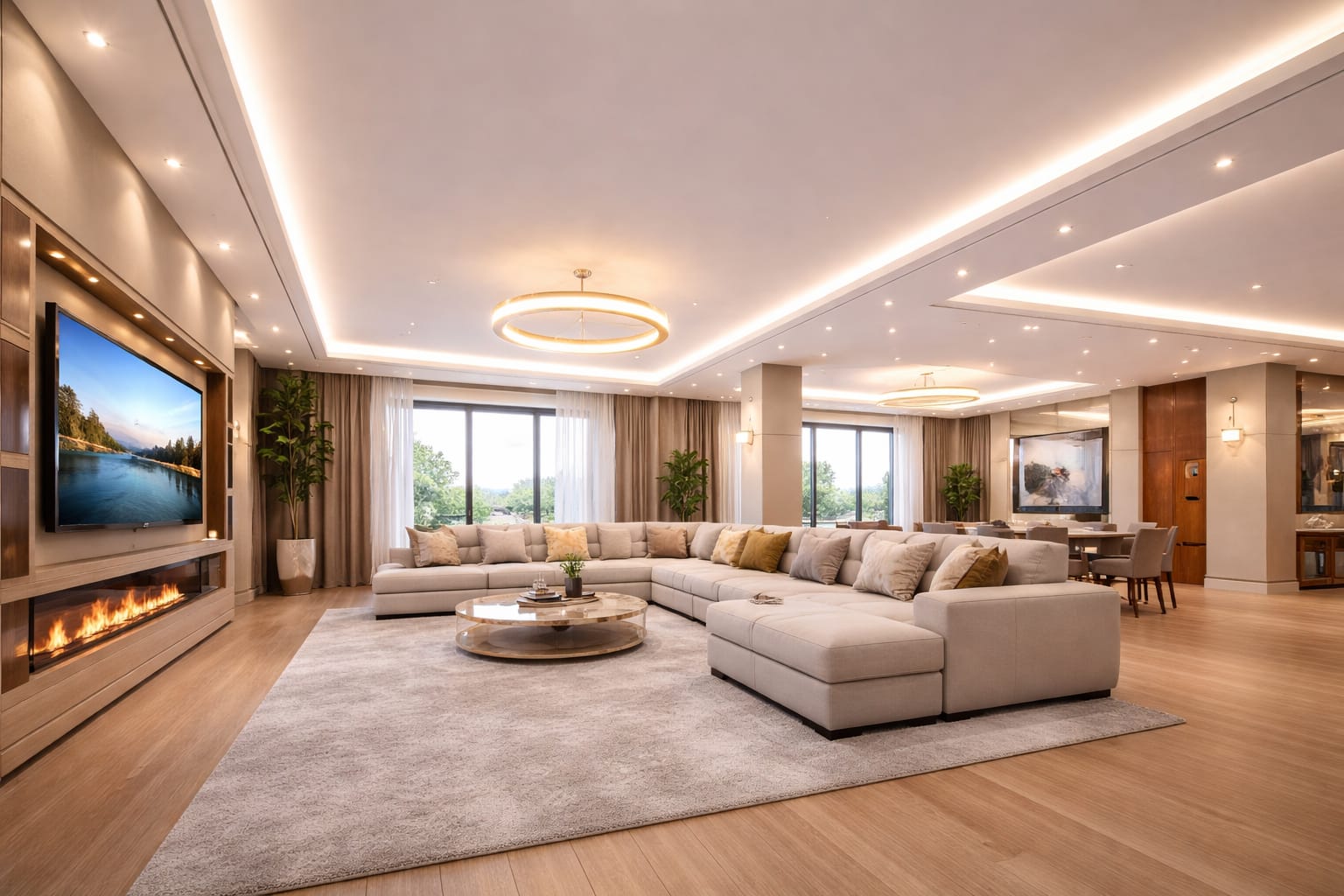
Dark corners can make an otherwise good room feel unfinished. Sometimes, the solution is as simple as adding a tall floor lamp or moving a secondary light closer to the weakest area. For a sofa corner, reading area, or empty side of a large room, an adjustable arc floor lamp for living room corners can add useful light without rewiring the ceiling.
Support lighting works because it fills the places where the main fixture naturally loses strength. In a wide room, that may be the far wall. In a long room, it may be the opposite end from the main fixture. In a family room, it may be the reading chair, sofa corner, or path between spaces.
Do not judge coverage while standing only under the main fixture. Walk the perimeter and sit where people actually relax. A room can appear bright from the center yet still be poorly lit where it matters most.
Color Temperature, Dimming and Smart Controls
Output matters, but tone matters too. A large room can be bright enough technically and still feel uncomfortable if the color temperature is too cold, too harsh, or wrong for the way the room is used.
Warm white lighting usually feels better in living rooms, TV rooms, bedrooms, and evening spaces. Neutral white can work better in open-plan areas, family rooms, multipurpose spaces, or rooms where people read, clean, work, or move around often. If the room connects to a kitchen or active prep area, these ideas for LED lights for kitchens can help you keep the brighter zone practical without making the whole room feel harsh.
Dimming also matters more in large rooms because the space may be used in different ways throughout the day. Morning cleanup, afternoon work, movie time, and guests all need different light levels. For a room where you want one simple ceiling fixture with adjustable tone, a modern LED ceiling light with adjustable color temperature can make sense as part of the setup, especially when you want remote control and warmer or cooler light without changing bulbs.
This is especially useful when the room opens into a kitchen, hallway, dining space, or home office area. Instead of forcing one brightness level across the entire space, you can adjust the lighting to the activity taking place. If one side of the room doubles as a work zone, this guide to LED lights for home offices can help you choose task lighting that does not overpower the rest of the room.
Mistakes That Cause Bad Coverage
One of the biggest mistakes is assuming that one extra-bright bulb will solve everything. Large rooms usually require better placement, a wider spread, or layered lighting rather than just more punch in the middle. Otherwise, the center becomes intense while the edges stay weak.
Another common mistake is buying a fixture based only on style. A light can look impressive online and still have a narrow pattern, poor diffusion, or weak edge coverage once installed. Shades, diffusers, ceiling height, wall color, and furniture can all reduce usable brightness.
Dimming quality also affects comfort. A room that seems bright enough can still feel irritating if the bulbs flicker, buzz, or dim poorly. If the room serves more than one purpose, plan for dimming or smart controls before choosing the final fixture.
Before buying LED lights for a large room, check:
- ✓ The room size and ceiling height.
- ✓ The darkest corner or seating area at night.
- ✓ Whether one fixture can cover the room or if layering makes more sense.
- ✓ The color temperature for how the room is actually used.
- ✓ Whether dimming or smart controls would make the setup more comfortable.
- ✓ Whether the fixture spreads light outward or mostly downward.
Which LED Light Setup Should You Choose?
The right setup depends on the shape of the room and how you use it. A TV room, a family gathering space, a bright open-plan lounge, and a large multipurpose room do not need the exact same lighting plan. If your large room includes a table or entertaining zone, this guide to LED lights for dining rooms can help you balance brightness with a more comfortable atmosphere.
- For a simple central upgrade: choose a larger ceiling fixture with wide light spread.
- For long or wide rooms: choose recessed lighting or multiple ceiling points for more even coverage.
- For dark corners: add a tall floor lamp or secondary LED light near the weak area.
- For reading or task zones: add focused support lighting instead of increasing the whole room’s brightness.
- For rooms used day and night: choose dimmable or smart lighting so the space can shift from bright to soft.
- For high ceilings: use stronger output, lower-hanging fixtures, or distributed lighting to avoid losing brightness overhead. For more detail, see this guide to lighting for high ceilings.
If you mostly relax in the evening, a warmer layered setup may feel better than maximum overhead output. If the room doubles as a workspace, playroom, or open family area, you may prefer stronger ambient coverage with a cleaner neutral tone.
If you want a result that still feels right months later, build the room in stages. Start with the main light, live with it for a few evenings, then add floor lamps, recessed lights, or directional support lighting only where the room still feels weak.
Take photos with your smartphone from the doorway, sofa, and far corner before and after any lighting upgrades. The camera often reveals uneven areas that your eyes quickly adapt to and stop noticing.
If you remember one principle, make it this: the best LED lights for large rooms are the ones that make the whole space feel usable. That includes the center, the corners, the reading chair, the sofa, and the path into the room.
Key Takeaways
Large rooms rarely feel underlit because they need one brighter bulb. The real issue is usually coverage. The most effective setups combine enough ambient output with better placement, useful layering, and a color temperature that suits the room’s purpose.
Start by judging the darkest parts of the room honestly. Then decide whether you need a stronger main fixture, a more distributed recessed layout, or support lighting for weak zones.
For most large rooms, the best result comes from a wide-spread main light plus one or two secondary sources. Choose lighting for the whole room, not just the center, and the space will stay useful long after the fixture is installed.
Sharing This Guide
Share this guide if you found it helpful. Save it or share it with someone planning to brighten a large space.
Interested in learning more? Browse all related articles in our category section.