PWM vs Analog Dimming for LEDs: Flicker, Color, and Control
PWM vs analog dimming for LEDs comes down to one main trade-off: PWM usually gives better color stability and precise control, while analog dimming is usually better when low-flicker or flicker-free performance matters most. Pulse width modulation dims by switching the LED on and off extremely quickly, while analog dimming lowers the current so the LED stays continuously on at a lower intensity.
That difference affects more than brightness alone. It can change flicker behavior, color stability, deep-dimming performance, driver compatibility, camera performance, and how the light feels in real use. In some situations, one method is clearly the better choice. In others, the answer depends on what matters most in your application.
This guide breaks down PWM vs analog dimming in practical terms so you can understand which one is better for general lighting, flicker-sensitive spaces, camera work, LED drivers, and demanding applications where light quality really matters.
Quick Answer
For most LED lighting, PWM dimming is usually better for color stability and precise control, while analog dimming is usually better when low-flicker performance, camera-safe dimming, or true flicker-free dimming matters more. An analog dimming LED setup lowers current continuously instead of rapidly switching the light on and off, which is why it can be useful in video, photography, medical, and flicker-sensitive spaces.
- PWM is often better for stable color across the dimming range.
- Analog dimming is often better when visible or camera-detected flicker must be minimized.
- PWM performance depends heavily on dimming frequency and driver quality.
- Analog dimming can shift LED color more at very low brightness levels.
- For most normal home lighting, either can work well if the driver and dimmer are designed properly.
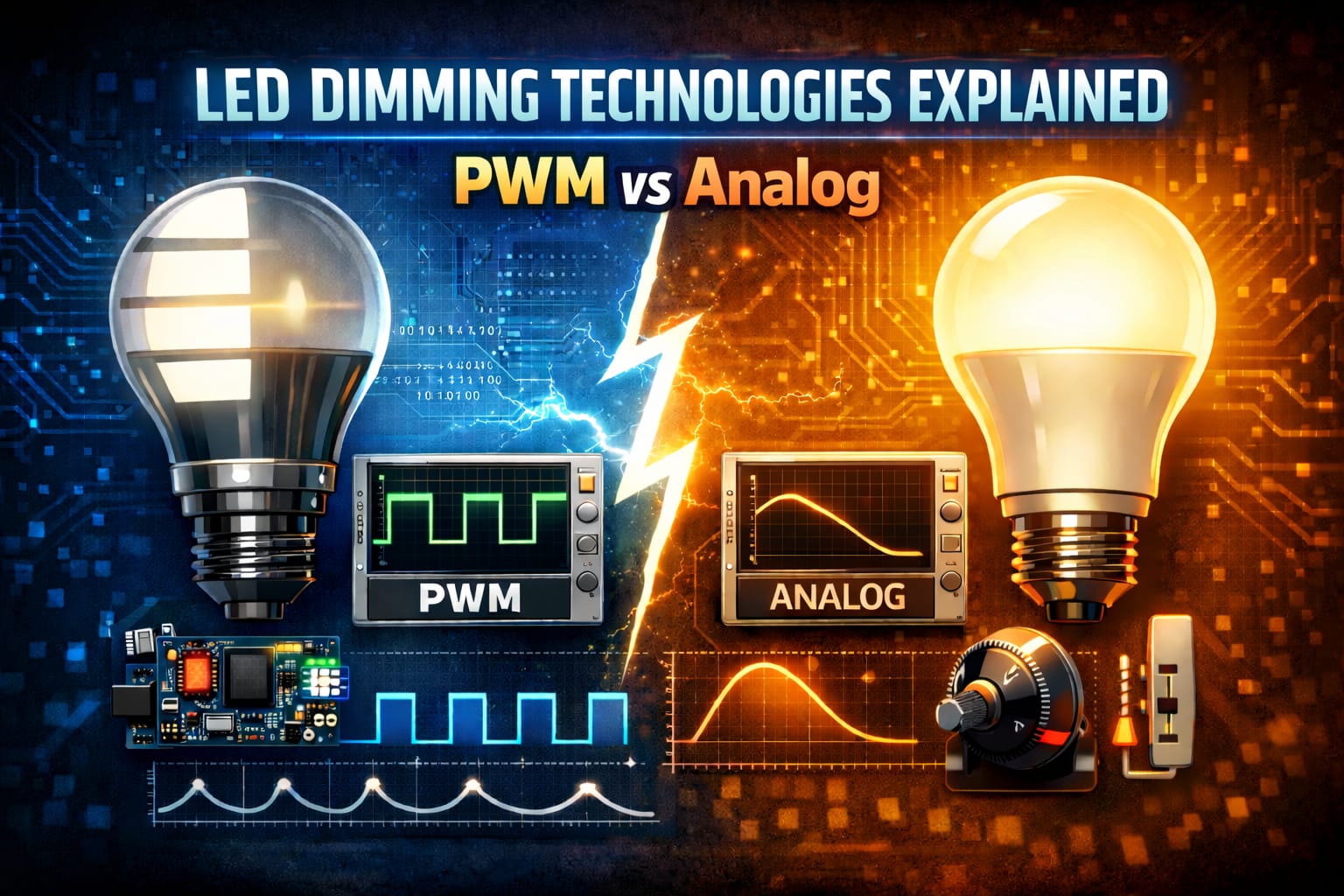
Table of Contents:
- Quick Answer
- What Each Method Means
- The Main Difference in Simple Terms
- Where PWM Has the Advantage
- Where Analog Dimming Has the Advantage
- Flicker and Dimming Frequency
- Color Stability and Deep Dimming
- Efficiency and Heat Behavior
- Compatibility With Dimmers and Drivers
- Best Use Cases for Each Method
- Troubleshooting Common Dimming Problems
- What Should You Choose?
- Key Takeaways
- Sharing This Guide
What Each Method Means
PWM and analog dimming are both ways to make an LED appear dimmer, but they do not reduce brightness in the same physical way. That is why the results can look similar at first while still behaving differently in real-world use.
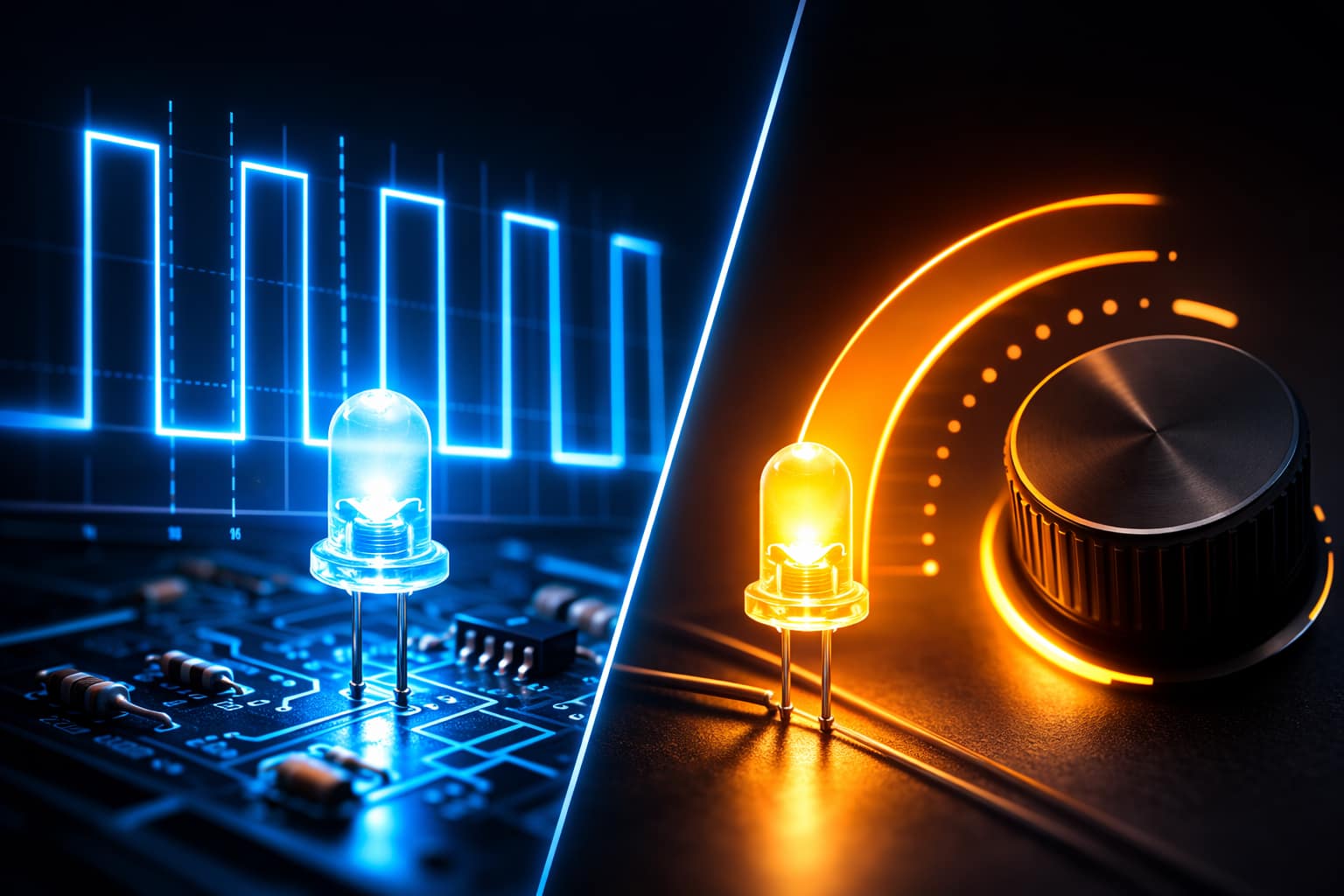
Pulse width modulation works by turning the LED fully on and fully off very quickly. The brighter the setting, the longer the LED stays on during each cycle. The dimmer the setting, the shorter the on-time becomes. Your eyes blend that fast switching into what looks like steady brightness, assuming the frequency is high enough.
Analog dimming works differently. Instead of switching the LED on and off, it lowers the electrical current flowing through it. The LED stays on continuously, but at a reduced intensity. In an analog dimming LED setup, brightness is reduced by lowering drive current instead of rapidly chopping the light output.
That makes analog dimming especially relevant when users are comparing LED flicker, camera banding, smooth low-level dimming, and driver behavior. If you want a refresher on the electronic side behind LED behavior, our guide on how LED lighting works gives useful background.
The Main Difference in Simple Terms
The easiest way to think about PWM vs analog dimming is this: PWM changes time, while analog dimming changes current. PWM keeps full power during each on-cycle but shortens how long the LED stays on. Analog dimming keeps the LED on continuously but feeds it less current.
That single difference explains most of the trade-offs. PWM usually preserves LED color more consistently because the LED still sees the same driving current during each pulse. Analog dimming usually avoids switching-based flicker because the light is never being chopped on and off in the first place.
So the analog vs PWM choice is not really about which method is universally better. It is about whether your setup needs lower flicker risk, better color stability, smoother deep dimming, easier driver compatibility, or cleaner performance on camera.
Where PWM Has the Advantage
PWM is very common because it is effective, widely understood, and usually easier to implement in mainstream LED systems. One of its biggest advantages is color stability. Because the LED sees the same current during every on-pulse, the color of the light tends to stay more consistent across the dimming range.
This is especially useful in display lighting, architectural lighting, and retail spaces where visual consistency matters. It is also helpful when you want deep dimming without unusual color drift. If the dimming frequency is high enough, PWM can perform extremely well for general-purpose LED lighting.
PWM also tends to work well with digital control systems because it is easy to regulate precisely. That is one reason it shows up so often in smart lighting, LED controllers, and integrated LED drivers.
Where Analog Dimming Has the Advantage
Analog dimming has its biggest advantage when flicker sensitivity is the top concern. Because the light stays continuously on instead of being rapidly switched, it is naturally better suited to applications where visible flicker, camera-detected flicker, rolling bands, or strobing need to be minimized.
That makes analog dimming attractive for photography, videography, medical spaces, labs, and other environments where visual comfort or equipment compatibility matters more than perfect color stability. If the goal is genuinely flicker-free dimming, analog control often offers the cleaner path.
Analog dimming can also be appealing at very low brightness levels, especially in applications where people notice even subtle pulse behavior. It is not automatically better everywhere, but it becomes especially useful when temporal light artifacts are unacceptable.
Flicker and Dimming Frequency
This is one of the most important parts of the PWM vs analog dimming question. PWM can look perfectly smooth or obviously problematic depending on the dimming frequency. If the switching frequency is too low, some users may see flicker directly, and cameras may capture rolling bands or strobing even when the human eye does not notice anything obvious.
Higher frequencies generally reduce these problems, but they do not always eliminate every issue for every person or every camera setup. That is why a PWM system with good implementation can feel excellent, while a low-frequency PWM system can be unpleasant or unusable in sensitive applications.
Analog dimming avoids this specific problem because there is no rapid on-off switching pattern to create temporal artifacts. If flicker complaints, camera banding, or video performance are serious concerns, this is usually the first reason analog control enters the conversation.
A good PWM system can feel comfortable and stable, but a low-frequency or poorly matched one can create the exact flicker problems many people are trying to avoid.
Color Stability and Deep Dimming
Color stability is one of PWM’s strongest arguments. Because the LED is still driven at its normal current during each pulse, the chromatic characteristics often stay more consistent across the dimming curve. That means the light is more likely to look similar in color at both high and low levels.
Analog dimming can shift color more because reducing current changes how the LED behaves electrically and thermally. Some products compensate for this well, while others become noticeably warmer or cooler as they dim. In premium products, this may be tightly controlled, but in cheaper designs, the shift can be obvious.
This is one reason PWM is often favored when color consistency matters more than perfect flicker immunity. It is also why product quality matters so much. Two analog-dimmed fixtures can behave very differently depending on driver design and phosphor behavior. Over time, these choices can also interact with long-term light degradation patterns in practical installations.
Efficiency and Heat Behavior
Efficiency can shift depending on how deep the dimming goes and how the driver is designed. PWM introduces switching losses because the system is repeatedly turning the LED on and off. At higher brightness levels, those losses are usually not a big deal. At very deep dimming levels, they can matter more.
Analog dimming avoids that specific switching penalty, which can make it more attractive at low output levels. LEDs also tend to run cooler at lower current, which can be beneficial for long-term stability. That said, driver design and application context still matter a lot, so it is risky to assume analog is always more efficient in every product.
If you want a related refresher on output efficiency, our guide to lighting efficiency metrics helps put those trade-offs into a more practical lighting context.
In practice, the trade-off usually comes down to a few simple patterns. PWM often keeps light output more controlled and color more consistent, while analog dimming usually has the advantage when reducing flicker is the bigger priority. Both can dim LEDs well, but they tend to shine in different areas.
For color stability, PWM usually has the edge. Because the LED still receives its normal driving current during each pulse, the light tends to stay more consistent in appearance across the dimming range. With analog dimming, color can shift more as current drops, especially in lower-quality products.
For flicker risk, analog dimming is usually the safer option. Since the light is not being rapidly switched on and off, it is less likely to create visible flicker, rolling bands, or camera-detected artifacts. PWM can still perform very well, but that depends heavily on frequency and driver quality.
For deep dimming, PWM is often more precise. It can deliver very controlled low-end dimming without changing the LED drive conditions during each pulse. Analog dimming can also feel smooth at low levels, but the result is usually more product-dependent.
The main strength of PWM is control precision with better color consistency. The main strength of analog dimming is its cleaner path to flicker-free behavior in sensitive environments.
The main weakness of PWM is the risk of flicker artifacts when the system uses poor frequency or weak driver design. The main weakness of analog dimming is that color can shift more as brightness drops.
Compatibility With Dimmers and Drivers
In real life, many dimming problems are not caused by PWM or analog theory alone. They come from poor compatibility between the bulb, driver, and dimmer. An LED product can have a perfectly decent control method internally and still behave badly if the wall dimmer is not appropriate for it.
That is why legacy incandescent dimmers often cause flicker, buzzing, limited dimming range, or lights that refuse to dim smoothly. If your system is unstable, the first practical move is often replacing the control hardware rather than obsessing over the internal dimming method. An LED dimmer switch built for smooth, flicker-free control is often a better fix than continuing to fight an incompatible old dimmer.
This is also why the PWM vs analog dimming question needs to be answered in context. The better method on paper can still perform badly if the rest of the system is mismatched.
Best Use Cases for Each Method
For normal residential lighting, PWM is very common and often perfectly fine when implemented well. Most homeowners care about stable output, decent dimming range, good color, and affordable products, and PWM can deliver that effectively in many mainstream fixtures and bulbs.
For photography, videography, medical spaces, visual inspection work, and highly flicker-sensitive environments, analog dimming often becomes more attractive. These are situations where even subtle temporal artifacts can matter more than absolute color consistency.
Retail, display, and architectural applications often lean toward PWM because color consistency and fine control matter a lot. Meanwhile, studios and camera-heavy spaces usually care more about true flicker-free dimming behavior. So the best choice depends heavily on where the light will actually be used.
If color consistency is your top priority, PWM often has the edge. If flicker-free performance matters most, analog usually has the edge.
Troubleshooting Common Dimming Problems
If you see visible flicker, start by checking dimmer compatibility and whether the product is using low-frequency PWM. If your LED lights flicker on camera, show rolling bands, buzz, or jump suddenly at low brightness, the issue may be related to PWM frequency, dimmer compatibility, or driver quality rather than the LED itself.
If the light changes color noticeably when dimmed, that usually points more toward analog current reduction or weak driver design. Incomplete dimming range, strange jumps, or unstable low-end behavior often come from mismatched control hardware. That is why replacing the dimmer or driver can solve a problem that no bulb swap seems to fix.
For more help diagnosing related issues, our LED troubleshooting guide and the broader LED Knowledge Center are both useful follow-ups.
In other words, do not assume PWM is bad or analog is bad just because one product behaved badly. Very often, the real issue is that the system was never matched properly in the first place.
What Should You Choose?
Choose based on what matters most in the final application, not on which method sounds more advanced.
- Choose PWM if you want stronger color stability and mainstream LED compatibility.
- Choose analog dimming if you need the cleanest path to flicker-free performance.
- For home lighting, either can work well if the driver and dimmer are matched properly.
- For video, photography, or sensitive environments, analog dimming or very high-frequency PWM is usually the safer route.
- If your current system flickers, troubleshoot compatibility first before blaming the dimming method alone.
Key Takeaways
PWM and analog dimming both reduce LED brightness effectively, but they do it in very different ways. PWM rapidly switches the LED on and off, while analog dimming lowers the current so the LED stays on continuously at a lower output.
In practical terms, PWM usually wins on color stability and control precision, while analog dimming is often the safer choice when flicker-free performance matters most. Driver quality, dimming frequency, and dimmer compatibility often matter just as much as the method itself.
For general home use, either method can work well in a properly matched system. For camera work, medical settings, or other sensitive applications, choosing the right dimming approach becomes much more important.
Sharing This Guide
If you found this guide helpful, you can save it for later or share it with a friend. It is especially useful for beginners, homeowners, and DIY users.
Share using the links below
Interested in learning more? Browse related articles in our LED Basics section.