Lighting for Windowless Rooms: How to Make Them Feel Bright
Good lighting for windowless rooms has to do more than make the space visible. It needs to replace the brightness, depth, and sense of comfort that natural light normally provides. Without that, a room can feel flat, gloomy, and closed in even when you technically have enough lumens.
The fix is usually a combination of the right brightness, the right color temperature, and a smarter layered setup. Once those pieces work together, a windowless room can feel brighter, more natural, and much more inviting for everyday use.
Table of Contents
- How bright a windowless room should be
- How to create a more natural daylight feel
- Best color temperature for windowless rooms
- Why layering matters more than one bright fixture
- Ceiling and wall strategies that make the room feel bigger
- Task lighting for work, reading, and everyday use
- How lighting affects comfort and mood
- Circadian support in rooms without daylight
- Energy efficiency and smart control
- Common mistakes that keep the room gloomy
- Sharing this guide
Quick answer: Windowless rooms usually feel best when they use enough total brightness, a balanced color temperature, and a layered setup instead of one harsh central fixture. The goal is not just visibility, but a room that feels open, natural, and comfortable to spend time in.
How Bright a Windowless Room Should Be
Most windowless rooms need more artificial light than people first expect. Without daylight reflecting off walls and ceilings, the room depends entirely on your fixtures for both function and atmosphere. That is why spaces with no windows often feel darker than similarly sized rooms even when the bulb wattage looks reasonable on paper.
As a practical starting point, many enclosed rooms work well around 50 to 100 lumens per square foot depending on use. A bedroom, hallway, or lounge-style den can stay closer to the lower end if it has warm layered lighting. A home office, hobby room, or dressing area usually needs more output to keep it feeling lively and usable.
The bigger point is that total brightness should be spread across the room instead of dumped from one overly strong fixture. Even distribution makes a room feel brighter and more open than a single harsh ceiling light with dark corners around it.
If you want help estimating output more confidently, our guide to lumens vs watts makes those numbers easier to interpret.
Practical Measurement Standards
If you want a more objective check, lux readings can help. General living areas in windowless rooms often feel comfortable around 500 to 750 lux, while task-heavy areas may need closer to 750 to 1000 lux at the working surface. That does not mean the entire room has to feel intensely bright. It means the room needs enough baseline light to avoid the cave effect, plus extra light where people actually do things.
Many people also confuse “brighter” with “harsher.” In reality, a room can feel bright and pleasant if the illumination is soft and layered. It can also feel uncomfortable even with lower output if the bulbs create glare or hard shadows.
The goal is not maximum brightness. It is usable, even light with a natural-looking feel. That is why boosting light levels should almost always happen together with better placement and better fixture choice, not through one stronger lamp alone.
How to Create a More Natural Daylight Feel
One of the biggest goals in lighting for windowless rooms is making the space feel less artificial. That does not mean trying to blast the room with cold blue-white light. It means choosing sources that feel clearer, cleaner, and more natural than a dim warm bulb in a dark box of a room.
This is where artificial daylight solutions can help. High-quality LED fixtures with good color rendering, balanced output, and the right color temperature usually do far more for a room than chasing vague “sunlight” marketing language. In many cases, the best result comes from combining a daylight-like ambient layer with warmer secondary lighting that keeps the room comfortable in the evening.
Backlit ceiling panels, slim LED panels, and bright indirect uplighting can also help mimic the feeling of daylight coming from above. They do not literally recreate a window, but they can make the room feel more open and less enclosed, which is often what people really want.
Do Full Spectrum LED Bulbs Matter?
They can, but only if the bulb quality is actually good. Some so-called full spectrum LED bulbs do a much better job of rendering colors naturally and avoiding that cheap, harsh look many people dislike. In windowless rooms, that matters because there is no daylight to correct poor color quality.
A good shortcut is to look for high CRI rather than relying only on the words “full spectrum.” If the bulb has strong color rendering and a sensible color temperature for the room, it will usually feel more natural than a low-quality daylight bulb with weak color performance.
If you want a broader foundation first, our lighting fundamentals guide explains why quality matters as much as raw brightness.
For many windowless rooms, the best result is not a clinical imitation of noon sunlight. It is a balanced artificial light that feels fresh during the day and comfortable after dark.
Best Color Temperature for Windowless Rooms
Color temperature has a huge effect on how a room without windows feels. Warm white can feel cozy, but in a room with no daylight at all it can also become a little dull or sleepy if used everywhere. Cool white can feel brighter and more open, but too much of it can make the room feel sterile.
That is why many windowless rooms perform best in the middle ground. Neutral white around 3500K to 4000K often gives a fresher look than 2700K without becoming harsh. For workspaces, 4000K to 5000K can make sense. For bedrooms or lounge spaces, a layered setup with neutral ambient light and warmer side lighting often works better than one single temperature everywhere.
If you are still unsure which range fits the room best, our color temperature guide breaks down when warm, neutral, and cool light each make the most sense.
Why Consistency Matters
Whatever temperature you choose, try to keep it consistent across the main fixtures. Mixing very warm and very cool lamps in one small enclosed room often makes the space feel messy rather than dynamic. Small differences can work, like slightly cooler ceiling light with slightly warmer table or floor lamps, but the contrast should be intentional and gentle.
This becomes even more important in windowless spaces because there is no natural daylight source to visually anchor the room. Inconsistent color temperature stands out more quickly, especially on white walls, neutral fabrics, and work surfaces.
If flexibility matters, tunable white or smart bulbs can be useful. They let you keep the room brighter and cleaner by day, then warmer and softer later on without replacing hardware.
Why Layering Matters More Than One Bright Fixture
Layered lighting is one of the most effective fixes for a windowless room because it adds depth. A single ceiling light usually leaves the room feeling flat. It might make the center bright enough, but corners stay dim and the whole space often feels more enclosed than it should.
A stronger setup combines ambient light, task light, and accent light. Ambient light establishes the overall brightness. Task light supports reading, working, or grooming. Accent light adds shape and visual interest so the room feels designed instead of merely illuminated. That is the practical core of good layered lighting techniques.
This also gives you control. You can run everything together when the room needs to feel bright and active, then rely on only two layers when you want a softer atmosphere. That flexibility is especially useful in rooms with no windows because artificial light is the room’s whole personality.
Our article on ambient, task, and accent lighting goes deeper into how these layers work together. In most cases, a layered setup looks more natural and feels more comfortable than simply increasing bulb output.
Accent Elements That Help the Room Feel Less Closed In
Accent lighting helps because it gives the eye somewhere to go. A wall sconce, a picture light, shelf lighting, or a soft uplight can break up the sealed-box feeling that many windowless rooms have. Instead of one blanket of flat light, the room starts to feel dimensional.
The key is restraint. You do not need to light every surface. Two or three well-placed accent touches often do more than filling the room with extra fixtures. The goal is to create shape, not clutter.
Used well, accent light makes a room feel less forgotten and more intentional.
Ceiling and Wall Strategies That Make the Room Feel Bigger
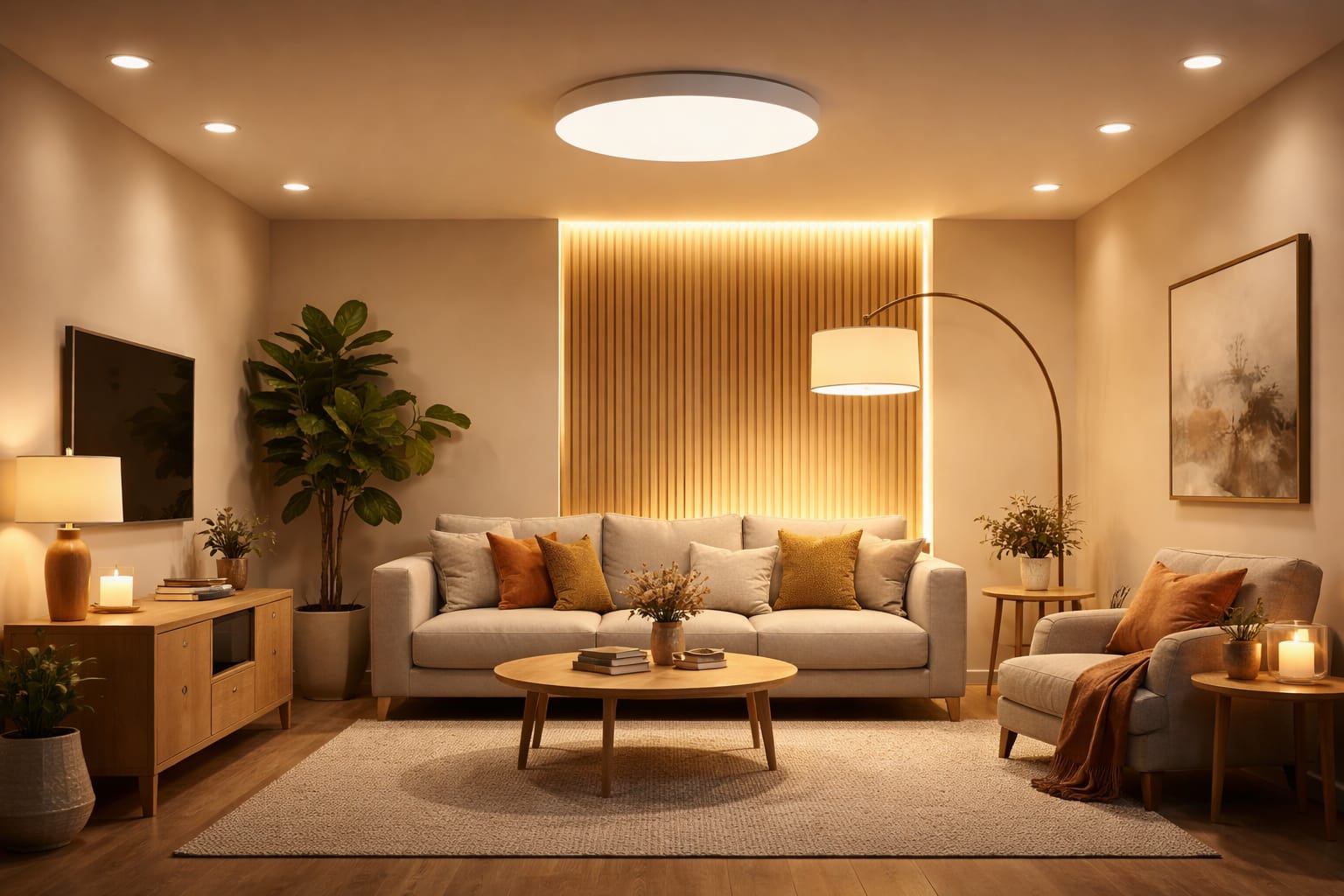
In a room without windows, ceilings and walls do a lot of work. If the ceiling stays dark, the room can feel lower and more enclosed. If the walls are poorly lit, the edges of the room recede and the whole space feels smaller. That is why lighting the perimeter matters so much.
Brightening the ceiling with indirect uplight or well-distributed recessed fixtures usually makes the room feel taller. Washing walls with soft light makes the space feel wider. This is one of the biggest reasons a room can still feel gloomy even after you add brighter bulbs: the light is not reaching the surfaces that define the room.
Light-colored paint helps too. White and pale neutrals reflect more light and make every fixture work harder for you. If the room also has low ceilings, our guide on lighting for low ceilings can help you avoid setups that make the room feel even more compressed.
Even small reflective upgrades, like mirrors or lighter furnishings, can support your lighting plan and make the room feel less boxed in.
How to Make the Ceiling Feel Higher
Indirect ceiling light is one of the easiest ways to make a room feel more open. Cove lighting, uplights, or wall sconces that send light upward can visually lift the room. Recessed fixtures also help when they are spaced well and not concentrated into one harsh cluster.
Wall grazing can help too. Drawing light upward along the walls encourages the eye to travel vertically instead of focusing only on the floor and central fixture. That subtle shift can make a small enclosed room feel less boxed in.
The room does not need to be extremely bright. It just needs enough vertical illumination to feel breathable.
Task Lighting for Work, Reading, and Everyday Use
Windowless rooms often serve practical functions, which means task lighting matters even more. A home office needs focused desk light. A dressing area needs good facial lighting. A reading corner needs direct comfortable illumination that does not rely entirely on the ceiling fixture.
Dedicated task light also helps you avoid over-lighting the whole room just to support one activity. That is a common mistake. Instead of making the entire room unnaturally bright, place stronger light only where it is actually useful. In work-focused spaces, our guide to the best LED bulbs for home offices may also help with specific bulb choices.
Position matters. A lamp behind you can create shadows. A lamp directly in your line of sight can create glare. Side lighting and adjustable fixtures usually work better because they let you direct the light where you need it without making the room uncomfortable.
This is especially important in enclosed rooms where people often spend long periods working or concentrating.
Portable and Flexible Options
Portable lamps, rechargeable lights, and plug-in task fixtures can be useful when you cannot rewire the room. They are also good for testing what kind of light placement feels best before making permanent changes. In some cases, moving one lamp to the right spot improves the whole room more than replacing the main fixture.
That said, permanent lighting usually feels more integrated and more reliable for primary use. Portable light is best when it supports an already decent base layer rather than replacing it.
Think of portable lighting as flexibility, not as the whole solution.
How Lighting Affects Comfort and Mood
A room without windows can affect mood more than people expect. When the lighting is poor, the room can feel stale, sleepy, or subtly oppressive even if it is technically functional. Good lighting for windowless rooms should reduce that effect by making the room feel active, clear, and comfortable enough to spend time in.
Variation helps here. A room that stays on one flat lighting setting all day can feel draining. Multiple circuits, dimming, and small shifts in brightness or warmth make the room feel more responsive and alive. That alone can improve the experience of working or relaxing in it.
Open connections to naturally lit spaces help too. If possible, glass doors, open doorways, or reflective surfaces that catch light from nearby rooms can reduce the sealed-off feeling. The room may not gain actual daylight, but it can still feel less disconnected.
This part matters because a brighter room is not automatically a better room. It still has to feel good to be in.
Small Biophilic Tricks That Help
Plants, nature imagery, and lighted décor can all soften the artificial feeling of a room without windows. Grow lights can support plants while also acting as a secondary light source. Backlit prints or soft-lit artwork can add a visual anchor that keeps the room from feeling like a dead zone.
These details are not replacements for good lighting, but they can support comfort and make the room feel less cut off from the outside world.
They are especially useful in windowless offices, dens, and hobby rooms where people spend real time every day.
Circadian Support in Rooms Without Daylight
One problem with windowless rooms is the absence of natural time cues. In a room with no daylight, your body gets less help understanding whether it is morning, afternoon, or evening. Lighting can partly support that by changing in intensity and color through the day.
Cooler, brighter light during the morning and daytime helps support alertness. Warmer, dimmer light later in the day helps the room feel calmer and can reduce the jarring effect of bright artificial light at night. This is especially useful in home offices, bedrooms, and multi-use spaces with no window exposure at all.
You do not need an elaborate wellness system for this to help. Even simple scheduling or tunable bulbs can improve how the room feels over a full day.
That kind of adjustment is often more valuable in a windowless room than chasing pure brightness numbers alone.
Managing Blue Light Later in the Day
In the evening, too much cool light can make a room feel harsh and keep it from winding down properly. In rooms used at night, especially bedrooms or den-like spaces, shifting toward warmer light after sunset usually makes the space feel better and supports a more natural transition into evening.
That does not mean every bulb has to be ultra-warm all the time. It means the room should have the ability to soften when needed. This is one of the strongest arguments for dimming and tunable color in enclosed spaces.
A room with no daylight benefits more from that flexibility because the lighting has to do the full job alone.
Energy Efficiency and Smart Control
Because windowless rooms rely so heavily on artificial light, efficiency matters. LEDs are the obvious choice because they give you strong output with far lower running costs than older technologies. That matters more in enclosed rooms than in naturally bright ones because the lights tend to be used longer and more consistently.
Dimming helps here too. A dimmed LED usually uses less power while still keeping the room comfortable. Motion sensors can help in short-use spaces like storage rooms or interior hallways, but in rooms where people sit still for long periods they can become annoying. The best control strategy depends on how the room is actually used.
In many homes, smart schedules are the most practical middle ground. They let the room brighten and soften automatically without forcing you to think about it every day.
The result is not just lower energy use. It is a room that feels better with less friction.
Why Lifetime Cost Still Matters
Windowless rooms often need more fixtures and more operating hours, so cheap low-quality bulbs tend to disappoint faster. Better LEDs may cost more up front, but they usually pay back through lower running costs, better light quality, and fewer replacements.
That becomes especially important if the room needs several sources working together, such as ceiling light, task lamps, accent light, and wall lighting. Once you multiply bulb count and daily use, reliability matters a lot more than it does in a room where the light is only used briefly.
This is one of the reasons good planning is worth it before you start buying random upgrades.
Common Mistakes That Keep the Room Gloomy
The biggest mistake is simply under-lighting the room. If the base level is too low, no amount of decorative layering will fully fix the space. The second big mistake is relying on one central ceiling light and expecting it to make the room feel open.
Another common problem is choosing a color temperature that works against the room. Extremely warm light can make a room without windows feel more closed in. Extremely cool light can make it feel sterile. Most rooms need a balance that matches their use and time of day rather than one extreme.
Glare is another frequent problem. A room may technically be bright enough, but if the fixtures produce harsh reflections or visible hotspots, it will still feel uncomfortable. Our guide on reducing lighting glare is helpful if that sounds familiar.
And finally, many people do not think about dimming or bulb compatibility until the setup is already frustrating to live with.
Why Skipping Dimming Is a Mistake
Without dimming, a windowless room often has only one mode: fully on. That is rarely ideal. These rooms benefit from flexibility more than most because the lighting has to carry the entire atmosphere by itself. A fixed-brightness setup can feel too stark at night and still not dynamic enough during the day.
Compatibility matters too. Not all LED bulbs dim well with all controls. If the room flickers, buzzes, or dims awkwardly, the setup will feel worse, not better. That is one reason it helps to think through the lighting system as a whole instead of upgrading one part at random.
A windowless room usually needs flexibility, not just raw brightness. If the lighting cannot dim or shift with the time of day, the space often feels harsher and less comfortable than it needs to.
If you want broader context beyond this room type, the LED Knowledge Center collects related guides that can help you fine-tune the rest of the setup.
Sharing this guide
If you found this guide helpful, you can save it for later or share it with a friend. It’s especially useful for beginners, homeowners, and DIY users.
Interested in learning more? Browse all related articles in our category section.