LED vs Halogen Energy Consumption: Watts, Cost & Savings
LED bulbs usually use 80% to 90% less electricity than halogen bulbs for similar brightness. For example, a 50W halogen spotlight can often be replaced by a 7W to 9W LED, cutting power use without losing usable light.
This guide is for anyone comparing LED vs halogen energy consumption before replacing bulbs, downlights, spotlights, desk lamps, or exterior fixtures. It shows the real wattage difference, how running costs change, why halogens waste more heat, and what to check before upgrading an existing halogen setup.
Quick Answer: LEDs Usually Use 80% to 90% Less Power
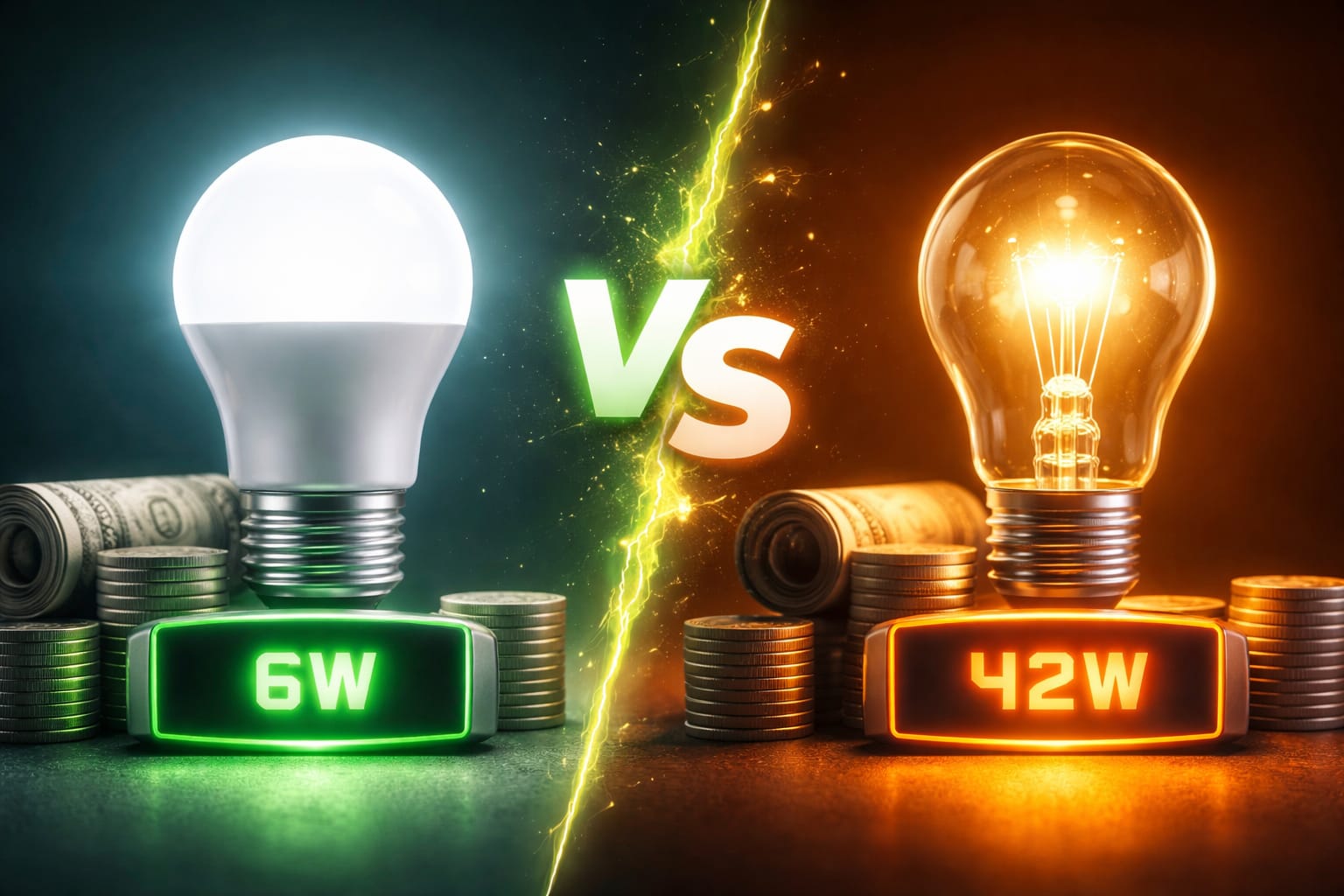
For most homes, LEDs are the better choice. They use far less electricity than halogen bulbs, run cooler, last longer, and usually cost less over time. A 50W halogen bulb can often be replaced with a 7W to 9W LED bulb, while six 50W halogen downlights can drop from about 300W total to roughly 42W with comparable LEDs.
- Choose LED if your priority is lower power usage and lower running costs.
- Choose LED first for kitchens, living rooms, exterior lights, and fixtures used for long hours.
- Check dimmers, transformers, base type, and enclosed fixtures before replacing halogen bulbs in bulk.
- Keep halogen bulbs only where a specific fixture or dimming system is not yet LED-compatible.
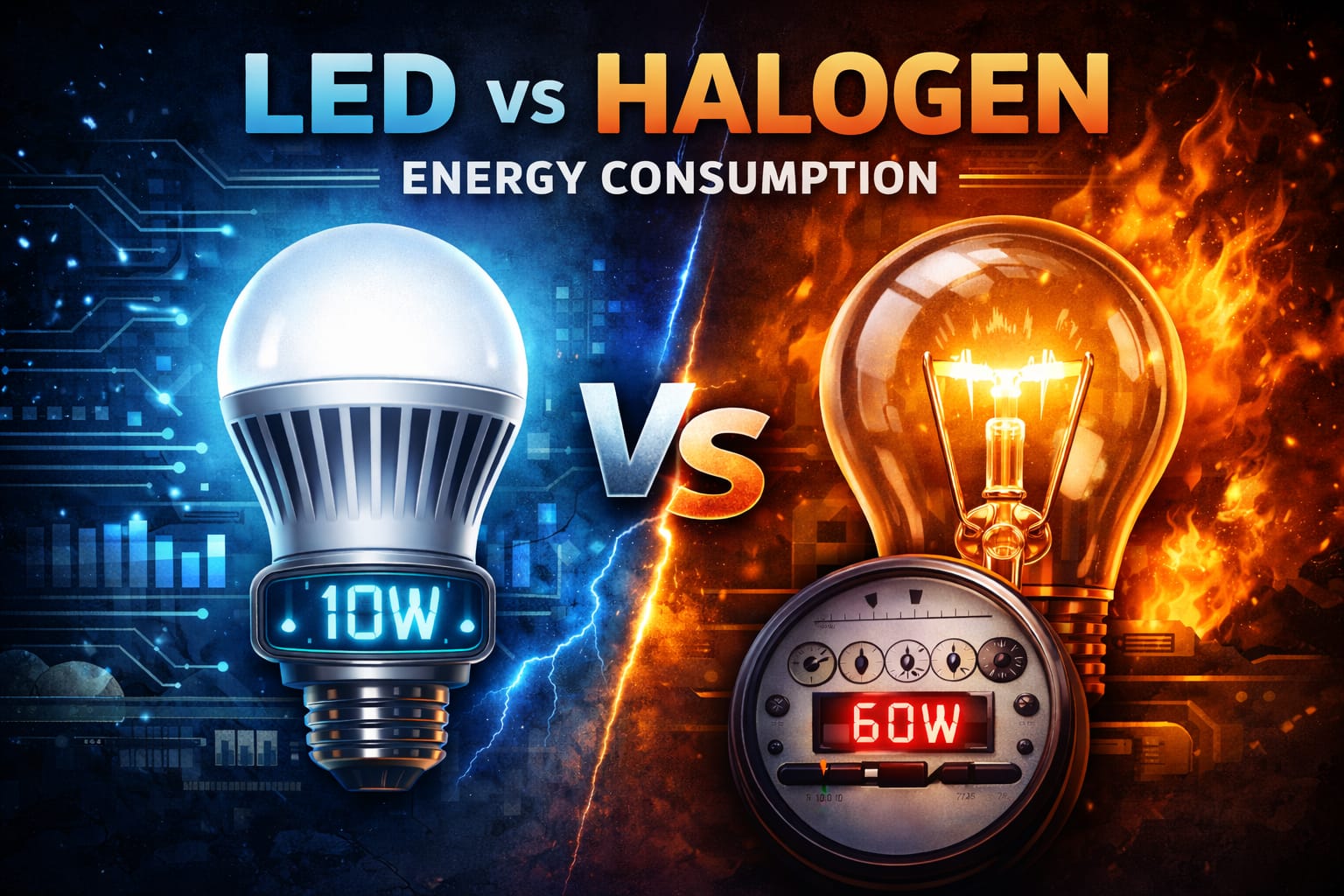
Table of Contents:
Watts vs Lumens: Why LEDs Use Less Power
Watts tell you how much electricity a bulb uses. Lumens tell you how much light it produces. This matters because a lower-wattage bulb is not automatically dimmer if it produces the same usable brightness more efficiently.
In a direct LED vs halogen energy consumption comparison, the key question is not simply which bulb has a lower wattage on the box. The useful question is how much power each bulb needs to reach the same light output. A typical 60W halogen bulb can often be matched by an LED using around 9W, which means the LED delivers similar brightness while drawing only a fraction of the electricity.
That is why searches around LED vs halogen wattage often lead to the same conclusion: LEDs convert more electricity into visible light, while halogen bulbs waste much more energy as heat. For a broader look at misleading assumptions around efficiency, see our guide to common LED energy myths.
LED vs Halogen Wattage: 50W Halogen vs 7W to 9W LED
The wattage difference becomes clear when you compare common replacements. A standard 50W halogen spotlight often only needs a 7W to 9W LED replacement to produce similar brightness. That is a major drop in lighting power usage without giving up useful illumination.
For GU10 track lights or recessed spotlights, a dimmable GU10 LED replacement for 50W halogen spotlights is the type of bulb to compare when you want similar brightness with much lower wattage.
Kitchen recessed lighting is one of the easiest examples. Six 50W halogen downlights draw 300W in total. Six comparable LED downlights may need only about 42W to 54W combined, depending on the exact bulb. In rooms where lights stay on every evening, that difference quickly becomes more than a small technical detail.
Outdoor security lighting shows the same pattern. A 150W halogen floodlight can often be replaced by a lower-wattage LED floodlight that covers the same area while using much less electricity. Track lighting also adds up quickly: five 40W halogen heads draw 200W, while five comparable LED heads may use closer to 35W to 50W total.
The exact LED equivalent depends on lumens, beam angle, color temperature, and fixture design, so it is better to compare brightness rather than replacing purely by wattage. If you are matching older bulb ratings to modern LEDs, an LED wattage equivalent chart can make the replacement decision clearer. For a wider comparison across bulb types, see our guide to LEDs vs halogens vs CFLs.
Efficiency, Heat and Light Quality
The most useful efficiency metric is lumens per watt. It shows how much visible light you get for each watt of electricity. Quality LEDs often deliver around 80 to 100 lumens per watt, and sometimes more, while halogen bulbs usually deliver much less.
Heat is the hidden reason halogens lose the efficiency battle. Halogen bulbs feel hot because a large share of their energy turns into heat rather than visible light. In small rooms, enclosed fixtures, desk lamps, bedside lamps, and warm climates, that wasted heat can make the fixture less comfortable and may add to cooling load during hotter months.
Light quality still matters. Halogen bulbs are known for warm color and strong color rendering, but modern warm-white LEDs can recreate much of that familiar look with far lower energy use. Color Rendering Index, or CRI, affects how natural colors appear, but it does not remove the energy-saving advantage of LEDs. If you want to compare tested efficiency labels and bulb performance claims, the ENERGY STAR light bulb guidance is a useful external reference.
LED vs Halogen Running Cost: What You Actually Pay
The running-cost difference becomes much easier to understand once watts are converted into electricity usage. The basic formula is simple: watts × hours used ÷ 1,000 = kilowatt-hours. Then multiply the kilowatt-hours by your electricity rate.
For example, a 60W halogen bulb used five hours a day consumes about 9 kWh per month. An equivalent 9W LED used for the same time consumes about 1.35 kWh per month. The saving from one bulb may look small at first, but the total changes quickly when you multiply it across kitchens, hallways, living rooms, exterior fixtures, and lamps used every day.
If you want to check your own fixture instead of relying only on estimates, a plug-in energy monitor for checking actual wattage can show how much power a lamp or plug-in lighting setup is really drawing. It is most useful for lamps, task lights, plug-in fixtures, and testing before-and-after changes.
The payback period is usually fastest in high-use fixtures. Although LEDs often cost more upfront, lower electricity use can offset the price difference within months in lights that stay on for long periods. The return improves further when you include fewer replacements over time. Our guide on how much LED lights save per year gives more detail on whole-home savings.
Start with kitchen lights, living room fixtures, exterior lights, and any halogen bulb that runs for several hours a day. Those locations usually show the fastest savings and the clearest payback.
Lifespan and Environmental Impact
Energy use is not the only cost difference. Lifespan matters too. Quality LEDs usually last much longer than halogen bulbs, which means fewer replacements, less maintenance, and lower total ownership cost.
This is especially valuable in hard-to-reach fixtures such as high ceilings, outdoor soffits, stairwells, chandeliers, and recessed lighting. Even when a light is not used constantly, avoiding repeated bulb changes can make LEDs the more practical choice. For more detail on longevity, see our guide to LED bulb lifespan.
The environmental benefit follows the same logic. Lower electricity demand generally means lower emissions from power generation, while longer lifespan means fewer replacement bulbs manufactured, packaged, shipped, and discarded. Proper recycling still matters, but the biggest everyday advantage comes from using less electricity and replacing bulbs less often.
Real-World Testing: How to Check Your Own Savings
Real measurements usually confirm what the specifications suggest. When bulbs are matched for similar brightness, LEDs draw far less power than halogen bulbs. The difference is easy to spot when you test a plug-in lamp, work light, or task light with a simple energy monitor.
Testing is most useful when you are comparing an old halogen bulb with a new LED replacement, checking a lamp that stays on for hours, or trying to prove whether a lighting upgrade is worth it before replacing multiple bulbs. For built-in ceiling lights, you may need to rely on bulb specifications or circuit-level measurements instead.
Seasonal usage can also change the value of the upgrade. In winter, lights often stay on longer because daylight hours are shorter. In summer, halogen heat can make small rooms feel warmer. Our guide to monthly savings when switching to LEDs explains how usage patterns can affect real bills, and our broader LED energy savings guide covers long-term savings across different lighting setups.
Dimming, Transformers and Fixture Compatibility
Most halogen-to-LED upgrades are straightforward, but compatibility is the main reason some replacements disappoint. Base type, fixture enclosure, dimmer behavior, and transformer setup can all affect performance.
Many halogen fixtures accept LED replacements with the same base type, including common formats such as GU10, MR16, and E26. In simple line-voltage fixtures, the swap can be as easy as replacing the bulb. The main exceptions are enclosed fixtures, low-voltage systems, and older transformers with minimum load requirements.
Dimming is another important check. Halogen bulbs use less power when dimmed, but not as efficiently as many people assume. LEDs usually keep a strong efficiency advantage across the dimming range, but older dimmers designed for halogen or incandescent bulbs may cause flickering, buzzing, limited dimming range, or unstable low-end performance.
If your current halogen setup uses an older dimmer or low-voltage transformer, check compatibility before buying LEDs in bulk. Even if the bulb fits, the control gear may still cause flicker, buzzing, or unreliable dimming.
If you are not replacing every halogen bulb at once, start with the fixtures that are used the most or are hardest to reach. Kitchens, living rooms, exterior lights, hallway fixtures, high ceilings, soffits, and stairwell fixtures usually offer the best balance of energy savings and convenience.
Want to understand bulb types, efficiency terms, and packaging specs before choosing replacements? The LED Knowledge Center provides more technical context for comparing lighting products.
What Should You Choose?
For most households, LEDs are the better choice because they use much less electricity, produce less wasted heat, last longer, and usually reduce total cost over time. Halogen bulbs only make sense when a fixture, transformer, or dimmer setup is not yet compatible with an LED replacement.
- For daily-use rooms: choose LEDs first in kitchens, living rooms, hallways, and home offices.
- For exterior lighting: replace high-wattage halogen floodlights with LED alternatives where coverage and brightness match.
- For low-voltage halogen systems: check transformer compatibility before buying several LED bulbs.
- For dimmable fixtures: use dimmable LEDs and a compatible LED-rated dimmer where needed.
- For hard-to-reach fixtures: prioritize LEDs because longer lifespan reduces replacement hassle.
Key Takeaways
The difference in energy consumption between LEDs and halogen bulbs is significant. For similar brightness, LEDs usually use 80% to 90% less electricity, run cooler, and cost less to operate.
A 50W halogen bulb can often be replaced with a 7W to 9W LED, while a group of six 50W halogen downlights can drop from about 300W total to roughly 42W to 54W with comparable LEDs.
The smartest upgrade path is to replace high-use halogen bulbs first, confirm dimmer and transformer compatibility, and use lumens rather than old wattage alone when choosing LED replacements.
Sharing This Guide
If this guide helped you compare LED and halogen energy consumption more clearly, save it or share it with someone planning a lighting upgrade.
Interested in more practical lighting comparisons? Browse related guides in our energy-saving LED lighting section.