Best Energy-Saving Lighting for Apartments: Practical Tips
The most effective lighting upgrades for apartments are usually simple changes that don’t require permanent modifications. Examples include swapping old bulbs for LEDs, using task lighting instead of lighting the whole room, adding timers or smart plugs, and choosing renter-friendly fixtures. These upgrades can reduce electricity use while making the apartment more comfortable.
For renters, the real goal is to lower energy use in a way that is practical and easy. It’s about getting better light in everyday spaces without creating lease problems, wasting money on upgrades you can’t keep, or making a small apartment feel harsher than necessary.
Quick Answer
If you want the biggest payoff first, replace the bulbs you use most with LEDs. Add a timer or smart plug to lamps that stay on too long. Use focused lighting in areas where you work, cook, or relax.
- Start with the bulbs you use every day
- Use lamps and task lights instead of full-room lighting
- Add simple controls to reduce wasted hours
- Choose portable upgrades that you can take with you
Looking beyond apartment lighting alone? Our LED Knowledge Center brings together practical guides on savings, bulb selection, smart controls, room layouts, and troubleshooting, helping you build a more efficient setup with fewer mistakes.
Table of Contents
- Quick Answer
- Start with LED Bulb Basics
- Understand Apartment Restrictions
- Choose Portable Lighting Solutions
- Use Timers and Automation
- Get More from Natural Light
- Use Task Lighting to Save More
- Smart Controls that Make Sense
- Pick Better Bulbs
- How Much Can You Save?
- Mistakes That Waste Electricity
- Seasonal Tips
- What Should You Prioritize?
- Key Takeaways
- Sharing this guide
Start with LED Bulb Basics
For most renters, the easiest way to save energy with lighting is to replace older bulbs with LEDs. This option is low-risk and affordable compared with larger home upgrades and is usually well within normal lease expectations. In everyday use, LEDs consume far less power than incandescent or halogen bulbs, and they last much longer. This results in savings on electricity and replacement costs.
This is especially important in apartments because the same rooms tend to be used heavily every day, such as the kitchen, living room, bathroom, and bedroom lamps at night. Replacing the bulbs used most frequently first usually provides the fastest return. If you are comparing technologies, this guide to the electricity cost of LEDs vs. incandescents shows why the savings add up faster than many people expect.
A better approach is to buy based on lumens rather than grabbing the highest watt-equivalent box on the shelf. Many apartments are overlit in one area and underlit in another, so achieving better efficiency often comes from distributing light more smartly instead of making everything brighter.
Lumen Requirements
Small spaces usually work best with layered lighting instead of one dominant light source. Living rooms often feel comfortable with roughly 1,500 to 3,000 lumens spread across a few fixtures rather than one harsh central bulb. Bedrooms usually need less, while kitchens and bathrooms often need more focused brightness where you cook, clean, and get ready.
This is why you should plan compact space illumination around how you use the room, not only around square footage. A studio apartment can feel brighter and more efficient with a floor lamp, a reading or desk lamp, and one well-chosen overhead bulb than with a single overpowered fixture. See how many lumens are recommended for each room.
Understand Apartment Restrictions
Many renter-friendly lighting solutions are effective precisely because they avoid making permanent changes. In most apartments, changing bulbs is permitted. However, replacing hardwired fixtures, drilling into ceilings, changing switches, or altering wiring can cause problems. This is why the smartest apartment lighting upgrades are often plug-in, portable, or easy to undo before moving out.
If your lease is strict, keep the original bulbs and avoid touching the wiring. Focus on lighting that can be easily unplugged, unclipped, or removed. This approach will give you lower running costs without creating deposit issues later.
Energy savings are not worth it if the upgrade risks damaging walls, fixtures, or wiring. In rentals, reversible changes are usually the safest and smartest option.
Reversible Upgrades
The best reversible upgrades are floor lamps, table lamps, clip lights, rechargeable lamps, removable LED strips, and plug-in automation. These options work especially well for renters because they improve poor lighting layouts without requiring landlord approval.
However, removable products still require some care. Adhesive strip lights can be useful, but only if the tape is genuinely removable and the surface can handle it. If you are using LEDs as part of a larger savings plan, it helps to avoid making assumptions about performance and cost. This guide to LED lighting energy myths clears up several common misconceptions.
Choose Portable Lighting Solutions
Portable lighting makes apartment efficiency practical. If the overhead light in your living room is too bright, poorly placed, or simply too wasteful for long evenings, a floor lamp with an energy-efficient LED bulb will often provide better results at a lower cost. The same is true for table lamps in bedrooms and desk lamps in work areas.
This is one of the easiest ways to reduce waste. Rather than lighting the entire apartment at full brightness, you can light only the part of the room you’re using. This simple change often does more to reduce utility bills than people expect.
Portable fixtures also make more financial sense for renters because you can take them with you when you move. A good lamp, a smart plug, and a few efficient bulbs can be useful in your next apartment, making the purchase easier to justify.
Clip Lamps
Clip lamps are especially useful in small apartments where floor space is limited. You can attach them to a shelf, desk, headboard, or side table to get focused light exactly where you need it. They are simple and inexpensive to operate, making them one of the most practical, renter-friendly lighting solutions for reading corners, compact desks, and bedside use.
The key is to use them instead of a large overhead fixture for low-intensity tasks. This is what makes apartment lighting efficient: a smaller light source closer to the task with fewer wasted lumens.
Use Timers and Automation
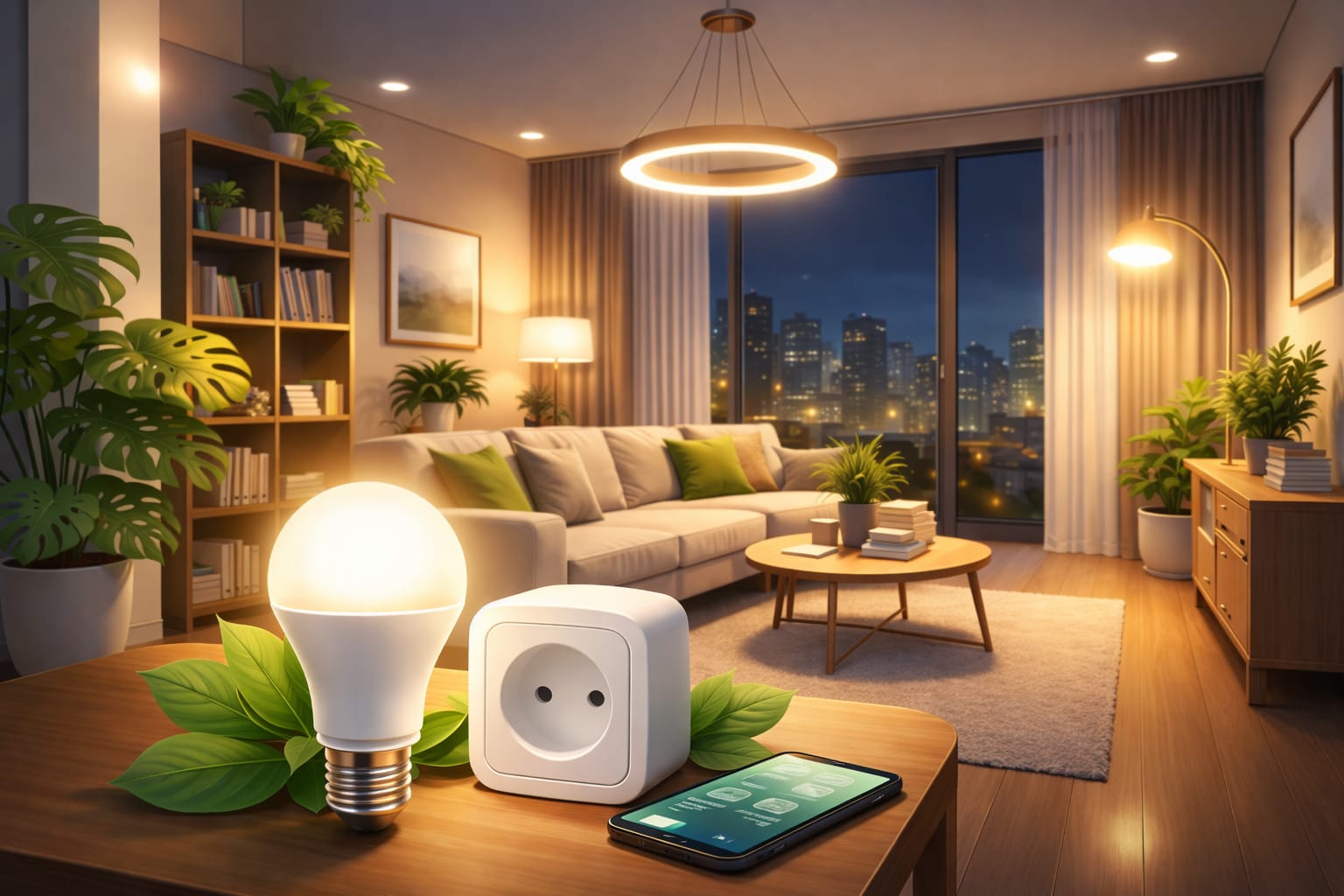
One of the easiest upgrades for an apartment is to add an automatic shutoff to lamps that are most often forgotten. Timers, smart plugs, and simple schedules are effective because they eliminate small daily habits that waste power over time.
If you want something cheap and simple, a plug-in timer is often enough. A smart plug is usually better if your schedule changes often or if you want app control. Renters can set up either one in minutes with no drilling or rewiring. If you are trying to save money, this guide to smart lighting on a budget is related to the same idea.
A reliable starting point is this plug-in light timer for standard lamps. It requires minimal setup and can easily be moved from one apartment to the next. For many renters, this is enough to prevent hallway, living room, or entryway lights from staying on longer than necessary.
According to the U.S. Department of Energy, efficient lighting works best when quality bulbs are paired with effective controls. This is why timers and schedules make such a noticeable difference over time.
Do not automate everything at once. Start with one or two lamps that are most often left on. Then, expand only if the routine is genuinely useful.
Occupancy Sensors
Occupancy sensors can work well in entryways, closets, storage areas, and bathrooms, where lights are only needed briefly. They aren’t necessary for every apartment, but they can be helpful in spaces where lights tend to stay on out of habit.
They are most useful in areas where people often forget to turn off the lights. Used selectively, they can support meaningful utility bill reduction without making the setup overly complicated.
Get More from Natural Light
Daylight is the cheapest lighting for any apartment, and it’s free! This may sound obvious, but many people underutilize it by leaving blinds partly closed, placing work surfaces too far from windows, or relying on artificial light too soon.
Small layout changes can make a big difference. For example, move a desk closer to a window, keep bulky furniture away from the brightest part of the room, and use lighter shades or sheer curtains if you need privacy without blocking too much light. In compact apartments, these changes often matter more than buying another bulb.
In these spaces, compact illumination is less about wattage and more about placement. An apartment that uses daylight well throughout the afternoon usually needs fewer hours of artificial lighting overall.
Mirror Placement
Mirror placement can help daylight travel farther into narrow or darker rooms. Placing a mirror opposite or near a window can make an apartment feel brighter without increasing electricity use. Leaning or freestanding mirrors are especially useful for renters because they prevent wall damage while improving a space’s light management.
Use Task Lighting to Save More
Task lighting is one of the smartest energy-saving upgrades for apartments because it solves two problems at once. It provides better visibility where needed and prevents the use of full-room lighting when unnecessary.
Often, a desk lamp for work, a reading lamp beside a chair, or under-cabinet lighting in the kitchen makes more practical sense than a bright central fixture. This approach is a more efficient and comfortable use of light. Apartments with limited outlets or awkward layouts especially benefit from this focused approach.
If you live in a studio or another compact space, LED lighting for small rooms is a good option since many of the same placement principles apply.
Adjustable Intensity
Adjustable brightness matters because the most efficient light isn’t necessarily the dimmest. Rather, it is the light level that suits the task. A lamp that can be dimmed for background lighting and brightened for reading is usually more efficient than a lamp with only one setting that is always brighter than necessary.
Dimmable lamps and tunable task lights are worth the extra cost for spaces you use every day. They give you more control, improve the ambiance of your apartment at night, and prevent over-lighting.
Smart Controls that Make Sense
Smart bulbs and smart plugs can help apartment renters save energy, but only when they solve a real problem. The most useful features are simple: remote shutoff for forgotten lights, routines that turn lamps off at night, schedules for entryway lighting, and dimming to lower output when full brightness isn’t necessary.
That is where the value lies. Not every apartment needs a full smart ecosystem. In many cases, a few bulbs or plugs in the most frequently used areas are enough. ENERGY STAR also points out that efficient bulbs paired with appropriate controls can improve overall savings and day-to-day usability.
The biggest advantage for renters is portability. Smart devices can be moved to a new apartment, making them much easier to justify than upgrades tied to the property itself.
Voice Integration
Voice control is convenient, but its real value lies in consistency. When it’s easier to say “Turn off the living room lights” than to get up or open an app, you’re more likely to avoid wasting energy. This may sound minor, but small behavioral changes are often how utility bill reduction actually happens over time.
Pick Better Bulbs
Bulb choice still matters. Good apartment lighting is not just about replacing older bulbs with LEDs. It’s about buying the right type of LED bulb for each room. Warm white bulbs usually work better in bedrooms and living rooms, while neutral white bulbs are often better suited for kitchens and bathrooms.
Consider dimmable bulbs for rooms that serve multiple purposes.
Quality matters, too. Cheap bulbs that flicker, buzz, dim poorly, or distort colors can make efficient lighting seem inferior to the setup you replaced. This often leads people to install more fixtures or purchase brighter bulbs than necessary, which undermines some of the benefits.
To balance efficiency with comfort, consider what each room actually needs instead of buying the same bulb for your entire apartment.
CRI importance
CRI (Color Rendering Index) matters most in places where color accuracy affects how the room feels or functions. Bathrooms, vanity areas, kitchens, and desks usually benefit from higher-quality bulbs. You don’t need premium CRI everywhere, but using it in areas where you’ll notice the difference can make efficient lighting much more enjoyable in everyday life.
How Much Can You Save?
This is the part that makes the topic worth caring about. In a one-bedroom apartment with around 20 bulbs used for an average of three hours per day, for example, the cost difference between older 60-watt bulbs and efficient eight-watt LEDs can be dramatic over the course of a year. That is why energy-saving lighting for apartments is not just a design decision. It’s a recurring cost decision.
With an electricity rate of $0.15 per kWh, 20 60W incandescent bulbs used for three hours per day would cost about $197.10 per year. The same number of 8W LEDs costs approximately $26.28 per year. This amounts to approximately $170 in yearly savings, not including better habits, smarter controls, or reduced heat output.
In practical terms, many apartments will see modest monthly savings rather than dramatic overnight changes. That is normal. Depending on bulb count, usage patterns, and local electricity rates, a renter might save around $10 to $20 per month.
Mistakes That Waste Electricity
The biggest mistake is thinking efficiency only comes from the bulb itself. In reality, waste usually comes from the full setup: a brighter bulb than needed, one overhead fixture doing all the work, lights left on in empty rooms, or poor use of daylight during the day.
Another common mistake is buying a smart bulb or timer and never actually using the scheduling features. The hardware only helps if it changes your routine. A simple schedule that turns a lamp off every night is usually more valuable than a feature-heavy product left in manual mode forever.
Over-lighting is another quiet problem in apartments. People often try to make a room feel better by adding brightness when what they really need is better placement, a warmer color temperature, or more focused light near the activity area.
Wrong Bulbs
Using the wrong bulb type can create enough frustration to waste money as well as power. Covered fixtures may need enclosed-rated bulbs. Dimmer setups need compatible dimmable bulbs. Some spaces simply do not need a high-lumen bulb at all. Matching the bulb to the fixture and the task is what makes a lighting plan feel efficient in real life, not just in theory.
Seasonal Tips
Apartment lighting use changes more by season than many people realize. In winter, lights come on earlier and stay on longer. In summer, daylight does more of the work. That means your most efficient setup is usually one that can adapt without much effort. Timers, smart plugs, and adjustable lamps help because they can shift with the season instead of locking you into one pattern.
This is also where LEDs have a less obvious advantage. They produce much less heat than incandescent bulbs, so less electricity is wasted as unnecessary warmth inside the apartment. In hot weather, that can slightly reduce the cooling burden as well.
Temperature Considerations
Because LEDs reach full brightness quickly and run cooler than older bulb types, they work well year-round. That makes them especially practical in apartments where comfort, energy use, and small-space heat buildup matter more than they might in a larger home.
What Should You Prioritize?
The best order is usually simple: upgrade the bulbs you use most, improve lighting placement with portable fixtures, and then add controls only where they actually reduce wasted hours.
- If your bills matter most → replace high-use bulbs first
- If the apartment feels badly lit → add layered portable lighting
- If lights get left on often → add timers or smart plugs
- If the space is small → use task lighting instead of more overhead brightness
- If you move often → favor upgrades you can pack and reuse
Key Takeaways
The best energy saving lighting for apartments comes from practical, reversible improvements rather than complicated upgrades. LEDs, better placement, portable fixtures, and simple controls usually deliver the biggest gains first.
For renters, efficiency works best when it also respects lease restrictions. Portable lamps, smart plugs, task lighting, and removable solutions often save more money in the long run than upgrades tied to the apartment itself.
Focus on the rooms and fixtures you use most, avoid over-lighting small spaces, and build a setup that feels comfortable enough to keep using every day. That is what turns efficient lighting into real, lasting savings.
Share this guide!
If you found this guide helpful, you can save it for later or share it with a friend. It is especially useful for renters, apartment dwellers, and anyone trying to lower lighting costs without making permanent changes.
Share using the links below
Interested in learning more? Browse all related articles in our category section.