Are Colored LED Lights on Cars Legal? Safe Colors & Risks
Colored LED lights on cars are not automatically legal. For normal road use, white or amber is usually the safest choice at the front, red is reserved for required rear lighting functions, and red or blue exterior accent lights are the biggest legal risk because they can look like emergency or warning lights.
This guide is for drivers who want to customize a car with LED strips, underglow, grille lights, footwell lights, or color-changing kits without creating problems during traffic stops, inspections, or everyday road use.
Quick Answer: Are Colored LED Lights Legal on Cars?
Colored LED lights on cars are usually legal only when they do not replace required lights, do not flash, do not face the wrong direction, and do not use protected emergency colors like red or blue where other drivers can see them.
- Lowest-risk option: subtle interior LEDs, especially RGB LED accent lights for interior-only car customization.
- Safer exterior colors: white or amber, depending on placement and local rules.
- Highest-risk colors: red, blue, flashing, strobing, or color-changing lights visible from outside.
- Front-facing lights: usually need to stay white or amber.
- Rear-facing lights: usually need to stay within standard red, amber, and white signal functions.
- Underglow: rules vary heavily by state, city, color, brightness, movement, and visibility angle.
Table of Contents:
- Quick Answer
- Why Car LED Light Laws Are Strict
- What Color LED Lights Are Legal on Cars?
- Where Can You Place Colored LED Lights?
- Is Underglow Legal While Driving?
- Are Interior LED Lights Legal in Cars?
- State Rules, Fines, Inspections, and International Use
- What Setup Should You Choose?
- FAQ
- Key Takeaways
- Sharing This Guide
Why Car LED Light Laws Are Strict
Vehicle lighting laws exist because drivers read color as a road signal. White headlights, red brake lights, amber turn signals, side markers, reverse lights, and emergency warning lights all tell other road users what a vehicle is doing. When a custom LED setup changes those signals, it can create confusion even if the modification is decorative.
The biggest concern is emergency-vehicle confusion. Red and blue lights have a strong meaning on the road, so civilian vehicles using those colors externally can attract attention from police even when the lights are steady rather than flashing.
Federal standards also shape the baseline for lighting equipment. In the United States, FMVSS No. 108 covers lamps, reflective devices, and associated equipment, including requirements for vehicle lighting performance and equipment. State and local rules then determine how modified vehicles can be used on public roads.
If you are new to functional and decorative car lighting, the car LED lights beginner guide is a useful next step before choosing between interior strips, underglow, bulb replacements, or exterior accent lighting.
What Color LED Lights Are Legal on Cars?
The safest answer is not “one color is always legal.” Legality depends on color, position, brightness, whether the light moves or flashes, and whether it is visible while driving. Still, some color rules are much more predictable than others.
Color
White
Typical road-use risk: Lower risk when used correctly.
Practical guidance: Usually expected at the front and for reverse lights, but beam pattern, brightness, and placement still matter.
Color
Amber
Typical road-use risk: Often acceptable in specific positions.
Practical guidance: Common for turn signals, side markers, and some front-facing auxiliary lighting, but still regulated.
Color
Red
Typical road-use risk: High risk outside normal rear lighting.
Practical guidance: Expected for brake and rear marker functions, but risky as decorative lighting, especially if visible from the front or side.
Color
Blue
Typical road-use risk: Very high risk.
Practical guidance: Usually associated with police or emergency vehicles and commonly restricted when visible from outside.
Color
Green, Purple, Pink, Neon Colors
Typical road-use risk: Depends on local rules.
Practical guidance: May still be illegal if distracting, too bright, visible in the wrong direction, or reserved for special vehicle categories.
Are Red and Blue LED Lights Legal on Cars?
Red and blue are the most sensitive colors for civilian vehicles. In most jurisdictions, red or blue exterior LED lights are restricted when they can be seen by other drivers, especially if they are mounted in the grille, windshield area, bumper, roofline, underbody, or side of the vehicle.
This restriction often applies even if the lights are not flashing. A static blue accent strip, a red glow visible from the front, or a color-changing kit accidentally left on red or blue can still create legal risk because the problem is the signal it sends to other drivers.
Do not assume that a non-flashing red or blue accent light is safe just because it is decorative. In many places, visibility from outside the vehicle is enough to trigger a stop, ticket, or inspection problem.
Amber, green, and other colors can also be restricted in specific situations. Amber is often associated with warning or service vehicles, while green may be reserved in some areas for volunteer firefighters or other authorized responders. That is why state and local vehicle codes matter more than general advice.
Where Can You Legally Place Colored LED Lights?
With colored LED lights on cars, placement can matter as much as color. A light that seems harmless inside the cabin may become a problem if it shines through the windshield. A downward-facing underbody light may still be questioned if the glow is visible from the front or rear. A decorative strip on the side may interfere with side-marker expectations.
Front, Rear, and Side Visibility
The front of the vehicle is usually the strictest area. Lights visible to oncoming traffic generally need to stay white or amber, and they should not imitate police, fire, EMS, construction, or hazard warning equipment.
At the rear, red remains the expected color for taillights and brake lights, while white is normally reserved for reverse lights. Blue, green, purple, or bright decorative rear lighting can create confusion because drivers behind you rely on standard rear signals to judge braking, reversing, and vehicle position.
Side markers follow their own logic: amber toward the front and red toward the rear. A side-mounted LED strip can become risky if it introduces a protected color, creates a misleading glow, or makes it harder for other drivers to understand which end of the vehicle they are seeing.
Are Colored LED Headlights and Taillights Legal?
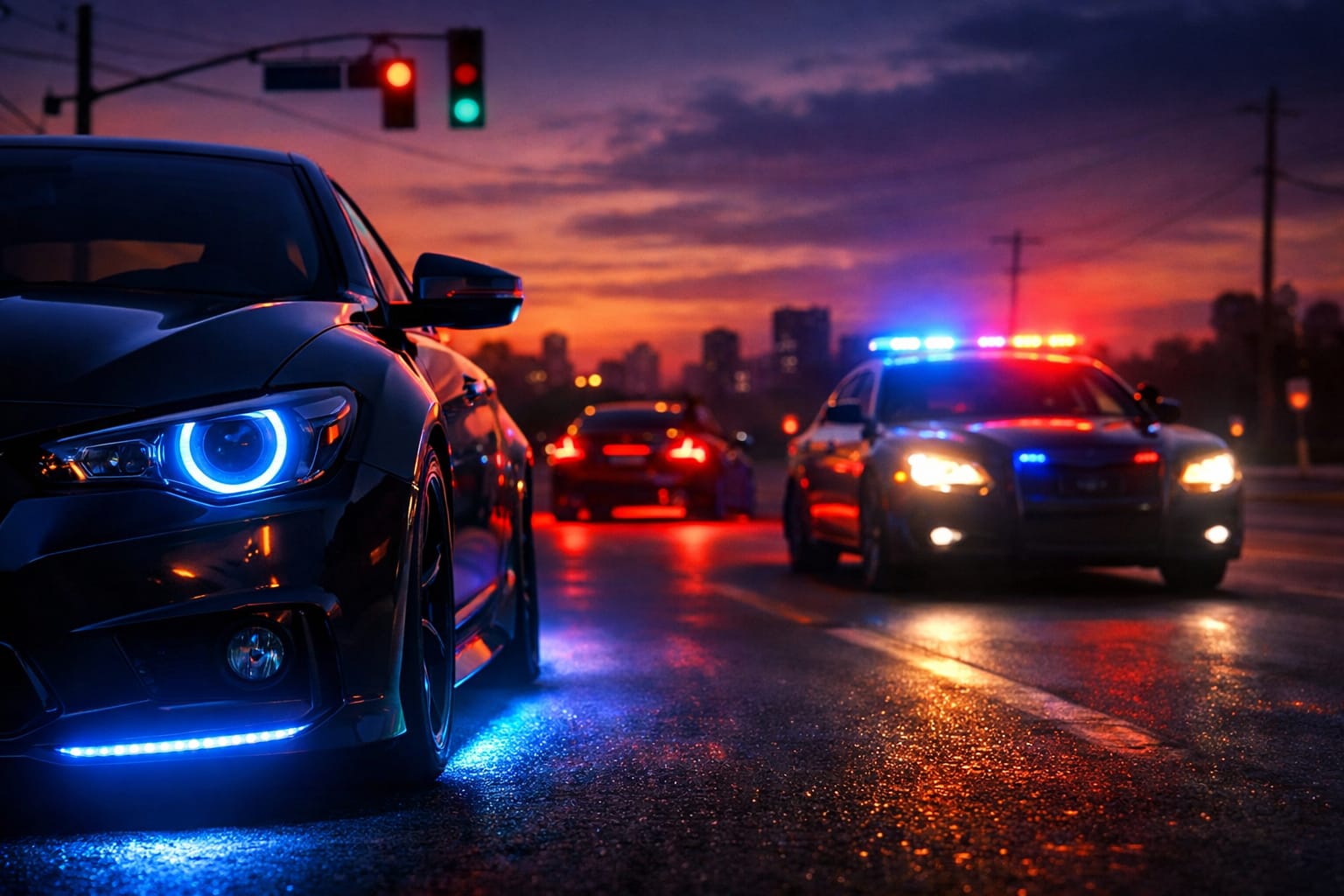
True colored headlights are generally not road legal. Drivers sometimes want blue, purple, or tinted headlight effects, but road-use headlights are expected to provide a compliant white beam rather than a clearly colored output. A cooler white may look slightly bluish because of LED color temperature, but that is not the same as installing a blue headlight.
Taillights are just as sensitive. Brake lights and rear running lights are expected to be red, and reverse lights are expected to be white. Smoked covers, tinted housings, decorative inserts, or poor LED retrofits can fail if they reduce output, distort the required color, scatter the beam, or make the car harder to read at night.
For a deeper look at certification, beam pattern, glare, and retrofit risks, see our guide to safety and certification standards for automotive LED lighting.
Is Underglow Legal While Driving?
Underglow is one of the most popular ways to use colored LED lights on cars, but it is also one of the least consistent legally. Some states allow limited underglow, while others restrict colors or visibility angles, and some treat underbody glow as illegal on public roads even when the color seems harmless.
White and amber underglow are usually safer choices than red or blue, but they are not guaranteed to be legal everywhere. Rules may focus on the color, whether the light is flashing, whether the tubes or diodes are visible, whether the glow can be seen from the front or rear, and whether the car is moving on a public road.
Our dedicated guide to LED underglow lights and legal road use goes deeper into the state-by-state issues that matter before installation.
Animated effects are especially risky. Flashing, strobing, chasing patterns, rapid color changes, and police-style sequences are widely restricted because they distract other drivers and can resemble emergency or hazard signaling.
If you mainly want underglow for shows, photos, or private-property use, choose an underglow kit with clear on/off control for show or private-property use. The safest road-use habit is to keep exterior decorative lighting off whenever legality is uncertain.
Are Interior LED Lights Legal in Cars?
Interior LED lights are usually the easiest and lowest-risk way to customize a car. Footwell lighting, door-panel accents, cupholder lighting, and subtle dashboard glow are often treated more flexibly because they are not intended to communicate with other drivers.
However, interior lighting is not a free-for-all. It can still become a problem if it is very bright, reflects off the windshield, interferes with night vision, distracts the driver, or shines outward strongly enough to look like exterior red or blue warning lighting.
The safest approach is subtle brightness, low mounting positions, and cabin-focused placement. Avoid pointing lights toward the windshield or side windows, and avoid using intense red or blue interior lighting while driving if it can be seen from outside.
Best low-risk use: Use interior LEDs for footwells, subtle trim accents, and cabin ambience. Keep exterior-facing red, blue, flashing, or high-brightness effects off while driving.
If you are comparing simple cabin glow with multi-zone color effects, the RGB vs RGBIC LED strips guide explains how basic color control differs from addressable lighting zones.
State Rules, Fines, Inspections, and International Use
State-by-state differences are where many drivers get caught. Two states may agree that emergency colors are restricted but treat underglow, amber lighting, interior LEDs, or decorative side strips differently. A setup that seems acceptable in one state may still be a problem after crossing a border.
Some states are more permissive and may allow limited decorative lighting if it is not red or blue, does not flash, does not distract drivers, and does not interfere with required lamps. Other states are more restrictive and may allow only lighting that clearly serves a recognized legal function.
Enforcement also varies. A minor lighting issue may lead to a warning or fix-it ticket, while emergency-style lighting can lead to citations, larger fines, required removal, inspection failure, or more serious consequences if the setup appears to impersonate an authorized vehicle.
Before an inspection, review every added light. Confirm that headlights, turn signals, brake lights, side markers, taillights, and reverse lights still use the correct color and function. Disconnect questionable decorative lighting before inspection if your local rules are strict or unclear.
International rules can differ even more. European ECE standards, North American SAE expectations, and country-specific road rules do not always align. If you drive across borders, import parts, or compare international advice online, our LED car light laws by country guide helps place local rules in a wider context.
What Setup Should You Choose?
If your goal is a clean custom look without constant legal risk, choose the setup based on where the light will be seen and how you will use the car.
●Daily Driving
Better choice: Subtle interior lighting, legal white/amber exterior lighting where allowed.
Avoid: Exterior red, blue, flashing, or police-style effects.
●Cabin Ambience
Better choice: Footwell lights, door accents, low-brightness cabin strips.
Avoid: Bright LEDs aimed at the windshield or windows.
●Car Meets and Photos
Better choice: Underglow or color-changing effects used only where allowed.
Avoid: Leaving show modes on while driving on public roads.
●App-Controlled Customization
Better choice: Cabin-only zones and controlled brightness.
Avoid: Exterior color sequences that can flash, chase, or mimic emergency lighting.
For most drivers, the best balance is simple: keep required exterior lights compliant, avoid red or blue exterior accents, reserve show lighting for private property, and use interior lighting for everyday personalization.
If you want app control and multiple cabin zones, app-controlled RGBIC interior lights for cabin-only color zones are a safer direction than exterior color-changing strips because they keep the effect inside the vehicle and away from required road signals.
Proper installation still matters. Secure mounting, safe wiring, adequate fusing, reliable switching, and a clear off mode are just as important as choosing the right color. The best custom setup is one that looks good, does not distract the driver, and does not confuse other road users.
For more lighting basics, safety concepts, troubleshooting guides, and upgrade comparisons, explore the LED Knowledge Center.
FAQ
Can I Drive With Colored LED Lights On?
Sometimes, but only if the color, position, brightness, and visibility comply with local law. Interior lights are usually less risky than exterior lights, while red, blue, flashing, and strobing effects are the most likely to cause trouble.
Are Blue LED Lights Illegal on Cars?
Blue exterior LED lights are commonly restricted because they can be associated with police or emergency vehicles. Even a non-flashing blue accent light can be risky if it is visible from outside the car.
Are Red LED Lights Allowed Inside a Car?
Red interior lighting may be allowed in some places when it is dim, cabin-focused, and not visible as an exterior signal. It becomes riskier if it shines through the windshield, side windows, or rear glass in a way that looks like emergency or warning lighting.
What Should I Check Before Buying a Car LED Kit?
Check your state and local vehicle code, whether the kit is meant for interior or exterior use, whether it has flashing modes, whether it can be turned completely off, and whether the colors you want are legal where the light will be visible.
Key Takeaways
Colored LED lights on cars are not automatically illegal, but exterior use is tightly controlled. The safest assumption is that front-facing lighting should stay white or amber, required rear lighting should stay within standard red, amber, and white functions, and red or blue exterior accent lights are high risk.
Interior LEDs are usually the lowest-risk customization option, especially when they are subtle, cabin-focused, and not shining outward. Underglow can look great, but it should be treated as a state-by-state issue rather than a universally legal upgrade.
The best setup is practical, controllable, and easy to switch off. If a light can confuse another driver, imitate emergency equipment, distract the driver, or interfere with required lamps, it is not worth the risk on public roads.
Sharing This Guide
If you found this guide helpful, please save it or share it with another driver planning a lighting upgrade.
Share using the links below.
Interested in learning more? Browse all related articles in our car LED accessories section.