Do LED Car Lights Save Energy? Watts, Battery & Fuel Savings
Yes, LED car lights usually save energy compared with halogen bulbs. A typical halogen headlight can draw around 55 watts per bulb, so a pair may use roughly 110 watts while driving. Many LED headlight setups use less power for similar or better road visibility, although the exact draw depends on the product, vehicle and installation.
The real benefit is lower electrical load, less wasted heat and longer bulb life. Just do not expect a dramatic improvement in fuel economy or EV range. For most drivers, the savings are useful but modest, and the bigger decision is whether the LED upgrade improves visibility safely and fits the vehicle correctly.
Quick Answer
LED car lights usually use less power than halogen lights, especially in headlights, brake lights, tail lights, turn signals and interior bulbs. The saving is most noticeable as lower electrical load and less heat, not as a big change in fuel economy.
- Power use: LED lights normally draw less current than comparable halogen bulbs.
- Battery and alternator: The lower draw can slightly reduce electrical stress, especially with many accessories running.
- Fuel or EV range: Any improvement is usually small, because headlights are only one part of total vehicle energy use.
- Best reason to upgrade: Better efficiency, longer life and improved visibility from a quality, well-aligned setup.
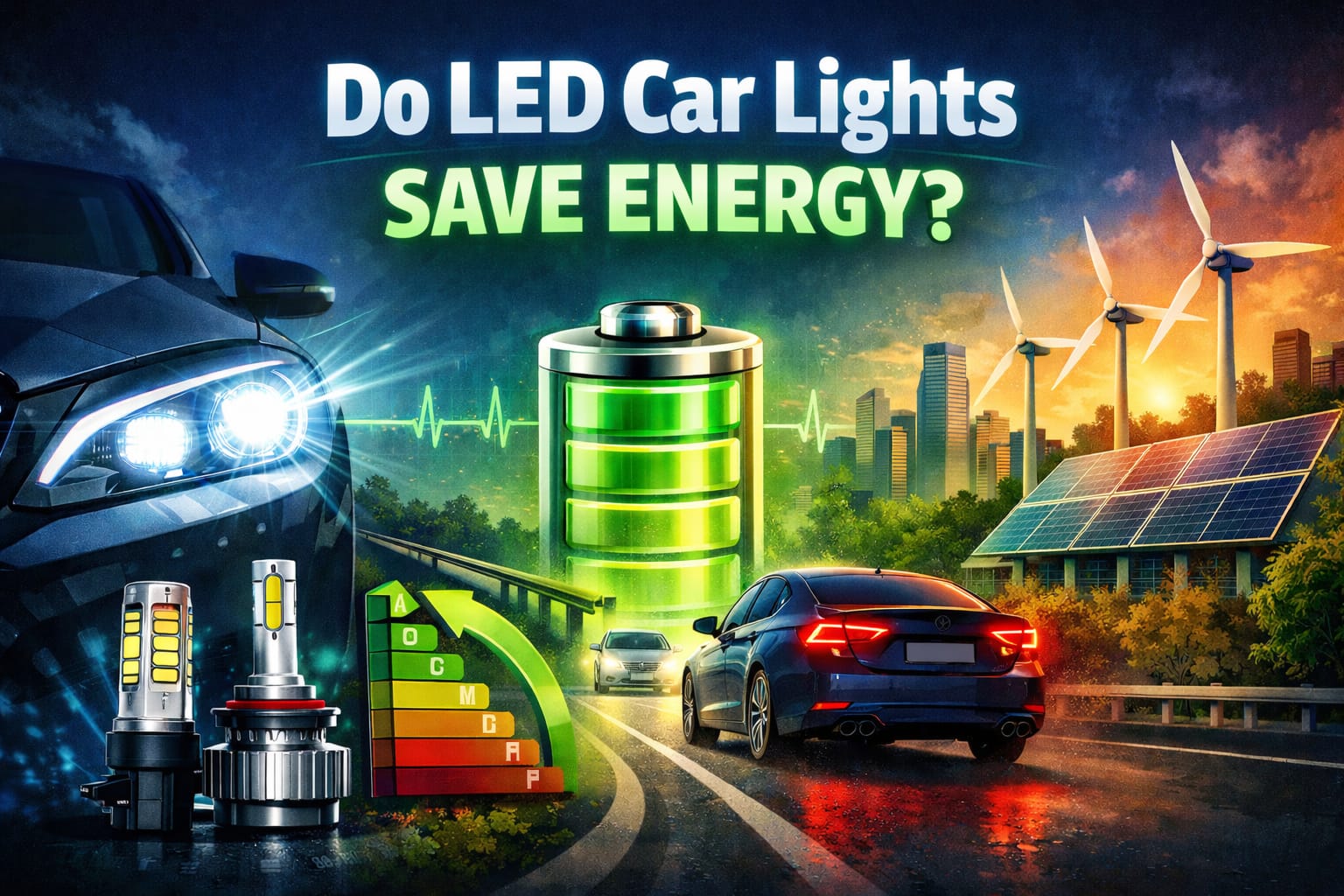
Table of Contents:
Do LED Car Lights Save Energy in Real Driving?
LED car lights save energy because they convert more electricity into usable light and waste less of it as heat. Halogen bulbs create light by heating a filament, which is simple and affordable but inefficient. A large part of the electricity becomes heat instead of road illumination.
Automotive LED technology works differently. LEDs use semiconductor components, controlled current and dedicated optics to produce light more precisely. That usually means lower power consumption, cooler operation and more useful light from the same vehicle electrical system.
The difference is most useful when the vehicle uses several lights at the same time: headlights, tail lights, brake lights, turn signals, license plate lights, interior dome lights and cargo-area lighting. One bulb may not transform the vehicle, but a full lighting system with efficient LEDs can reduce total electrical demand across more circuits.
For smaller positions such as interior lights, license plate lights or courtesy lights, T10/W5W LED bulbs for interior and license plate lights can reduce draw across multiple small circuits while keeping the upgrade simple. Always check your vehicle’s bulb size before ordering.
Lower wattage alone does not automatically mean a better headlight. An efficient and safe LED setup also needs the correct beam pattern, proper optics, enough cooling space and careful alignment.
If you are comparing a full vehicle lighting upgrade rather than only headlights, the guide to LED lights for cars explains the different bulb positions and what each upgrade actually changes.
How Many Watts Do LED Car Lights Use vs Halogen?
Car headlight power consumption is one of the easiest ways to understand the efficiency difference. Many halogen headlights draw around 55 watts per bulb, which means a pair of low beams may use roughly 110 watts while driving. HID systems often use less power than halogens after startup, and many LED headlight setups use less power than halogen bulbs while delivering comparable or stronger usable light.
However, not every LED product has the same wattage or the same performance. Output level, cooling design, driver quality, LED chip placement and whether the system is factory-installed or aftermarket can all affect the final result. A low-wattage LED bulb that produces a poor beam pattern is not a better upgrade just because it consumes less electricity.
Simple comparison:
Often around 55 watts per headlight bulb.
Often lower draw, depending on design and output.
Lower electrical load, less heat and usually longer service life.
Wattage does not prove beam quality, legality or compatibility.
For beam performance, brightness and daily usability, see the full comparison of LED versus halogen headlights. If you also want to compare LEDs with discharge lighting, LED Headlights vs. HID breaks down the practical differences.
Battery, Alternator, Fuel Economy and EV Range
When your lights draw less power, the vehicle’s electrical system has less work to do. This does not transform the car, but it can reduce the load on the alternator and slightly lower demand on the battery, especially when lighting, climate control, infotainment, heated seats and charging ports are all running at the same time.
This matters most in older vehicles, cars with many electrical accessories, stop-and-go driving, short trips and cold starts. LED lighting will not fix a weak battery, but lower current draw can reduce electrical stress in situations where the charging system has limited time to recover.
Fuel economy and EV range are where expectations need to stay realistic. In a combustion vehicle, less electrical load can mean slightly less work for the alternator. In an electric vehicle, every accessory load is part of total energy use. But headlights are still only a small part of the full driving load, so the fuel or range improvement is usually modest.
Do not buy an LED kit expecting major fuel savings. The best reason to upgrade is the combination of lower power consumption, longer lifespan and better lighting performance when the product, beam pattern and installation are right.
If you are new to the automotive side of LED lighting, the car LED lights beginner guide is a useful next step before changing several bulbs at once.
Before You Replace Halogen Bulbs with LEDs
Just because LEDs are more efficient does not mean every retrofit is a good upgrade. Fitment, cooling space, polarity, CAN-bus sensitivity, reflector or projector design and bulb alignment can all affect the final result. A cheap LED bulb may use less electricity but still perform poorly if it puts light in the wrong place.
Factory LED systems are usually designed around the housing, optics and heat management from the start. Aftermarket LED products vary more widely, so quality and compatibility matter much more. If your vehicle is sensitive to dashboard errors or flickering after a lighting change, our guide to CAN-Bus in car LED lighting explains one of the most common compatibility issues.
Legal compliance also matters. Energy efficiency should never come at the expense of safety. In the United States, NHTSA has warned that some LED replacement bulbs for replaceable-bulb headlamps may not comply with FMVSS No. 108, even though LED light sources can be used in properly designed compliant headlamp systems. You can read the official NHTSA interpretation on LED headlights and FMVSS No. 108.
Checklist
- ✓ Confirm the correct bulb size for your vehicle.
- ✓ Check whether your car needs CAN-bus compatible bulbs or decoders.
- ✓ Make sure the LED bulb can fit with enough cooling space.
- ✓ Choose beam quality and alignment over the highest lumen claim.
- ✓ Check local road-use rules before using aftermarket LEDs in headlight housings.
For vehicles that use H11, H8 or H9 bulbs, H11/H8/H9 LED headlight bulbs with CAN-Bus support can be a practical option when compatibility, cooling space and beam pattern are checked first.
The safest upgrade is not simply the lowest-watt bulb. It is the setup that reduces power draw while keeping the beam controlled, legal and useful on the road.
Are LED Car Lights Worth It for Energy Savings?
For most drivers, yes, LED car lights are worth considering. They usually reduce power consumption, improve vehicle lighting efficiency and last longer than halogen bulbs. But the upgrade makes the most sense when you value better visibility and lower electrical load, not just tiny fuel savings.
The strongest value comes from the full ownership picture: less heat, fewer replacements, lower current draw and better light quality from a well-designed setup. That matters more than the wattage number alone.
If your current halogen headlights are dim, burn out often or make night driving uncomfortable, LEDs may be a practical upgrade. If your only goal is to noticeably improve MPG or EV range, the payoff will probably feel too small.
What Should You Choose?
The best choice depends on what problem you are trying to solve. If your goal is simply to save fuel, LED car lights are probably not the biggest upgrade you can make. If your goal is lower electrical load, longer bulb life and better night visibility, a quality LED setup can make much more sense.
Best option by situation:
- Daily city driving: prioritize reliability, legal fitment and clean beam control over maximum brightness.
- Frequent night driving: choose a quality LED headlight setup with strong optics and proper alignment.
- Older battery or many accessories: LED lighting can help reduce electrical load, but it should not replace battery or alternator maintenance.
- EV or hybrid use: LEDs can reduce accessory load slightly, but the range gain will usually be small.
- Full vehicle conversion: upgrade gradually and check each lighting position instead of assuming every bulb should be replaced at once.
For rear lighting positions, 1157 LED brake and tail light bulbs can reduce draw in brake and tail light circuits, but always check your vehicle’s bulb size, socket type and color requirements before ordering.
If you are deciding which lighting positions matter most, our guide to the best LED car lighting upgrades can help you prioritize headlights, tail lights, interior bulbs and other common upgrades.
FAQ
Do LED Headlights Use Less Power than Halogen Headlights?
Yes, LED headlights usually use less power than halogen headlights for comparable usable light. The exact difference depends on the LED design, driver electronics and vehicle setup.
Do LED Headlights Save Battery?
They can reduce battery demand because they normally draw less current than halogen bulbs. However, LED headlights will not fix a weak battery or charging problem. They only reduce part of the electrical load.
Do LED Car Lights Improve Fuel Economy?
LED car lights can slightly reduce alternator load in combustion vehicles, but the fuel economy improvement is usually small. Most drivers notice better light quality and longer bulb life before they notice fuel savings.
Are LED Car Lights Always Better than Halogen Bulbs?
No. A good LED setup can be more efficient and longer lasting, but a poor retrofit can create glare, dashboard errors or poor beam control. Compatibility and beam pattern matter as much as efficiency.
Key Takeaways
LED car lights typically consume less electricity than halogen bulbs, making them a more efficient choice for modern vehicles. The clearest benefits are lower electrical draw, less heat and longer bulb life.
The fuel economy or EV range improvement is usually modest. LEDs can reduce accessory load, but lighting is only one part of total vehicle energy use.
The best LED upgrade is not just the one with the lowest wattage rating. It should fit the vehicle, control glare, maintain a safe beam pattern and improve real-world visibility.
Sharing This Guide
If you found this guide useful, save it for later or share it with someone who is comparing halogen and LED car lighting upgrades.
Use the links below.
Interested in learning more? Browse all related articles in our Car LED Accessories category section.