LED vs Halogen Headlights: Best Choice for Night Driving
For most drivers, LED headlights are the better choice for night driving because they are brighter, more efficient, and last much longer than halogen bulbs. Halogen headlights still make sense if you want the cheapest, simplest replacement for an older car.
This guide compares LED vs halogen headlights by visibility, beam quality, lifespan, cost, fitment, and legality so you can decide whether upgrading to LED is really worth it for your vehicle.
Quick Answer: Are LED Headlights Better Than Halogen?
LED headlights are better for most drivers who want stronger night visibility, lower power use, and longer bulb life. Halogen headlights are better if you need a low-cost replacement, have an older vehicle, or want to avoid fitment and glare issues.
- Best for night visibility: LED headlights.
- Best for cheapest replacement: halogen headlights.
- Best for older reflector housings: often halogen, unless the LED retrofit is properly matched.
- Main LED risk: glare, poor beam pattern, dashboard errors, or local legality issues.
- Best decision: choose based on housing type, socket fitment, budget, and how often you drive at night.
Table of Contents:
LED vs Halogen Headlights at a Glance
The main difference between LED and halogen headlights is how they create light. Halogen bulbs use a heated tungsten filament inside a gas-filled bulb, which makes them simple, affordable, and easy to replace. LED headlights use semiconductor chips, which allow them to produce strong light output with less power and less wear over time.
That technology difference affects almost every practical buying decision: how far you can see at night, how often you replace bulbs, how much power the lights use, how much the upgrade costs, and whether the beam pattern works correctly in your vehicle.
Night Visibility
LED Headlights
Usually stronger, clearer, and whiter when properly aimed.
Halogen Headlights
Softer, warmer light with shorter usable range.
Cost
LED Headlights
Higher upfront cost, better long-term value if the kit is reliable.
Halogen Headlights
Cheapest and simplest short-term replacement.
Lifespan
LED Headlights
Often much longer, depending on heat management and build quality.
Halogen Headlights
Shorter lifespan because the filament wears out over time.
Compatibility
LED Headlights
Must match the socket, housing, beam pattern, and local rules.
Halogen Headlights
Usually easiest to replace in vehicles designed for halogen bulbs.
Best Use Case
LED Headlights
Frequent night driving, rural roads, long-term ownership.
Halogen Headlights
Budget replacement, older cars, simple maintenance.
Are LED Headlights Brighter Than Halogen?
LED headlights are usually brighter than halogen headlights. Many LED bulbs are marketed in the range of 3,000 to 6,000 lumens per bulb, while many halogen bulbs are closer to 1,000 to 1,500 lumens. In real driving, that can mean better forward visibility, earlier hazard detection, and clearer road sign recognition.
However, brightness alone does not make a headlight better. A clean beam pattern matters more than a high lumen claim. A properly designed LED setup should put more light on the road without scattering it into the eyes of oncoming drivers. If you want to understand what brightness numbers actually mean before buying, our car LED headlight brightness guide explains lumens, beam distance, and usable road light in plain terms.
This is where many LED upgrades succeed or fail. A quality LED bulb in a compatible housing can improve nighttime confidence. A poor LED retrofit in the wrong reflector housing can create glare, uneven output, or even worse road visibility than the original halogen bulb.
If you want better visibility without blinding other drivers, focus on beam control and proper aiming first. A brighter bulb in the wrong housing may perform worse than a lower-output bulb in a properly matched setup.
For official safety context, review vehicle lighting guidance from the National Highway Traffic Safety Administration before making major changes to your headlight setup.
Lifespan, Cost and Efficiency
Halogen bulbs are cheaper upfront, but they usually need to be replaced more often. Many halogen bulbs last around 450 to 1,000 hours depending on quality, vibration, heat, and driving habits. LED headlights can last far longer, often in the range of 15,000 to 50,000 hours, although real-world lifespan depends heavily on cooling design and product quality.
That lifespan difference is one of the strongest reasons people compare LED headlights vs halogen bulbs. If you only need a quick replacement, halogen is easier to justify. If you plan to keep the vehicle for years and drive often at night, a good LED setup can reduce replacement frequency and feel like a better long-term investment. For more detail on rated hours and real-world expectations, read our LED bulb lifespan guide.
LED headlights also use less power. Halogen headlights typically consume around 55 to 65 watts per bulb, while many LED replacements use closer to 20 to 30 watts. The fuel or range difference will usually be modest, but lower electrical demand still helps efficiency, especially in vehicles that use lights frequently. Our LED energy savings guide explains how lower wattage can translate into long-term savings across different LED products.
Heat is another practical difference. Halogen bulbs run very hot because the filament must glow to produce light. LED headlights usually produce less heat at the lens, but they still need heat sinks or cooling fans to protect the electronics. Without proper thermal management, LED performance and lifespan can drop quickly.
There is one cold-weather tradeoff: halogen bulbs can help melt snow or ice on the headlight lens because they produce more radiant heat. Some LED setups run cooler at the lens, so snow buildup can be more noticeable in harsh winter conditions.
Can You Replace Halogen Bulbs With LED?
In some vehicles, you can replace halogen bulbs with LED bulbs, but it is not always a simple plug-and-play upgrade. The LED bulb must match the socket type, fit behind the housing, work with the vehicle’s electrical system, and produce a safe beam pattern.
For vehicles that use H11, H8, or H9 sockets, these H11/H8/H9 LED headlight bulbs for compatible vehicles are a more direct upgrade option, but you should still confirm socket fitment, rear clearance, and beam pattern before buying.
Replacing a halogen bulb with another halogen bulb is usually straightforward. In many vehicles, it can be done with basic tools and very little preparation. LED retrofits often require more checking because some cars may need load resistors, decoder modules, or extra rear clearance for fans and heat sinks. If you are new to automotive LED upgrades, the beginner’s guide to car LED lights is a useful starting point for compatibility, wiring basics, and common upgrade mistakes.
Housing design matters just as much as the bulb. Reflector housings designed around a halogen filament do not always control LED emitters correctly. Projector housings are often a better match, but fitment and aiming still matter. If you are planning a DIY upgrade, our guide on how to replace car bulbs with LEDs walks through the practical checks before installation.
Do not assume that every LED bulb is safe or legal just because it fits the socket. A poor retrofit can create glare, trigger dashboard warnings, or provide worse visibility than the halogen bulb you removed.
Before making the switch, check local rules and vehicle requirements. Our guide to LED headlight conversion legality explains what to look for before relying on an aftermarket LED setup for daily driving. For broader official transportation safety information, you can also review resources from the U.S. Department of Transportation.
Which Light Color Is Better for Night Driving?
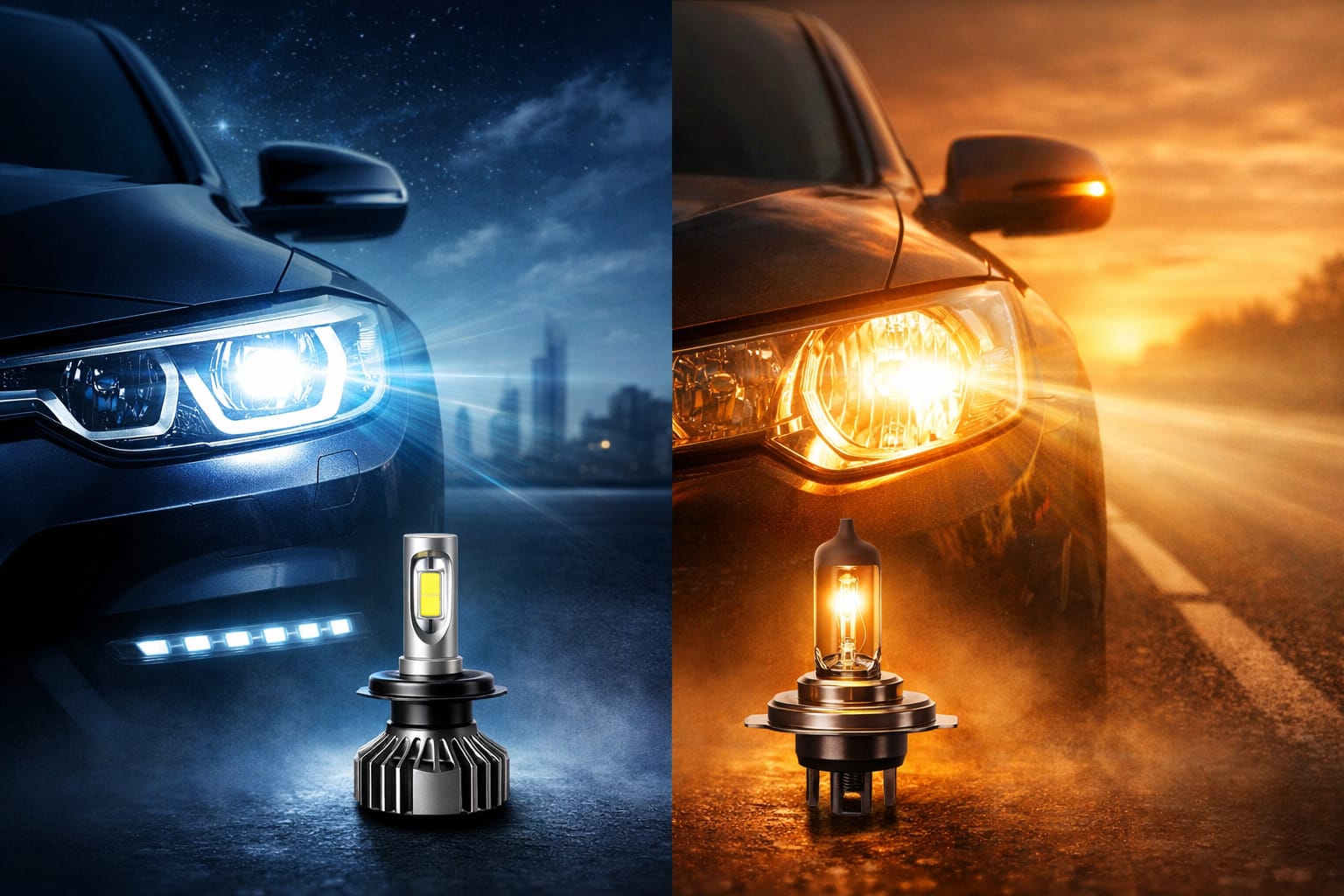
Halogen headlights usually produce a warmer yellowish light around 3,200K. Many drivers find this familiar and comfortable, especially on wet roads or during long nighttime drives.
LED headlights are available across a wider color temperature range, often from 3,000K to 6,500K. Many modern LED headlights sit around 5,000K to 6,000K, which creates a crisp white appearance that can improve contrast and make road markings, signs, and obstacles easier to see.
The best color temperature is not always the coldest or bluest option. Extremely cool-looking lights can create glare, look harsh, or perform poorly in rain and fog. For most drivers, a clean white beam with a controlled pattern is more useful than chasing the brightest or bluest bulb. If you are comparing other headlight technologies as well, our LED vs HID headlights guide gives broader context.
Which Headlights Should You Choose?
The best choice depends on what you need from your headlights. Halogen is the practical option when price, simplicity, and original fitment matter most. LED is the better option when you want stronger long-term performance, better efficiency, and improved night visibility, as long as the product is compatible with your vehicle.
Choose Halogen Headlights If:
- You want the lowest upfront cost.
- You need a simple replacement for an older vehicle.
- Your current housing works best with stock-style bulbs.
- You rarely drive at night and do not need a major visibility upgrade.
- You want to avoid compatibility checks, extra modules, or retrofit issues.
Choose LED Headlights If:
- You often drive at night, on rural roads, or in poorly lit areas.
- You want a brighter, whiter beam with better road contrast.
- You plan to keep the vehicle long enough to benefit from longer lifespan.
- You are willing to check fitment, beam pattern, and local rules before upgrading.
- You want lower power consumption and fewer bulb replacements over time.
If you frequently drive on dark rural roads, a compact LED driving light for extra rural-road visibility can be a useful add-on, as long as it fits your vehicle and local rules. It should support your main headlights, not replace proper headlight fitment, aiming, or legality checks.
If you are not ready to change your headlights yet, LED reverse bulbs for improving rear visibility can be a simpler first LED upgrade. For a wider look at lighting options beyond headlights, see our overview of automotive LED lighting upgrades.
For more practical guides on LED brightness, efficiency, and lifespan, browse the LED Knowledge Center.
FAQ
Are LED Headlights Better Than Halogen?
LED headlights are better for most drivers who want stronger night visibility, longer lifespan, and lower power use. Halogen headlights are better when you want the cheapest and simplest replacement.
Are LED Headlights Worth Upgrading To?
LED headlights are usually worth upgrading to if you drive often at night and your vehicle can accept a compatible, properly aimed LED setup. They are less worthwhile if your housing creates glare or if the upgrade is not legal where you drive.
Do LED Headlights Last Longer Than Halogen Bulbs?
Yes. LED headlights usually last much longer than halogen bulbs because they do not rely on a fragile filament. However, poor cooling or low-quality electronics can shorten LED lifespan.
Can LED Headlights Cause Glare?
Yes, LED headlights can cause glare if the bulb does not match the housing, the beam pattern is poor, or the lights are not aimed correctly. The issue is usually not LED technology itself, but poor compatibility or installation.
Which Is Better for Older Cars, LED or Halogen?
Halogen is often the safer, simpler choice for older cars because the housing was designed for it. LED can still work well, but only if the bulb, housing, electrical system, and beam pattern are properly matched.
Key Takeaways
The LED vs halogen headlights decision comes down to cost, compatibility, and how much night driving you do. Halogen bulbs are inexpensive, familiar, and easy to replace. LED headlights offer stronger long-term performance when the fitment and beam pattern are right.
For most drivers who regularly drive after dark, LED headlights are the better choice for night visibility, efficiency, and lifespan. For drivers who only need a quick, low-cost replacement, halogen headlights still make sense.
Do not judge a headlight upgrade by brightness claims alone. The smartest choice is the one that fits your vehicle, creates a controlled beam, follows local rules, and solves your real driving problem.
Sharing This Guide
If you found it helpful, save it for later or share it with someone comparing LED vs halogen headlights for night driving, cost, safety, and compatibility.
Use the links below to share it.
Interested in learning more? Browse all related articles in our car LED accessories section.