Types of LED Strip Lights: Ultimate Expert Guide
Choosing the right types of LED strip lights can transform any space with energy-efficient illumination. Whether you need accent lighting for your kitchen, ambient glow for your bedroom, or dynamic color effects for entertainment areas, understanding the various LED strip light types available helps you make informed decisions for your lighting projects.
Table of Contents
Single Color Options
Single color strips represent the most straightforward category among types of LED strip lights. These strips emit light in one consistent color temperature or hue throughout their entire length. White strips dominate this category, offering options in warm white, neutral white, and cool white temperatures.
Warm white strips typically operate around 2700K to 3000K, creating cozy atmospheric lighting perfect for living rooms and bedrooms. Neutral white ranges from 4000K to 4500K, providing balanced illumination for kitchens and workspaces. Cool white strips exceed 5000K, delivering crisp, energizing light ideal for task-oriented environments.
Beyond white options, single color strips come in red, blue, green, amber, and other dedicated hues. These monochromatic solutions work exceptionally well for specific accent applications where consistent color remains paramount. Commercial signage, automotive underglow, and theatrical productions frequently employ these specialized strips. If you want a dependable option, a solid example is a single-color LED strip for clean consistent accent lighting, which is widely trusted for indoor setups.
Multicolor Solutions
RGB Technology
RGB LED strips rank among the most popular types of LED strip lights for residential and commercial applications. Each RGB unit contains three separate diodes producing red, green, and blue light. By adjusting the intensity of these three primary colors, RGB LED strips create millions of color combinations.
The versatility of RGB LED strips makes them perfect for dynamic lighting displays and entertainment spaces. Users control color output through dedicated controllers or smartphone applications, enabling smooth transitions between hues. Gaming rooms, home theaters, and retail displays benefit tremendously from this flexible LED lighting technology.
Standard RGB configurations cannot produce pure white light effectively because combining red, green, and blue yields a pale, often unsatisfactory white. This limitation led manufacturers to develop enhanced versions addressing this shortcoming. If you’re new to this technology, check out our comprehensive introduction to strip lighting fundamentals before diving deeper.
RGBW Advancement
RGBW strips add a dedicated white diode to the RGB configuration, creating one of the most versatile LED strip light types. This fourth channel enables both vibrant colors and quality white illumination from a single strip. The white diode typically provides warm or cool white light, depending on the specific model.
These strips excel in applications requiring both colorful accent lighting and functional white illumination. Kitchen under-cabinet installations, bedroom cove lighting, and hospitality venues frequently choose RGBW technology for its dual-purpose capability. Users switch seamlessly between colored mood lighting and practical white light as needs change.
RGBWW and RGBCCT Options
Premium RGB LED strips incorporate dual white channels, labeled RGBWW or RGBCCT. These advanced LED strip light types include both warm white and cool white diodes alongside the three color channels. This configuration allows independent adjustment of white light temperature while maintaining full color capabilities.
High-end residential projects and professional installations favor these sophisticated strips for their exceptional versatility. Users enjoy complete control over both color and white light characteristics, adapting lighting precisely to activities and preferences throughout the day.
Temperature Adjustable Strips
Tunable white strips, also called CCT adjustable strips, represent specialized types of LED strip lights focusing exclusively on white light quality. These strips contain both warm and cool white diodes, enabling users to adjust color temperature without changing brightness levels significantly.
This flexible LED lighting approach supports circadian rhythm alignment by mimicking natural daylight patterns. Morning settings might favor cool, energizing tones around 5000K, while evening configurations shift toward relaxing warm whites near 2700K. Healthcare facilities, offices prioritizing employee wellness, and smart homes increasingly adopt this technology. Another practical alternative is an RGB LED strip for full-spectrum color control indoors, which performs reliably in everyday use.
Tunable strips require compatible controllers capable of managing two separate channels simultaneously. Many integrate with home automation systems, enabling scheduled temperature adjustments throughout the day. According to research from the U.S. Department of Energy, proper lighting temperature control can improve productivity and comfort in work environments.
High Density Configurations
Standard Density
Most basic LED strip light types feature standard density configurations with 30 to 60 diodes per meter. These provide adequate brightness for general applications like accent lighting, pathway illumination, and decorative installations. Standard density strips offer cost-effective solutions for projects where maximum brightness isn’t critical.
Power consumption remains moderate with standard configurations, making them easier to wire and control. Longer runs become feasible without voltage drop concerns that plague higher density alternatives. Budget-conscious projects and large-scale installations often select standard density for their favorable economics.
High Density
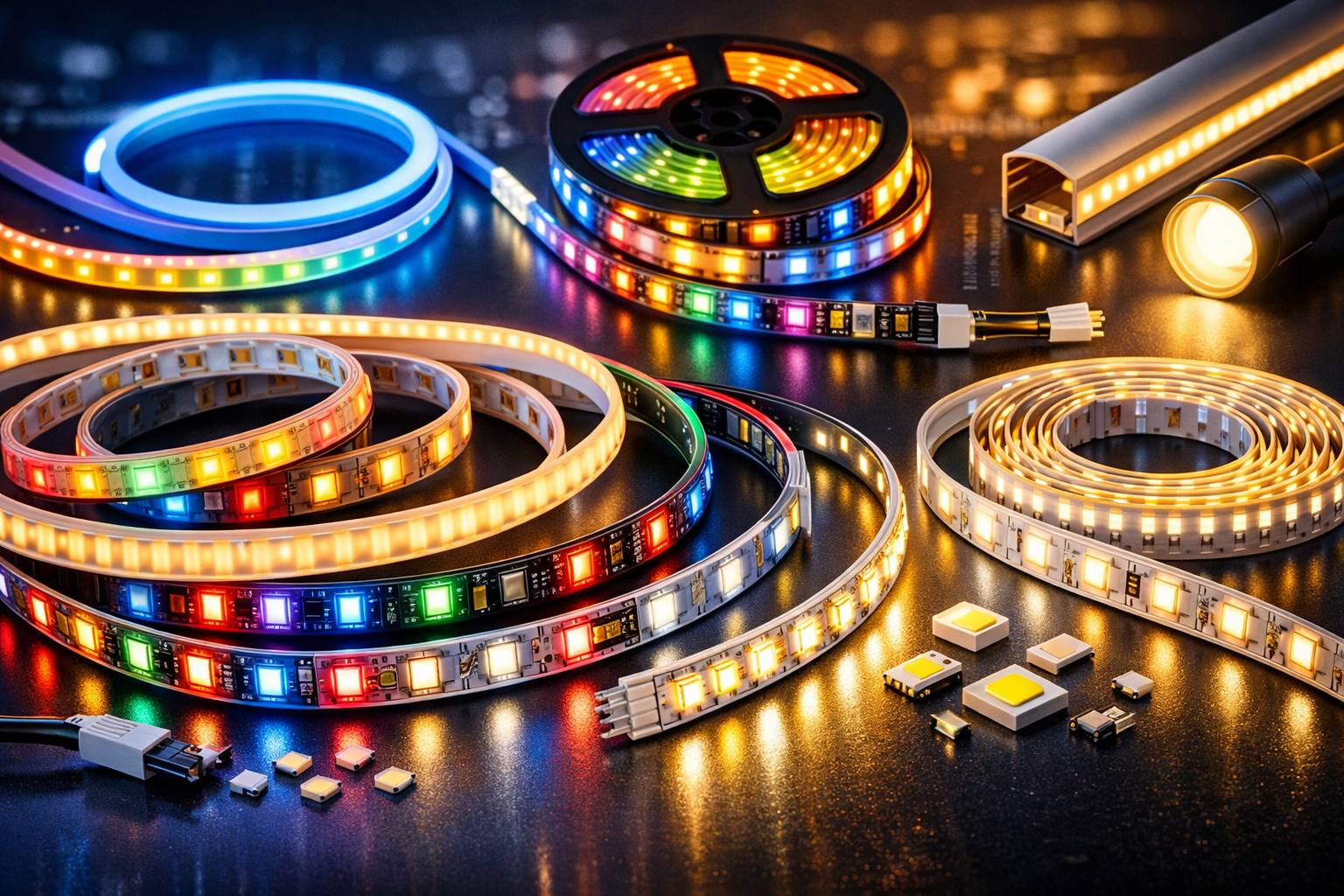
High density strips pack 120 or more diodes per meter, creating substantially brighter output and smoother light distribution. These types of LED strip lights minimize visible individual LED spotting, producing more uniform illumination along the strip length. Professional installations requiring seamless light quality typically specify high density configurations.
Cove lighting, display cases, and architectural features benefit from high density strips because they eliminate the dotted appearance common with standard density. Power requirements increase proportionally, demanding robust power supplies and careful electrical planning. Heat generation also rises, sometimes necessitating aluminum channels for adequate thermal management.
COB Technology
Chip-on-board technology represents the pinnacle of uniform distribution among LED strip light types. COB strips feature numerous tiny diodes mounted extremely close together, covered by a phosphor coating. The result resembles a continuous line of light rather than individual points.
This construction method eliminates visible LED spotting entirely, making COB strips perfect for applications where reflected light reveals strip imperfections. Linear cove installations, closet lighting, and display shelving showcase COB advantages beautifully. Premium pricing reflects the sophisticated manufacturing process required for these advanced strips.
Waterproof Variations
Environmental protection distinguishes several important types of LED strip lights. Waterproof ratings follow the International Protection (IP) code system, with IP ratings indicating dust and moisture resistance levels. Understanding these ratings proves essential for outdoor and wet location installations.
Non-waterproof strips carry an IP20 rating, suitable exclusively for dry indoor environments. IP65 rated strips feature a silicone coating protecting against water spray and dust, making them appropriate for bathrooms, covered patios, and light outdoor use. These represent popular flexible LED lighting choices for semi-protected locations.
IP67 and IP68 ratings provide submersion protection, with IP68 offering the highest water resistance. These fully waterproof strips endure direct water contact, pool installations, and fountain lighting. Silicone extrusion completely encases the strip, creating a waterproof seal around all electrical components. Underwater accent lighting, boat applications, and landscape features commonly employ these robust strips.
Waterproof coatings affect heat dissipation and flexibility. Silicone sleeves trap heat more than bare strips, potentially reducing lifespan in high-power applications. The coating also increases strip thickness and reduces flexibility, complicating installations in tight spaces. Project requirements should balance protection needs against these performance considerations.
Smart Connected Models
Smart RGB LED strips integrate wireless connectivity, enabling control through smartphones, voice assistants, and home automation platforms. These intelligent LED strip light types respond to Wi-Fi, Bluetooth, or Zigbee commands, eliminating the need for dedicated physical controllers in many installations.
Popular platforms like Amazon Alexa, Google Home, and Apple HomeKit work with compatible smart strips. Users create lighting schedules, trigger color changes based on events, and integrate strips into broader smart home routines. Voice control adds convenient hands-free operation particularly appreciated in kitchens and entertainment spaces.
Music synchronization features allow certain smart strips to pulse and change colors matching audio input. Gaming enthusiasts and home theater owners value this dynamic capability for immersive entertainment experiences. Advanced models support multiple zones, enabling independent control of different strip segments from a single controller.
Smart functionality adds complexity and cost compared to basic strips. Network reliability becomes crucial since connectivity issues prevent control. Some users prefer traditional controllers for their simplicity and guaranteed local operation. For technical details on how these systems function, explore our article on the technology behind modern strip lighting.
Voltage Differences
12V Strips
Twelve-volt strips represent the most common voltage among types of LED strip lights. These strips offer excellent availability, wide controller compatibility, and straightforward power supply selection. Most residential projects and DIY installations default to 12V systems for their accessibility and safety.
Maximum run lengths before voltage drop becomes problematic typically reach 5 meters for standard density strips. Higher density configurations may require power injection earlier. The low voltage minimizes shock risk while remaining powerful enough for most applications. Automotive and RV applications universally employ 12V strips matching vehicle electrical systems.
24V Strips
Twenty-four volt strips reduce current draw for equivalent brightness, enabling longer continuous runs before voltage drop impacts performance. These LED strip light types suit commercial installations and longer residential projects where minimizing power injection points saves labor and materials.
Lower current requirements also allow thinner wire gauges in some installations, potentially reducing costs. Professional integrators often prefer 24V for its technical advantages in large projects. Controller and accessory compatibility remains good, though slightly less universal than 12V options.
High Voltage Options
Specialty strips operate at 48V, 110V, or even direct 220V AC. These represent niche types of LED strip lights designed for specific commercial and industrial applications. High voltage strips can run extremely long distances without power injection, simplifying certain architectural installations.
Safety concerns increase with voltage, requiring professional installation and appropriate precautions. Direct AC strips eliminate the need for large power supplies but sacrifice dimming flexibility and control options. Most residential users should avoid these specialized products unless working with qualified electricians.
Specialized Designs
Addressable Strips
Addressable RGB LED strips give independent control over each individual diode or small groups of diodes. These sophisticated LED strip light types enable complex animations, running patterns, and pixel-level effects impossible with standard strips. Each controllable segment acts as an individual light source responding to programming commands.
Popular addressable chips include WS2812B, SK6812, and APA102, each offering different speed and control characteristics. Programming these strips requires compatible controllers and often custom code for desired effects. Entertainment venues, digital signage, and advanced home projects showcase addressable technology’s creative potential. For a more permanent upgrade, many users switch to an RGBIC LED strip with individually addressable segment control, which offers consistent results over time.
Side Emitting Strips
Most strips emit light perpendicular to their mounting surface, but side-emitting variants direct light parallel to the mounting plane. This orientation serves specialized applications like edge-lit panels, sign channel lighting, and slim architectural details. Side-emitting flexible LED lighting creates unique visual effects standard strips cannot achieve.
Neon Flex
Neon flex mimics traditional glass neon tubing using flexible silicone housings around small diodes. These types of LED strip lights produce smooth, continuous glow without visible individual LED points. Signage, architectural outlining, and artistic installations benefit from neon flex’s distinctive aesthetic combined with LED efficiency and safety.
Choosing the Right Option
Selecting appropriate LED strip light types begins with defining project requirements clearly. Consider the installation location, desired lighting effects, control preferences, and budget constraints. Indoor applications without moisture concerns typically use non-waterproof strips for cost savings and better heat dissipation.
Color requirements significantly narrow choices. Static white applications need only single color strips in the appropriate temperature. Projects requiring occasional color accents work well with basic RGB LED strips. Installations demanding both quality white light and colors should consider RGBW or RGBCCT configurations.
Brightness needs inform density selection. Accent lighting and indirect applications often succeed with standard 60 diode-per-meter strips. Task lighting, display cases, and applications where uniform appearance matters justify high density or COB investments. Balance initial costs against long-term satisfaction with lighting quality results.
Control method preferences influence whether smart or traditional strips better suit the project. Smart integration offers convenience and automation but adds complexity and ongoing connectivity dependence. Simple manual or remote control remains reliable and sufficient for many applications without requiring network infrastructure.
Installation Considerations
Proper installation maximizes the performance and lifespan of all types of LED strip lights. Surface preparation ensures adhesive backing bonds securely, preventing strips from sagging or falling over time. Clean, dry, smooth surfaces provide optimal mounting conditions. Degreasing agents remove oils that compromise adhesion.
Aluminum channels enhance both appearance and thermal management. These extruded profiles accept strips in U-shaped or recessed configurations, adding diffusers that further smooth light output. Channels protect strips from physical damage while providing heat dissipation pathways extending operational life, particularly for high-density installations.
Power supply sizing requires calculating total wattage including safety margins. Undersized supplies cause dimming, flickering, or premature failure. Most manufacturers recommend 20% oversizing to ensure reliable operation. Power supplies should match strip voltage precisely while providing adequate current capacity for the entire installation length.
Voltage drop calculations prevent dimming at strip ends during longer runs. Injecting power at multiple points maintains consistent brightness across the installation. Different LED strip light types exhibit varying voltage drop characteristics based on their density and construction. Professional installers use voltage drop calculators ensuring proper electrical design.
Wire gauge selection follows electrical code requirements based on current load and run distance. Undersized wiring creates resistance, generates heat, and reduces efficiency. Color-coding helps identify positive and negative conductors, preventing connection errors during installation. Soldered connections provide superior reliability compared to connector blocks in permanent installations.
Sharing this guide
If you found this guide helpful, you can save it for later or share it with a friend. It’s especially useful for beginners, homeowners, and DIY users.
Share using the links below
Interested in learning more? Browse all related articles in our category section.